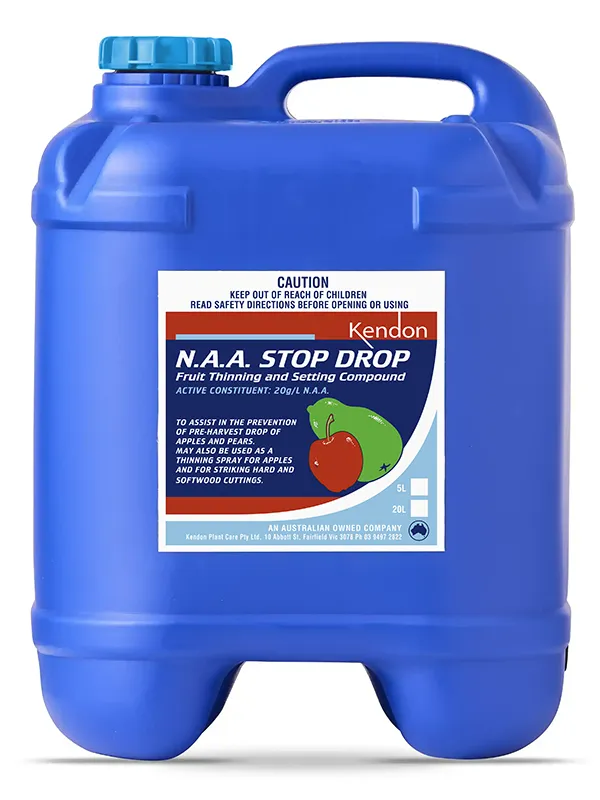
Systemic plant growth regulator. Assists in the prevention of pre-harvest fruit drop in apples and pears. Promotes elongation and formation of roots. Inhibits growth at higher concentrations. Also functions as an effective thinning spray in apples and for striking hard and softwood cuttings.
| N.A.A. Stop Drop | |
|---|---|
Target |
Apples | Pears | Hardware & Software Thinning |
Product Type |
Growth Regulator |
Active Ingredient |
20g/L Naphthaleneacetic Acid (N.A.A.) |
Pack Size |
1L, 5L, 20L |
APVMA Registration # |
30727
Search APVMA number at APVMA PubCRIS. |
Introduced in 1953. Acts as a synthetic plant growth hormone ( auxin, e.g. indole-3- acetic acid).
Acute oral (LD50, mg/kg) rats 1000–5900
| Crop | Action | Rate | Critical Comments |
|---|---|---|---|
| Apples & Pears | Assist prevention of pre-harvest fruit drop | 1L / 2000L
of water (10ppm) 500ml / 2000L of water (5ppm) | Apply as a high volume spray 12-14 days before harvest to thoroughly wet fruit and foliage. A second, half strength spray (5ppm), may be necessary if conditions favour excessive fruit drop. |
| Apples | Fruit thinning | 250ml - 1L/ 2000L of water (2.5ppm - 10ppm) | Apply as a high volume spray 10-14 days after full bloom, to the top two thirds of tree for uniform thinning.
For specific varieties, consult local Dept. of Agriculture. In Tasmania, apply, particularly to Golden Delicious, from balloon blossom to 7 days after full bloom. Application rates for mature trees should be a minimum of 4000L I ha. |
| Hardwood or Softwood Cuttings | Root striking | 12.5ml - 50ml / 10L of water | Dip base of cutting to depth of 5mm into N.A.A. solution, for approx. 5 seconds. Allow to dry and insert half the length of the cutting into striking medium. Use the stronger solution for hardwood cuttings, weaker solution for softwood cuttings. |
|
|||
NAA Stop Drop is a plant growth regulator containing 20 g/L naphthaleneacetic acid (NAA) used on apples and pears to help prevent pre‑harvest fruit drop, as well as to thin apples and promote rooting of hard and softwood cuttings. It gives growers a targeted way to manage apple and pear fruit drop before harvest, support more uniform apple fruit thinning, and improve strike rates in cuttings when used according to the Directions for Use and Application Guide.
Always prepare a dilute, high‑volume spray, using clean water and a suitable wetter such as Kendeen 20 at 125 mL per 100 L of spray volume, unless the label directs otherwise. Mix the required amount of NAA Stop Drop into the spray tank, ensure continuous agitation, and apply as a thorough cover spray to wet fruit and foliage for stop‑drop and thinning uses, or dip the base of cuttings to about 5 mm for several seconds for root striking, following the rates and comments in the Application Guide and label.
Apply NAA Stop Drop as a high volume spray 12–14 days before harvest on apples and pears to thoroughly wet fruit and foliage when there is a risk of pre‑harvest fruit drop. Under high drop pressure or when conditions favour excessive fruit drop, a second spray at half strength may be required, and fruit should not be left on the trees beyond normal harvest timing to avoid over‑maturity, so always check the Application Guide and label before scheduling NAA Stop Drop sprays.
For fruit thinning in apples, apply NAA Stop Drop as a high volume spray 10–14 days after full bloom, targeting the top two‑thirds of the tree to achieve uniform thinning. Rates vary by variety and tree size within the recommended range in the application guide, and growers should consult local agriculture advisers for variety‑specific guidance, noting that in Tasmania, applications (especially on Golden Delicious) are made from balloon blossom to seven days after full bloom with a minimum spray volume specified on the label.
For root striking, dilute NAA Stop Drop at the rate shown in the application guide and label, typically between 12.5 and 50 mL per 10 L of water depending on cutting type. Dip the base of each cutting to a depth of about 5 mm in the solution for approximately five seconds, allow it to dry briefly, then insert about half the length of the cutting into the striking medium, using the stronger solution for hardwood cuttings and the weaker solution for softwood cuttings.
NAA Stop Drop is generally used alone in water with a suitable wetting agent such as Kendeen 20 at 125 mL per 100 L of spray to improve coverage and uptake, as recommended on the label. It should only be tank‑mixed with other products where this is explicitly supported by the label or local advice, and growers must always follow the Directions for Use and any compatibility or restraint statements to avoid crop damage or reduced performance.
The withholding period for NAA Stop Drop is one day, meaning it must not be applied later than one day before harvest. Always follow the withholding period and harvest interval instructions in the Directions for Use on the label for your crop before picking or marketing fruit.
NAA Stop Drop must be absorbed by the tree or cutting to be effective, so slow drying conditions after spraying, high volume applications and the use of a wetting agent all help to enhance uptake. For best results, spray when trees are healthy and not under moisture stress, and follow the timing, rate and volume guidance in the application guide and label.
Do not use NAA Stop Drop for any purpose or in any manner contrary to the label, and do not leave fruit on the tree beyond normal harvest timing after using the product for pre‑harvest drop control, as fruit may become over‑mature. Avoid contaminating streams, rivers or waterways with product or used containers, and always observe the label’s safety directions, environmental protections and storage and disposal instructions.
Store NAA Stop Drop in the closed, original container in a dry, cool, well‑ventilated area out of direct sunlight and out of reach of children, and triple‑rinse empty containers into the spray tank before disposal. Dispose of or recycle packaging according to local regulations, never burn product or containers, avoid contact with eyes and skin, wash thoroughly after use, and if poisoning or exposure occurs follow the first aid instructions on the label and contact a doctor or Poisons Information Centre on 13 11 26.