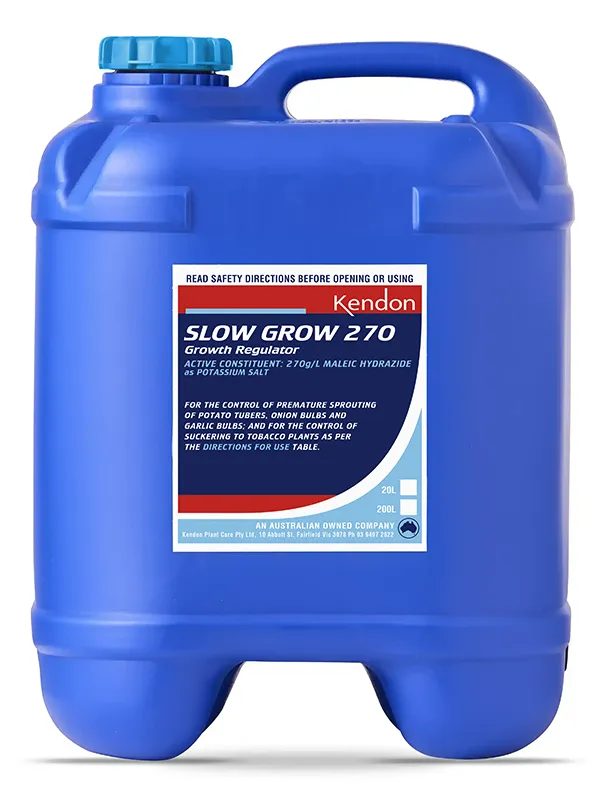
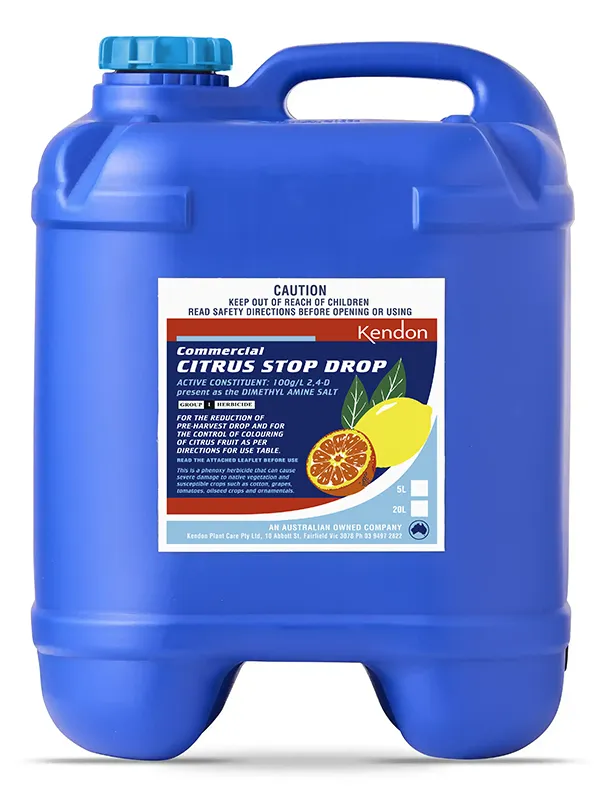
Commercial Citrus Stop Drop
Reduction of Pre-Harvest Drop
Selective, Systemic growth regulator acts as a synthetic Auxin. Moves mainly in the plant via the phloem. Effectively reduce pre-harvest drop of certain crops and for the control of colouring of citrus fruit.
| Commercial Citrus Stop Drop | |
|---|---|
Target |
Navel Oranges & Mandarins | Grapes | All Citrus |
Product Type |
Growth Regulator |
Active Ingredient |
100g/L 2,4-D Dimethylamine Salt |
Pack Size |
1L, 5L, 20L |
APVMA Registration # |
33330
Search APVMA number at APVMA PubCRIS. |
Profile
- 2,4-D Dimethylamine Salt was use as a plant growth regulator began shortly after its introduction—from the mid-1940s to early 1950s
- It acts as a synthetic auxin, mimicking the natural plant hormone indole-3-acetic acid (IAA). When absorbed through leaves or stems, it disrupts normal hormone balance and overstimulates auxin pathways, causing uncontrolled cell elongation, abnormal gene expression, and disruption of vascular tissue development
- This leads to unregulated growth, twisting, bending, and ultimately growth suppression or death of sensitive tissues
- In regulated low-dose applications, this auxin-like activity is harnessed to control sucker growth, modify shoot development, or influence fruiting responses depending on the crop
Key Features & Benefits
- Synthetic auxin formulation (100 g/L): Mimics natural plant hormones to regulate growth by reduction of pre-harvest drop and control of colour
- Selective growth regulation: Controls unwanted shoot and sucker growth without harming the main crop when used at recommended rates
- Improve fruit quality: Helps improve fruit set, uniformity, Retardation of colouring and delay aging to rind especially in Navel Oranges, Mandarins & Grapefruits
- Easy-to-use dimethylamine salt: Highly soluble and readily absorbed for consistent and reliable performance
- Versatile crop application: Suitable for pome fruits, citrus, grapes, and other horticultural crops requiring targeted growth control
Toxicity
Acute oral (LD50, mg/kg) rats – 5660
APPLICATION GUIDE
Kendon Commercial Citrus Stop Drop is a phenoxy herbicide (Group I) containing 100g/L 2,4-D, present as the dimethyl amine salt. It is used for the reduction of pre-harvest fruit drop and for the control of colouring of citrus fruit, and can also be used as a post-harvest dip to assist retention of green colour before ethylene de-greening.
Full rates and directions are set out below. See Pre-Harvest Application for foliar spray use on trees, and Post-Harvest Application (Dipping) for bulk dipping tank use. Always check Application Restraints and Buffer Zones before spraying.
Application Restraints and Buffer Zones
Restraints
DO NOT apply if heavy rains or storms are forecast within 3 days.
DO NOT irrigate to the point of runoff for at least 3 days after application.
DO NOT apply if crop is stressed due to dry or excessively moist conditions.
In Tasmania, this product may only be used from 15 April to 15 September unless otherwise permitted by the Registrar of Pesticides.
Not to be used for any purpose, or in any manner, contrary to this label unless authorised under appropriate legislation.
This product is for professional growers only. Do not use at rates higher than recommended, as damage may result. Store away from seeds, seedlings, fertilisers and other chemicals or any materials used on plants.
Spray Drift Restraints
DO NOT apply by a boom sprayer.
DO NOT apply by aircraft.
DO NOT allow bystanders to come into contact with the spray cloud.
DO NOT apply in a manner that may cause an unacceptable impact to native vegetation, agricultural crops, landscaped gardens and aquaculture production, or cause contamination of plant or livestock commodities, outside the application site from spray drift. The buffer zones in the table below provide guidance but may not be sufficient in all situations. Where ever possible, correctly use application equipment designed to reduce spray drift and apply when the wind direction is away from these sensitive areas.
DO NOT apply unless the wind speed is between 3 and 20 kilometres per hour at the application site during the time of application.
DO NOT apply if there are hazardous surface temperature inversion conditions present at the application site during the time of application. Surface temperature inversion conditions exist most evenings one to two hours before sunset and persist until one or two hours after sunrise.
Specific definitions for terms used in this section of the label can be found at www.apvma.gov.au/spraydrift.
Vertical Sprayers
DO NOT apply by a vertical sprayer unless the following requirements are met:
- Spray is not directed above the target canopy.
- The outside of the sprayer is turned off when turning at the end of rows and when spraying the outer row on each side of the application site.
- For dilute water rates up to the maximum listed for each type of canopy specified, minimum distances between the application site and downwind sensitive areas (see the buffer zone table below) are observed.
| Type of target canopy and dilute water rate | Mandatory buffer zones (distances given in metres) | ||||
|---|---|---|---|---|---|
| Bystander Areas | Natural Aquatic Areas | Pollinator Areas | Vegetation Areas | Livestock Areas | |
| 2 metres tall and shorter, maximum dilute water rate of 1000L/ha | 0 metres | 0 metres | 0 metres | 0 metres | 0 metres |
| Taller than 2 metres (not fully-foliated), maximum dilute water rate of 4000L/ha | 15 metres | 15 metres | |||
| Taller than 2 metres (fully-foliated), maximum dilute water rate of 4000L/ha | 10 metres | 5 metres | |||
Always download and read the current product label before use and follow all regulatory and safety instructions.
Pre-Harvest Application
Apply as a dilute foliar spray to trees to the point of run-off, making sure fruit is thoroughly wetted. Use the table below to select the correct rate for the situation and desired result.
| Situation | Mode of Action | Rate | Critical Comments |
|---|---|---|---|
| Navel Oranges & Mandarins | Reduction of pre-harvest drop. | 10ml/100L of water (10ppm ai) |
Apply to trees to the point of run-off. Make sure fruit is thoroughly wetted. Apply April/May when the rind colour changes from dark to light green. |
| Grapefruit | Reduction of pre-harvest drop. | 20ml/100L of water (20ppm ai) |
Apply to trees to the point of run-off. Make sure fruit is thoroughly wetted. Apply April/May when the rind colour changes from dark to light green. |
| Navel Oranges, Mandarins & Grapefruit | Retardation of colouring, delay ageing to rind. | 10ml/100L of water (10ppm ai) plus Gibberellic Acid at label rate | Addition of Gibberellic Acid to Citrus Stop Drop spray will hold fruit in good condition after July. |
Always download and read the current product label before use and follow all regulatory and safety instructions.
Post-Harvest Application (Dipping)
Kendon Commercial Citrus Stop Drop can also be used as a bulk dipping tank treatment before gas colouring (ethylene de-greening) to help retain green colour in the buttons.
| Situation | Mode of Action | Rate | Critical Comments |
|---|---|---|---|
| All Citrus | Post-harvest dipping (Ethylene de-greening). | 500ml/100L of water in bulk dipping tank (500ppm ai) |
Dipping in 500ppm 2,4-D solution before gas colouring assists in retaining the green colour in the buttons. 2,4-D should be used with care on very green fruit due to potentially adverse cosmetic effects on the skin. Kendon Commercial Citrus Stop Drop can be mixed with fungicides in the bulk dipping tank. |
Disposal of Post-Harvest Dip
Unused or spent dips should be disposed of carefully to avoid contamination of wetlands or watercourses. Dispose of dip in an authorised dip disposal facility. If an authorised dip disposal facility is not available, the spent dip should be evenly spread over flat land not exceeding 20,000L/ha. The disposal site must be dedicated and adequately bunded (soil at least 15cm high). DO NOT dispose unwanted spent dip in the same place repeatedly, as repeated depositions in one location may, over time, create a contaminated site.
Always download and read the current product label before use and follow all regulatory and safety instructions.
What is Kendon Commercial Citrus Stop Drop used for?
What is the active constituent in Kendon Commercial Citrus Stop Drop?
How does Kendon Commercial Citrus Stop Drop work?
How do I apply Kendon Commercial Citrus Stop Drop?
Application depends on the intended result. For foliar use, spray to the point of run-off, making sure fruit is thoroughly wetted, following the rates and timing set out in the Pre-Harvest Application section of the Application Guide above. For post-harvest use, dip fruit in the bulk dipping tank at the rate set out in the Post-Harvest Application section.
Always download and read the current product label before use. This product is not to be used for any purpose or in any manner contrary to the label unless authorised under appropriate legislation.
Is there a withholding period for Kendon Commercial Citrus Stop Drop?
Are there any restraints on when I can apply Kendon Commercial Citrus Stop Drop?
What precautions apply when spraying near other crops or waterways?
What PPE is required when using Kendon Commercial Citrus Stop Drop?
When opening the container and preparing spray or dip, wear cotton overalls buttoned to the neck and wrist, a washable hat, elbow-length chemical resistant gloves, and a face shield or goggles. When using the prepared spray, wear cotton overalls buttoned to the neck and wrist and a washable hat. When applying by dip, wear protective waterproof clothing, elbow-length chemical resistant gloves and impervious footwear.
If re-entering treated areas before the spray has dried, wear overalls, elbow-length gloves and water-resistant footwear, and launder clothing after each day's use. After use and before eating, drinking or smoking, wash hands, arms and face thoroughly with soap and water.
How should Kendon Commercial Citrus Stop Drop be stored and disposed of?
Store in the closed, original container in a cool, well-ventilated area, away from seeds, seedlings, fertilisers and other chemicals or materials used on plants. Do not store for prolonged periods in direct sunlight.
Triple-rinse containers before disposal and add rinsings to the spray tank; do not dispose of undiluted chemical on site. Containers that are clean, dry, free of visible residues and carry the drumMUSTER logo can be recycled through a drumMUSTER collection point.
Unused or spent post-harvest dip should be disposed of at an authorised dip disposal facility, or evenly spread over flat land not exceeding 20,000L/ha at a dedicated, adequately bunded disposal site.
Where can I find the Safety Data Sheet (SDS) for Kendon Commercial Citrus Stop Drop?
Where can I buy Kendon Commercial Citrus Stop Drop?
BUY FROM
Our Distributors