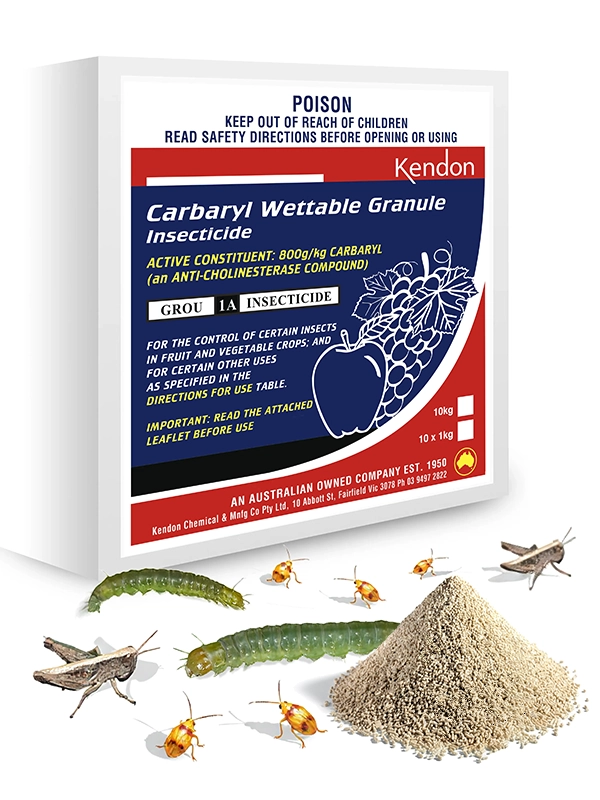
Carbaryl 800 WG Insecticide
Insecticide active by contact and ingestion with slight systemic mobility. Effectively controls Lepidoptera, Coleoptera and other chewing and sucking insects in fruit, nuts, vegetables, crops and pastures.
| Carbaryl 800 WG Insecticide | |
|---|---|
Target Pests |
Caterpillars including codling moth, light brown apple moth, armyworms, Heliothis (budworms) etc | beetles | grasshoppers |
Product Type |
Insecticide |
Active Ingredient |
800g/kg Carbaryl WG |
Group |
1A |
Pack Size |
1kg, 10kg (10×1kg) |
APVMA Registration # |
68322
Search APVMA number at APVMA PubCRIS. |
Profile
Introduced in 1956. Carbaryl inhibits acetylcholinesterase (AChE) by covalent (irreversible) reaction with the enzyme at the acetylcholine binding site, blocking hydrolysis of acetylcholine and resulting in hyperexciattion.
Key Features & Benefits
- Broad-Spectrum Control
- Low Odour
- Residual Protection: Provides good residual protection on foliage
- Fruit thinning: Thought to be superior as a thinning agent for apples, without fear of russeting as there is no surfactant in the formula.
Toxicity
Acute oral (LD50, mg/kg) rats (male) 264; rats (female) 500; rabbits 710
What is Carbaryl 800WG Insecticide and how does it work?
Carbaryl 800WG is a Group 1A carbamate insecticide containing 800g/kg carbaryl, formulated as a wettable granule for control of certain insect pests in fruit, vegetable, field crops, pastures and ornamentals as listed in the Directions for Use. It acts mainly by contact and ingestion as an anti‑cholinesterase compound, inhibiting acetylcholinesterase in insects and causing nervous system failure and death.
On which crops and situations can I use Carbaryl 800WG?
Registered uses include tree and vine crops (avocados, citrus, grapes, longans, litchis, macadamias, mangoes, pome fruit, stone fruit, coconuts, feijoa/guava), fruit and vegetables (melons and other cucurbits, potatoes, raspberries, beetroot, turnips/swede, sweet potato) and field crops, pastures and ornamentals (cereals including maize and sorghum, duboisia, lucerne, pastures and pasture seed crops, elm trees and ornamentals).
What key pests does Carbaryl 800WG control?
It controls a wide range of chewing and sucking pests including leaf beetles, caterpillars, heliothis/budworms, armyworms, grasshoppers and locusts, leafrollers, codling moth, lightbrown apple moth, oriental fruit moth, pear/cherry slug, leafhoppers, weevils, bugs and various beetles, as specified against each crop in the Directions for Use tables.
Are there limits on how often I can apply Carbaryl 800WG?
Yes, the label states that you must not apply Carbaryl 800WG more than four times per season to avocados and not more than three times per season to mangoes, and you must not apply it by air or use it in home gardens.
How do I mix Carbaryl 800WG for spraying?
Fill the spray tank half full with water, add the required amount of Carbaryl 800WG and mix thoroughly, then add the remainder of the water and mix again; when tank mixing with spray oils, add the oil and water first, then the pre‑mixed Carbaryl 800WG, maintaining agitation while filling and spraying.
What is the difference between dilute and concentrate spraying on the Carbaryl 800WG label?
Dilute spraying uses high water volumes up to the point of run‑off, with a set rate of product per 100 L, whereas concentrate spraying uses lower water volumes and a proportionally higher product rate per 100 L so that the same total amount of product per hectare is applied as in the dilute spray; the label explains how to calculate concentrate rates from a known dilute volume.
When should I spray Carbaryl 800WG for best results?
In general, you should apply at the first sign of pest activity and repeat as necessary at the intervals specified in the critical comments, ensuring thorough coverage of foliage, fruit or trunks as directed for each crop and pest.
Can Carbaryl 800WG be mixed with other products?
Carbaryl 800WG may be mixed with one of copper oxychloride, dimethoate, sulphur, summer spray oil, thiram, zineb or ziram, but must not be mixed with lime sulphur, Bordeaux mixture or other alkaline materials; when adding summer oil, add the oil to the water first, then the Carbaryl 800WG.
What pests and rates does Carbaryl 800WG control in tree and vine crops?
- Carbaryl 800WG is registered on avocados, citrus, grapes (butt treatments), longans and litchis (non flowering/non fruiting), macadamias, mangoes, pome fruit, stone fruit (not cherries), coconuts and some other tropical fruit trees.
- Key pests include Monolepta beetle, citrus leaf eating weevil, lightbrown apple moth, yellow peach moth, fruit piercing/orange fruit borer, Fuller's rose weevil, bronze orange bug, spined citrus bug, pink and white wax scale, macadamia nut borer and twig girdler, fig leafhopper, codling moth, pearleaf blister mite and pear/cherry slug, with typical rates between 65 and 130 g/100 L plus summer oil where indicated.
Trees & Vine Crops Application Guide
Rate: All rates in the following table are for dilute spraying (g product per 100 L water) or, where specified, kg/ha. For concentrate spraying, refer to the Application section in the General Instructions on the label.
Critical Comments: Where appropriate, apply by dilute or concentrate spraying equipment, always applying the same total amount of product per hectare as the dilute rate. Follow crop specific comments on thinning, flowering, variety sensitivity and maximum seasonal applications.
| Crop | Pest | Rate | Critical Comments |
|---|---|---|---|
| Avocados (NSW & QLD) | Monolepta beetle | 130g / 100L | Apply at first sign of infestation and repeat as swarms re-infest. |
| Coconut
(non-flowering & non-fruiting trees only) | Palm leaf beetle | 125g / 100L water or 1.4kg / ha | Apply at first sign of pest activity and repeat as necessary. |
| Orange and Lemon | Citrus leaf-eating weevil, Light brown apple moth | 100g–130g / 100L | Apply at first sign of pest activity and repeat at intervals of 2 weeks or as necessary. Use higher rate where high insect pressure occurs. |
| Fuller's Rose weevil | 100g–130g / 100L | Spray lower parts of the trees and ground beneath, only when attack noticed. Use higher rate where high insect pressure occurs. | |
| White scale wax | 90g / 100L & 1L Summer Oil | Spray trees thoroughly to run off.
Two applications necessary; early December and again in late January to early February. | |
| Bronze orange bug, Spined citrus bug | 65g / 100L | Apply at first sign of activity and repeat spray as necessary. | |
| Orange fruit borer, Yellow peach moth | 130g / 100L | Apply at first sign of activity and repeat spray as necessary. | |
| Pink wax scale | 90g / 100L & 1L Summer Oil | Apply at first sign of activity and repeat spray as necessary. | |
| Grapes
(butt treatment only) | Cutworms | 130g / 100L | Apply to the base of vine. |
| Longans and
Litchis
(non-flowering & non-fruiting trees only) | Yellow peach moth, Macadamia nut borer, Monolepta beetles, Rhyparida beetles, Leaf roller, Red shouldered leaf beetle | 125g / 100L water | Apply at first sign of pest activity and repeat spray as necessary.
Thorough coverage of foliage is necessary. |
| Macadamias | Macadamia nut borer | 130g / 100L | Four sprays at 2-3 weekly intervals during late November to February.
Direct the spray to nut clusters. |
| Macadamia twig-girdler | Two sprays - one in spring and again in autumn. Spray on appearance of pest. Do not spray flowers. | ||
| Mangoes | Flattids, Pink wax scale | 90g / 100L | Apply in December. |
| Fig leaf hoppers | Apply when pest appears on fruit stalks (October to November). | ||
| Pome Fruit: Apples, Pears | Codling moth, Light brown apple moth, Pear leaf blister mite | 130g / 100L | DO NOT apply to apples or pears earlier than 4 weeks following full bloom,
if reduction in fruit set is not desired.
DO NOT apply to McIntosh apples before the second cover spray. DO NOT apply to York variety of apples. Apply at first sign of pest activity in the spring. Repeat as necessary at 3-4 week intervals. |
| Pear & cherry slug | 130g / 100L | Apply at first sign of pest
activity. Repeat as necessary at 3-4 week intervals. | |
| Fruit thinning | 100g–130g / 100L | Apply to apples and
pears between 7 and 28
days, following full bloom. Should other factors be likely to cause thinning, apply this product with caution. Do not add wetting agents or spray in cold, wet conditions. If no reduction in fruit set is desired, do not apply this product within 30 days following full bloom. | |
| Stone Fruit: Apricots, Nectarines, Peaches, Plums, Prunes only
(Not Cherries) | Light brown apple moth, Oriental fruit moth, Native bud worm | 100g–130g / 100L | Apply at first sign of pest activity and repeat at intervals of 2 weeks or as necessary. Use higher rate where high insect pressure occurs. |
| Fruit tree borer | 180g / 100L | Apply to areas of trunks
and limbs showing damage by fruit tree borer. Ensure that the protective webbing and surrounding bark is thoroughly saturated. Allow some spray to enter the tunnel in which the larvae shelter during the day. Apply by jet or course spray. Apply twice at 21 day intervals during winter. |
How do I use Carbaryl 800WG on fruit and vegetable crops?
- Carbaryl 800WG is registered for melons and other flowering cucurbits (up to flowering), potatoes, raspberries, beetroot, turnips/swede and sweet potatoes.
- Key pests include budworms (Heliothis spp.), pumpkin beetle, 28 spotted ladybird, vegetable weevil, potato moth, armyworms, mealy bug, weevils, Rutherglen bug and related chewing pests, with rates usually between 100 and 190 g/100 L or 1.4 kg/ha.
Fruit and Vegetables Application Guide
Rate: All rates in the following table are for dilute spraying in g product/100 L water or, where indicated, per hectare. For concentrate spraying, refer to the Application section in the General Instructions on the label.
Critical Comments: Use sufficient water for good coverage, apply at the first sign of pest activity and repeat as necessary, observing crop specific limitations such as “prior to flowering only” and withholding periods.
| Crop | Pest | Rate | Critical Comments |
|---|---|---|---|
| Melons and other flowering cucurbits - up to time of flowering only | Budworms (Heliothis spp), Pumkin beetle, 28-Spotted ladybird | 100g–130g / 100L | Apply at first sign of pest activity and repeat spray as necessary. |
| Potatoes | Potato moth | 1.4kg / ha | Use sufficient water to obtain thorough coverage. Commence when moth activity first observed and repeat spray as necessary. |
| Raspberry | Light brown apple moth, Heliothis, Mealy bug, Rutherglen bug, Weevils, Armyworm | 200ml / 100L water | Apply at first sign of pests and repeat as required. |
| Root vegetables: Beetroot, Turnips (Swede) only | Brown vegetable weevil | 190g / 100L | Apply at first sign of pest activity and repeat as necessary. |
| Sweet Potato | Sweet potato weevil | 125g / 100L water OR 1.4kg / ha | Apply at first sign of pest activity and repeat as necessary. |
How does Carbaryl 800WG perform in cereals, lucerne, duboisia and pastures?
- In cereals including maize and sorghum, Carbaryl 800WG controls Australian plague locust, wingless grasshopper, yellow‑winged locust and migratory locust at 700–900 g/ha, with higher rates used on adults and sufficient water for coverage.
- Inlucerne and pastures it controls lucerne leafroller, native budworm, leafhoppers, lucerne flea and locusts at 320 g/ha to 1.4 kg/ha, with warnings that some tropical pasture legumes may develop phytotoxic symptoms.
Field Crops and Pastures Application Guide
Rate: Rates are given as g or kg product/ha or as g/100 L water for dilute applications. For concentrate spraying, follow the General Instructions.
Critical Comments: Apply when pests first appear and repeat as necessary; use higher rates where insect pressure is high and ensure adequate spray volume. Observe all comments on lucerne timing and tropical pasture legumes.
| Crop | Pest | Rate | Critical Comments |
|---|---|---|---|
| Cereals (including Maize and Sorghum) | Australian plague locust, Wingless grasshopper, Yellow winged locust, Migratory locust | 700g–900g / ha | Apply when pest appears and repeat as necessary. Use higher rate where high insect pressure occurs. Use sufficient water for adequate coverage. |
| Duboisia | Sandal-box hawk moth, Cluster caterpillar, Leaf eating ladybirds, Australian plague locust, Grasshopper | 130g / 100L | Apply as necessary. |
| Lucerne | Lucerne leaf roller | 1kg–1.4kg / ha | Apply when pest appears and repeat as necessary. Use higher rate where high insect pressure occurs. Use sufficient water for adequate coverage. |
| Native budworm, Leaf hopper | 1.4kg / ha | Use sufficient water for adequate coverage. | |
| Lucerne flea | 320g / ha | Apply 3–5 weeks after opening autumn rains and repeat as necessary. | |
| Pastures, Pasture seed crops | Yellow winged locust, Migratory locust, Australian plague locust | 750g–875g / ha | AApply when pests first appear and repeat as necessary. Use higher rates on adults. WARNING: Some cultivars of tropical pasture legumes may develop phytotoxic symptoms after use. |
What pests and rates does Carbaryl 800WG control in ornamentals and elm trees?
- Carbaryl 800WG controls elm leaf beetle in elm trees and a range of chewing and sucking pests in ornamentals, including green vegetable bug, potato moth, European earwig, cabbage white butterfly, cabbage moth, native budworm, loopers, leaf‑eating ladybird and pumpkin beetle.
- Elm trunk band treatments use higher rates to protect trees from serious defoliation, while foliar sprays and general ornamental sprays are used at lower rates, with a strong recommendation to test a small area first because of variable plant sensitivity.
Ornamentals Application Guide
Rate: Rates are given per 100 L water for dilute spraying. For concentrate spraying in suitable ornamental situations, follow the General Instructions and industry best practice.
Critical Comments: Apply at the first sign of pest activity and repeat as necessary, following special instructions for trunk banding of elms and test‑spraying ornamentals due to potential phytotoxicity.
| Situation | Pest | Rate | Critical Comments |
|---|---|---|---|
| Elm Trees | Elm leaf beetle | 2.5kg / 100L | Apply to the trunk of the tree in December, when the larvae are first observed on leaves. A repeat spray should be applied 4-6 weeks later, if large numbers of larvae are found on the leaves. To the trunk of a tree, apply a half meter wide band at a height of 1.5 metres or above. On large trees, the upper surface of branches, where they meet the trunk, should also be sprayed. Apply the spray to the trunk, at (a rate of) no more than 1L per m². The larvae are exposed to the chemical when they crawl down the trunk to pupate. This treatment will not eradicate the pest, but will protect the tree from serious defoliation. |
| 125g / 100L | If large numbers of larvae threaten to defoliate small specimen trees, a carbaryl spray may be applied to the foliage. Repeat spray when required. This treatment will not eradicate the pest, but will protect the tree from serious defoliation. | ||
| Ornamentals | Green vegetable bug, Potato moth, European earwig, Cabbage white butterfly, Cabbage moth, Native budworm, Loopers, Leaf eating ladybird, Pumpkin beetle | 130g / 100L | Apply at first sign of pest activity
and repeat as necessary. NOTE: Because of the wide range of ornamentals and their pests, phytotoxicity and efficacy of this product cannot be guaranteed, so use a small test area before widespread use. |
What are the main harvest and grazing withholding periods for Carbaryl 800WG?
- Harvest:
- Coconuts (non-flowering & non-fruiting), Cucurbits (flowering), Grapes (Butt
treatment), Macadamia nuts, Longan & Litchi:
Withholding period Not Required when used as directed - Avocados, Oranges, Lemons, Beetroot, Potato, Sweet potato, Turnips (Swede): 3 days
- Mangoes, Raspberries: 7 days
- Cereals: 14 days
- Stone Fruit: 5 weeks
- Pome Fruit: 11 weeks
- Coconuts (non-flowering & non-fruiting), Cucurbits (flowering), Grapes (Butt
treatment), Macadamia nuts, Longan & Litchi:
- Grazing:
- Pasture: 7 days
- Cereals , Lucerne: 14 days
How should I manage resistance when using Carbaryl 800WG?
Carbaryl 800WG is a Group 1A insecticide and repeated use can select resistant biotypes, so it should be used according to any local resistance management strategies and rotated with insecticides from other mode‑of‑action groups where possible; Kendon advises consulting local agronomists or the company for resistance advice.
What personal protective equipment and re‑entry rules apply?
When handling granules and spray, wear cotton overalls buttoned to the neck and wrist or equivalent clothing, a washable hat and elbow‑length chemical‑resistant gloves, avoid contact with skin and eyes, and wash thoroughly after use; re‑entry into treated areas is restricted until sprays have dried, or until day 6 for hand‑harvesting after airblast or ground‑boom application, unless specified protective clothing is worn.
What key environmental and bee‑safety precautions are on the Carbaryl 800WG label?
Carbaryl 800WG is very toxic to aquatic life and toxic to bees, so sprays must not drift onto streams, rivers or other waterways and must not be applied to plants in flower while bees are foraging.
How does Carbaryl 800WG differ from Carbaryl 500SC?
Carbaryl 800WG is a higher‑strength 800 g/kg wettable granule insecticide, while Carbaryl 500SC is a 500 g/L suspension concentrate insecticide; both cover many similar fruit, vegetable, field crop, pasture and ornamental situations, but their registered pests, rates and withholding periods are not identical. Always select the product whose label explicitly lists your crop, pest and situation, and follow that label’s Directions for Use as the final authority.
Where can I buy Carbaryl 800WG?
BUY FROM
Our Distributors