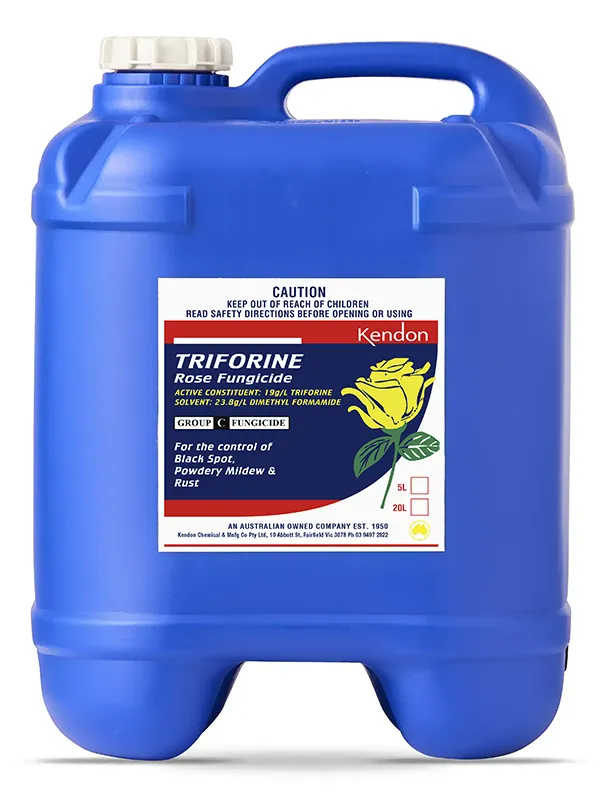
Triforine Rose Fungicide is a systemic fungicide with protective, curative and eradicant activity absorbed in leaves, translocated acropetally in the xylem. Effectively controls black spot, powdery mildew and rust in roses.
Introduced in 1969. Inhibitation of ergosterol biosynthesis, by inhibitation of C14-demethylase (SBI Class I)
Key Features & Benefits
Systemic fungicide action – Moves into plant tissues, providing internal protection and helping control infections that may already be developing.
Effective on powdery mildew, black spot, and rust – Delivers reliable control of major fungal diseases commonly affecting roses. Effective on ornamentals, and other garden plants as well.
Protective and curative properties – Stops fungal spores from germinating while also suppressing early-stage infections, reducing disease spread.
Low-odour, low-irritation formulation – Easier and more comfortable for users to apply, especially in home garden environments.
Gentle on foliage – Designed to minimise leaf burn or phytotoxicity, making it suitable for sensitive ornamental plants.
Flexible application timing – Can be used preventatively or at the first signs of disease, supporting both routine and corrective spray programs.
Compatible with integrated pest management (IPM) – Targets fungi specifically, offering a safer option for beneficial insects when used as directed.
Liquid formulation at 19 g/L – Easy to measure, mix, and apply with common garden sprayers for consistent, even coverage.
Apply at intervals of 7–10 days, for as long as diseases are active.
Apply Triforine Rose Fungicide as a spray to the point of run-off following the Directions for Use above. Always read the full label before use and follow all regulatory and safety instructions.
What is Triforine Rose Fungicide and what diseases does it control?
Triforine Rose Fungicide is a liquid fungicide registered for use on roses (all types) in Australia. It controls Black Spot, Powdery Mildew, and Rust. It is a Group C fungicide containing the active constituent triforine (19g/L) and is formulated as a liquid concentrate.
What is the active constituent in Triforine Rose Fungicide?
The active constituent is 19g/L Triforine. The product also contains the solvent 23.8g/L Dimethyl Formamide. Triforine is a member of the DMI (demethylation inhibitor) group of fungicides, classified as Group C for fungicide resistance management purposes.
How do I mix and apply Triforine Rose Fungicide?
Mix 15ml of product per 1 litre of water. Slowly add the desired amount to water while stirring. Apply the prepared mixture immediately — do not allow it to stand before spraying. Spray roses to the point of run-off to ensure thorough wetting and coverage. Do not use a wetting agent, as it may cause excessive run-off.
This product is not to be used for any purpose or in any manner contrary to the label unless authorised under appropriate legislation.
How often should I spray Triforine Rose Fungicide?
Apply at intervals of 7–10 days, for as long as diseases are active. Do not apply during abnormally hot, cold, or slow drying conditions.
Can I mix Triforine Rose Fungicide with other products?
Triforine Rose Fungicide may be combined with either Carbaryl or Pirimor, but mixing with both, or with other products, may cause serious damage. Do not use combinations not listed on the label.
What is fungicide resistance, and how does it affect Triforine Rose Fungicide?
Triforine is a Group C (DMI group) fungicide. Some naturally occurring individual fungi resistant to triforine and other Group C fungicides may exist through normal genetic variability in any fungal population. If Group C fungicides are used repeatedly, resistant individuals can eventually dominate the fungal population, resulting in reduced efficacy.
What personal protective equipment (PPE) do I need to use when applying Triforine Rose Fungicide?
When preparing the spray, wear elbow-length PVC gloves and a face shield. Avoid contact with eyes and skin, and do not inhale vapour or spray mist. Keep out of reach of children. After use and before eating, drinking, or smoking, wash hands, arms, and face thoroughly with soap and water. After each day's use, wash gloves, face shield, and contaminated clothing.
Is Triforine Rose Fungicide flammable, and are there any health hazard warnings?
Yes. Triforine Rose Fungicide is classified as a highly flammable liquid and vapour (UN No. 1993, Packing Group II, Flammable Liquid N.O.S., Ethanol >60%). The GHS hazard statements on the label are: highly flammable liquid and vapour; suspected of damaging the unborn child; causes serious eye irritation; may cause drowsiness and dizziness. In a transport emergency, dial 000 (Police or Fire Brigade). For specialist advice, contact Kendon Chemical on (03) 9497 2822.
How should I store and dispose of Triforine Rose Fungicide?
Store in the closed original container in a cool, well-ventilated area out of direct sunlight. Triple or preferably pressure rinse containers before disposal, and add rinsings to the spray tank. Do not dispose of undiluted chemicals on site. Break, crush, or puncture and bury empty containers below 500mm in a disposal pit specifically marked and set up for this purpose, clear of waterways, desirable vegetation and tree roots. Do not burn empty containers or product. Do not contaminate streams, rivers, or waterways with the chemical or used containers.
What should I do if poisoning occurs, and where can I find the Safety Data Sheet?
If poisoning occurs, contact a doctor or the Poisons Information Centre — phone 131 126 (Australia). If skin contact occurs, immediately wash the affected area with soap and water. Additional information is listed in the Safety Data Sheet (SDS), which can be requested by clicking the "Request SDS" button.
Where can I buy Kendon Triforine Rose Fungicide?
You can purchase this product from leading agricultural suppliers throughout Australia. If you are a grower and would like a distributor for larger quantities, send us a message on our contact us page requesting "Triforine Rose Fungicide" distributors near you.