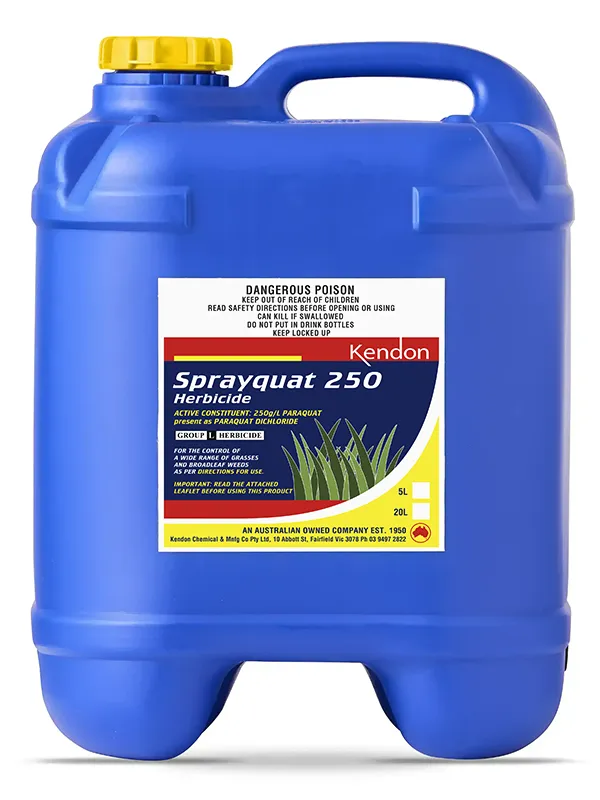
Sprayquat 250
Fast-acting, non-selective contact herbicide, ideal for broad-spectrum weed control. Generally used for gardens.
| Sprayquat 250 | |
|---|---|
Product Type |
Herbicide |
Active Ingredient |
250g/L Paraquat |
Group |
L |
Pack Size |
5L, 20L |
APVMA Registration # |
52141
Search APVMA number at APVMA PubCRIS. |
Profile
- First marketed in 1962
- Paraquat disrupts the process of photosynthesis by diverting electrons from photosystem I within the chloroplasts, leading to the formation of reactive oxygen species (ROS)
- These highly reactive molecules cause rapid oxidative damage to cell membranes, resulting in the desiccation and death of plant tissue
- As Paraquat is not systemically translocated, it only affects the parts of the plant it directly contacts, making thorough spray coverage essential for effective weed control
Key Features & Benefits
- Quick Weed Suppression: Reduces competition for nutrients, water, and sunlight, supporting better crop establishment
- Minimal Soil Impact: Safe for soil microbes and subsequent planting due to lack of residual soil activity
- Rain fast: Becomes rain fast quickly after application, ensuring reliable performance in variable weather
Toxicity
- Acute oral Mammalian Toxicity (LD50, mg/kg) - rats: 100-157
What is Sprayquat 250 Herbicide?
Sprayquat 250 is a Group L paraquat herbicide that provides rapid knockdown of annual grasses and most annual broadleaf weeds (excluding Capeweed) in labelled agricultural, horticultural and non‑agricultural situations.
How does Sprayquat 250 work?
Sprayquat 250 is a bipyridyl herbicide that inhibits photosynthesis at photosystem I, quickly burning down green plant tissue on contact while being immediately inactivated in the soil.
What weeds does Sprayquat 250 control?
It controls annual grasses and most annual broadleaf weeds listed in the Directions for Use tables, but does not control Capeweed and may only suppress some problem species without a residual partner.
How do I manage situations with Capeweed, Erodium or low Sprayquat 250 rates?
When Capeweed or Erodium spp. are present, or when Sprayquat 250 is used at lower rates, additional partner products and wetters are required; refer to the Application Guide and Directions for Use for the exact Desiquat, Kendral 600 or Kenwet 1000LF rates and mixing instructions, noting that the registered label Directions for Use override any summary in the Application Guide.
Where can Sprayquat 250 be used?
Approved uses include broadacre crops (cereals, pulses), pastures, orchards, vineyards, bananas, hops, sugar cane, potatoes, row crops, vegetables, seed beds, fire breaks and non‑agricultural areas such as sheds, roadways and paths.
Is Sprayquat 250 suitable for home gardens?
No, Sprayquat 250 is for agricultural and horticultural use only and is too hazardous to be used in a home garden.
When should Sprayquat 250 be applied for best results?
Apply when target weeds are young, actively growing and not stressed by waterlogging, frost or drought, and when foliage is not covered by dust, soil or heavy dew.
Does Sprayquat 250 have residual activity in the soil?
No, Sprayquat 250 is rapidly inactivated on contact with soil and does not provide residual soil weed control on its own.
Can Sprayquat 250 be mixed with other herbicides?
Yes, it is compatible with several soil‑active and contact partners such as Atradex WG, Diurex WG, Simagranz WG, Spray Seed, MCPA and others listed on the label, which can extend the length and spectrum of weed control when used as directed.
What spray volumes and equipment are recommended in broadacre crops?
Use a properly calibrated boom spray with flat fan jets, travelling 6–15 km h, typically applying 50–200 L ha depending on weed height and density to ensure good leaf coverage and at least double overlap at the top of the weeds.
Does Sprayquat 250 already contain a wetter?
Yes, Sprayquat 250 contains a wetting agent, and extra wetter is only required when the product rate falls below 400ml per 100L of water or in specific high‑volume or problem‑weed situations described on the label.
Can Sprayquat 250 be used for spray topping annual ryegrass?
Yes, it is registered for spray topping annual ryegrass to reduce seed set and assist resistance management, with specific rates, crop growth stages and grazing recommendations provided in the Directions for Use.
How is Sprayquat 250 used for fire breaks and hay freezing?
It can be applied to knock down vegetation on fire breaks and to “hay freeze” pastures for maximum protein retention in standing dry feed, using higher rates and timing given in the label critical comments.
Is Sprayquat 250 suitable for inter‑row or directed spraying?
Yes, it can be used as a directed inter‑row or inter‑space spray in crops such as row crops, vegetables, orchards, vineyards, hops and sugar cane, provided shields or droppers are used to minimise contact with crop foliage.
How dangerous is Sprayquat 250 to handle?
Sprayquat 250 is a dangerous poison; it can kill if swallowed, is fatal if inhaled and harmful in contact with skin, so it must be kept locked up, never put in drink bottles and only handled with appropriate protective equipment.
What personal protective equipment (PPE) is required?
When opening containers, mixing and spraying, wear elbow‑length PVC gloves plus a face shield or goggles, and in situations with mist risk also wear suitable protective clothing and a compliant respirator.
What are the key withholding periods for Sprayquat 250?
Do not graze or cut treated vegetation for stock food for at least 1 day (7 days for horses) after application, remove stock 3 days before slaughter, and do not harvest field peas, chickpeas, faba beans or lupins for 14 days after spraying.
How should empty Sprayquat 250 containers be disposed of?
Triple rinse containers into the spray tank, then recycle through an approved program or, if recycling is not available, dispose of as directed on the label in a marked pit away from waterways, desirable vegetation and tree roots; do not burn containers or product.
What about spray drift and environmental protection?
Do not apply under conditions that may cause drift onto nearby susceptible crops, pastures or native vegetation and do not spray on or near water used for irrigation, as Sprayquat 250 is toxic to aquatic life.
Where can I buy Sprayquat 250?
You can purchase this product from leading agricultural suppliers throughout Australia. If you are a grower and would like a distributor for larger quantities, send us a message on our contact us page requesting "Sprayquat 250" distributors near you.
APPLICATION GUIDE
Sprayquat 250 Herbicide must always be used in accordance with the registered label and leaflet Directions for Use. This guide is designed to help interpret the label by summarising key use patterns, but it does not replace or override any label instructions. In any conflict between this guide and the label, the approved label is the final authority.
Use the DOWNLOAD THE LABEL button for complete Directions for Use, weed tables and safety information for Sprayquat 250.
Weeds controlled (situations, rates & timing)
Use the table below with the Sprayquat 250 Directions for Use to match your crop or situation, target weeds, state and rate. It highlights the main weeds and situations where Sprayquat 250 is registered, but full restraints and critical comments must always be checked on the label.
General restraints
- Do not spray plants which are waterlogged, under stress of any kind or covered with soil or dust.
- Do not spray plants covered with heavy dew. Light rain after spraying will not affect results.
- Do not sow or cultivate for 1 hour after spraying, but commence operations within 7 days.
- For ground application only; do not apply through aircraft, misting machines (except in banana plantations) or hand‑held ultra‑low‑volume CDA units.
| Crop Use or Situation | Weeds Controlled | State | Rate / Ha | Critical Comments |
|---|---|---|---|---|
| Aid to cultivation to minimise cultivation and prepare a clean bed for sowing. |
Annual Grass and Broadleaf weed control. Early Autumn sowing. |
QLD, NSW, VIC, SA, TAS, NT, ACTonly | * 1.2L to 1.6L |
Where cultivation follows spraying, it may commence one hour after spraying but should be completed within 7 days. Where heavy weed growth is present at spraying, a better seed bed will result if cultivation is delayed 3-5 days. Use the higher rates for dense, more mature weed stands. Wild oats must have at least two leaves. Where Desiquat is used, the lower Sprayquat 250 rate should be sufficient to control dense mature weeds. Pasture: Remains of old pasture should be reduced by continuous heavy grazing. Remove stock 3-5 days before spraying to allow weeds to freshen up. Pre-sowing. Post-sowing, pre-crop emergence. |
| Winter, Spring and early Summer sowing. | 1.6L to 2.4L | |||
| Wild Oats at 2-5 leaf stage in Autumn / Winter. | QLD, VIC, SA, TAS, NT only | 600ml to 800ml | ||
| NSW & ACT Only | 600ml | |||
| Rice | Annual Grass and Broadleaf weedcontrol QLD, NSW, NTonly 1.6L 800ml | QLD, NSW, NT only | 1.6L | |
| 800ml | ||||
| Wild Oat control in Spring Fallows | Wild Oats at 2-5 leaf stage | QLD, NSW, NT, ACT only | 1.2L to 2L |
Use higher rate for Summer growth. Avoid spraying under hot dry conditions. Best results will be obtained when spraying is carried out in the late evening. |
| Kikuyu / Paspalum Pasture | To suppress growth to oversow winter seed | QLD, NSW, ACT only | 1.6L or 2.4L | Use the high rate for February spraying and the low in March. |
| Selective Weed
Control Autumn / Early Winter - annual clovers - perrenial clover |
Annual grass and some broadleaf weed control, except Patterson’s Curse, Sorrel, Dock, Shepherd’s Purse and some thistles. | All States |
* 600ml to 1.2L 1.2L to 1.6L |
Use the higher rates for dense weed stands. |
| Selective Weed Control Late Winter / Early Spring - annual and - perrenial clover |
Control of
some broadleaf weeds, including Patterson’s Curse, Sorrel, Dock, Shepherd’s Purse and some thistles, will not be achieved. Alternative methods such as the spray-graze technique with 2, 4-D or MCPA should be considered. |
QLD, NSW, VIC, SA, TAS, NT, ACT only | * 1.6L to 2.4L |
Use the higher rate in Winter / Early Spring when Barley grass is present.
All Applications Graze pastures continuously after the seasonal break to a height of 2-4cm. Remove stock 2-3 days before spraying to allow weeds to freshen up. Do not apply until clover has reached the 6 leaf stage. Do not spray clovers which are affected by insect attack, disease or moisture stress. Do not use on clover pastures growing in water repellent sands or other situations subject to moisture stress at or immediately following treatment. Poor recovery of the clover will result. DO NOT APPLY TO MEDICS. |
| Lucerne Autumn / Early Winter Late Winter / Early Spring |
Annual grass and some broadleaf weeds. | QLD, VIC, SA, WA, TAS, NT only | * 1.2L to 1.6L |
Use the higher rates for dense weed stands. Do not spray Lucerne stands under 12 months old. For residual weed control or if Patterson’s Curse, Shepherd’s Purse and some other broadleaf weeds are present, add Diurex WG Herbicide at 1.1kg or 1.9kg. If mintweed is present, use Atradex WG Herbicide at 600g / ha. WARNING – In certain areas, an uncommon species of barley grass, (H. glaucum – common barley grass is H. leporinum), resistant to paraquat based products has become established. It may regrow after initial scorch by Sprayquat 250. Where this problem is suspected, use Fusilade for grass weed control. If Sprayquat 250 has been applied, use Fusilade at 1L/ha after regrowth, but before heading. |
| NSW only | 1.2L | |||
| Annual grass and some broadleaf weeds. | QLD, VIC, SA, WA, TAS, NT only | * 1.6L to 2.4L |
||
| NSW, ACT only |
* 1.2L |
|||
| Perennial Grass Seed Crops Cocksfoot, perennial ryegrass, Phalaris and Demeter Fescue only |
Annual grass and some broadleaf weeds | All States | * 600ml to 1.2L |
Use the low rate for cocksfoot and perennial ryegrass and the higher rate for Phalaris and Demeter Fescue. Spray about 4 weeks after a full weed germination following the autumn break. The perennial grasses must be at least 12 months old at spraying. |
| Spray topping to reduce seed set
Field peas, Lupins, Chickpeas, Faba beans, Vetch |
Annual ryegrass | NSW, VIC, SA, WA, ACT only | 400ml or 800ml |
As an aid in managing annual ryegrass resistance. For use on escapes from a previous herbicide application in the current crop. Spray the crop when the ryegrass is at the optimum stage, that is when the last ryegrass seed heads at the bottom of the plant have emerged and the majority are at or just past flowering, (with anthers present or glumes open), but before haying off is evident – usually October to November. Use of the higher rate in these crops is usually more reliable and gives greater reduction in seed set. Reduction in crop yield may occur, especially if the crop is less advanced relative to the ryegrass, that is, if crops have a majority of green immature pods. The higher rate may also increase any yield reduction. In practice, crop losses in excess of 25% may occur. Apply by ground boom only in 50L- 100L / ha. Spray with a calibrated boom spray raised to give double overlap at the level of the ryegrass seed heads. Pressures of 250 - 350kPa and use of 110015 or 02 nozzles or equivalent will aid coverage. |
| Spray topping to reduce seed set Pastures |
Grasses generally, (particularly annual ryegrass) | All States | 400ml | Heavily graze paddocks during spring flush to encourage even head development. Remove stock 2-3 weeks before the anticipated maturity date of the target species. However, if this is not feasible through lack of stock, it is preferable to allow the pasture to mature ungrazed. Delay spraying until the last seed heads, at the bottom of the plant, have emerged and initial signs of haying off appear. Spray with a calibrated boom spray raised to give double overlap at the level of the seed heads. |
| Barley Grass |
Manage paddocks as above. Spray after head emergence but when all seed heads are green and there is no sign of haying off. Inspect paddocks before returning stock. Provided spraying was carried out before hardening of grass seeds, stock, (excepting horses), may be returned 24 hours after spraying. Where hardening seeds are present, harrow to knock seeds from the heads.
DO NOT introduce lambs into paddock until safe from risk of seed injury. If seasonal conditions favour regeneration, stock should be returned to selectively graze new shoots. Spray with a calibrated boom spray raised to give double overlap at the level of the seed heads. |
|||
| Saffron Thistle | NSW, SA, ACT only | Spray after the plant begins to run to head until flowering. | ||
| Prevention of annual ryegrass toxicity | Spray top - Graze to destroy seed heads | WA only | 400ml |
Grazing management as for spray topping above. Remove stock 3-4 weeks before the anticipated maturity date. Spray must be applied within 10 days after emergence of the first ryegrass seed heads. To ensure adequate control of toxin development, heavy continuous grazing is essential from 1 day after spraying until the pasture has completely hayed off. The required stocking rate will vary, but must be sufficient to keep all regrowth after spraying completely eaten off to prevent further growth producing new seed heads, which could become toxic. |
| Hay freezing | Maximum retention of protein in standing dry feed. | All States | 800ml |
Graze paddocks as for spray topping above. Remove stock 3-4 weeks before the anticipated maturity date. Apply prior to commencement of haying off, regardless of the grass species involved. Spray with a calibrated boom spray raised to give double overlap at the level of the seed heads. |
| General weed control Bananas |
Annual weed control | QLD, NSW, NT only | * 100ml/100L Misters 8ml / L |
Apply soon after emergence and before weeds reach 15cm in height. Use spraying pressure less than 240 kPa. Avoid chemical contact with roots and peepers near the pseudo stem. Repeat sprays as required. |
| Hops | Annual grasses | VIC, TAS only | * 1.2L to 1.6L plus 1.1kg / ha Simagranz WG and / or 750ml to 1.4L / ha Desiquat |
Apply as a directed inter-row spray, prior to crop emergence from winter dormancy, using a minimum of 250L / ha spray volume, to ensure good and even coverage of weeds. |
| Orchards Vineyards | Annual weed control | QLD, VIC, SA, WA, TAS, NT only | *+ 1.6L to 3.2L / sprayed ha |
Spray as necessary for control of annual weeds. Avoid contacting crop foliage. Sprayquat 250 will not harm trees or vines with mature brown bark, if this alone is sprayed. Use the higher rate for dense weed growth. If Fat Hen (Chenopodium album) or (Portulaca spp.) are present, and Sprayquat 250 rate is less than the ratio 800ml / 100L, add 200ml Kendral 600 or 120ml Kenwet 1000LF per 100L of spray mix. |
| NSW only | *+ 1.7L / sprayed ha |
|||
| Peanuts post-emergence (in crop) | Datura spp. (2-4 leaf) | QLD, NT only | 400ml |
Spray peanuts up to 7-8 leaf stage, but before majority of plants are flowering. Foliage will be scorched following application, but plants recover rapidly. Apply in 200L-250L / ha for thorough coverage of weed foliage. A dense canopy of weeds may reduce weed control due to shielding. Add 100ml Kendral 600 or 60ml Kenwet 1000LF / 100L of spray mix. |
| Annual ground cherry (2-3 leaf) | 600ml | |||
| Apple-of-Peru (2-4 leaf) | 600ml | |||
| Milkweed (2-3 leaf) | 600ml | |||
| Stagger weed (2-3 leaf) | 800ml | |||
| Blue heliotrope (2-3 leaf) | 800ml | |||
| Wandering Jew (2-3 leaf) | 800ml | |||
| Anoda weed (2-3 leaf) | 800ml | |||
| Bellvine (2-3 leaf) | 1L | |||
| Common morning glory (2 leaf) | 1L | |||
| Potatoes | General weed control (in crop) | All States | * 1.2L to 1.6L |
Spray at early crop emergence, (no later than 25% emergence of potato shoots). Use the higher rate for dense weed growth. |
| Pre-harvest weed control | * 2.8L | Spray about one week beforedigging and after tops have died down. | ||
| Row crops, Vegetables and Market Gardens | Pre-planting and pre-crop emergence | All States | *+ 1.2L to 1.6L or 200ml / 100L |
To control weeds in seed beds. Treat no less than three days before sowing or before crop emergence. Use the lower rate for early autumn applications. |
| Post-emergence inter-row weed control | Apply after crop seedlings have emerged or when transplanted crops are established. Direct the spray so that it does not touch thecrop. Use shielded nozzles. | |||
| Seedling weeds | Seedling weeds – use the lower rate for early Autumn applications. | |||
| Older weeds | * 2.4L or 400ml / 100L |
More mature stages of weed growth. | ||
| Sugar cane (plant and ratoon) | Grass and some broadleaf weeds | QLD, NSW, NT only | + 1.2L to 1.6L / sprayed ha |
Apply as a broadcast spray over the top of plant cane up to 3-4 leaf stage. Cane foliage will be scorched, but new leaves will appear in 7-10 days. Between the 3-4 leaf stage and the formation of the true stem, use a directed interspace spray with droppers and or shields or leaf deflectors to avoid excess drift onto cane foliage, while spraying up the cane bases. Use coarse nozzles, such as flood jets (reflex nozzles) and pressure of 100-200 kPa. After the formation of the true stem, which is resistant to Sprayquat 250, droppers can be raised to overlap the spray pattern to give weed control in the stool. Use the higher rate for dense, more mature weeds. Sprayquat 250 can be mixed with Atradex WG Herbicide to give residual weed control when used as a directed spray. It may also be mixed with Diurex WG Herbicide. To improve the activity of Sprayquat 250, under favourable growing and in open sunny conditions, add 135g to 275g / ha Diurex WG Herbicide, except for blanket application after the spike stage. |
| Non-Agricultural situations, around sheds, roadways and paths | Annual weed control | All States | *+ 1.6L to 4L / ha or 200ml / 100L |
Spray to thoroughly wet weed growth. Sprayquat 250 can be combined with soil residual herbicides Diurex WG Herbicide, Simagranz WG Herbicide or Atradex WG Herbicide, to give rapid knockdown and prolonged weed control. Use the higher rate for dense weed growth. |
| Columbus grass | NSW only |
+ Spot Spraying 160ml/100L Plus 1L Kenock Boom spray 2.3L to 4.5L / ha Plus 12L to 22L Kenock |
||
| Fire breaks | Knock down weed growth to eliminate fire hazard or assist fire break burn | All States | 1.6L to 4L |
Apply midwinter to early summer.
Use the higher rate for dense weed growth. After desiccation is complete, the sprayed area may be burnt, (normally 7-10 days after spraying). Sprayquat 250 can be combined with soil residual herbicides Atradex WG Herbicide, Diurex WG Herbicide or Simagranz WG Herbicide, to give rapid knockdown and prolonged weed control. |
Wetting agent and partner product notes
- This product contains a wetting agent and additional wetter is not required unless high‑volume spraying dilutes the wetter content. When Sprayquat 250 rates fall below 400 mL per 100 L of spray, add 100 mL Kendral 600 or 60 mL Kenwet 1000LF per 100 L of spray mix.
- Where Fat Hen (Chenopodium album) or Portulaca spp. are present in orchard or vineyard situations and the Sprayquat 250 rate is less than 800 mL per 100 L, add wetter at double these rates. Do not use alkaline or anionic wetting agents.
- Where Capeweed or Erodium spp. are present, add Desiquat at 750 mL to 1.5 L per hectare (125 mL to 250 mL per 100 L for high‑volume spraying), using the higher rate for plants more than 10 cm in diameter.
Table notes
- * Capeweed or Erodium spp. present: Add Desiquat at 750 mL to 1.5 L per hectare (125 mL to 250 mL per 100 L for high‑volume spraying). Use the higher rate for plants more than 10 cm in diameter.
- + If Sprayquat 250 Herbicide rate is less than the ratio 400 mL per 100 L, add 100 mL Kendral 600 or 60 mL Kenwet 1000LF per 100 L of spray mix.
- Sprayquat 250 provides rapid knockdown of annual grasses and most annual broadleaf weeds listed in the Directions for Use, but does not control Capeweed unless used with a suitable partner as specified.
- The table shows registered use patterns across broadacre crops, pastures, orchards, vineyards, bananas, hops, sugar cane, potatoes, row crops, vegetables, seed beds, fire breaks, non‑agricultural areas and spray‑topping or hay‑freezing programs.
- For each situation, use the table to confirm the crop or use (for example spray topping annual ryegrass, fire breaks, pre‑plant knockdown), the weeds controlled, applicable states, Sprayquat 250 rate and any critical comments on timing, grazing management and equipment.
- For each situation, use the table to confirm the crop or use (for example spray topping annual ryegrass, fire breaks, pre‑plant knockdown), the weeds controlled, applicable states, Sprayquat 250 rate and any critical comments on timing, grazing management and equipment.
BUY FROM
Our Distributors