SODIUM MOLYBDATE

FOR THE TREATMENT OF MOLYBDENUM DEFICIENCY

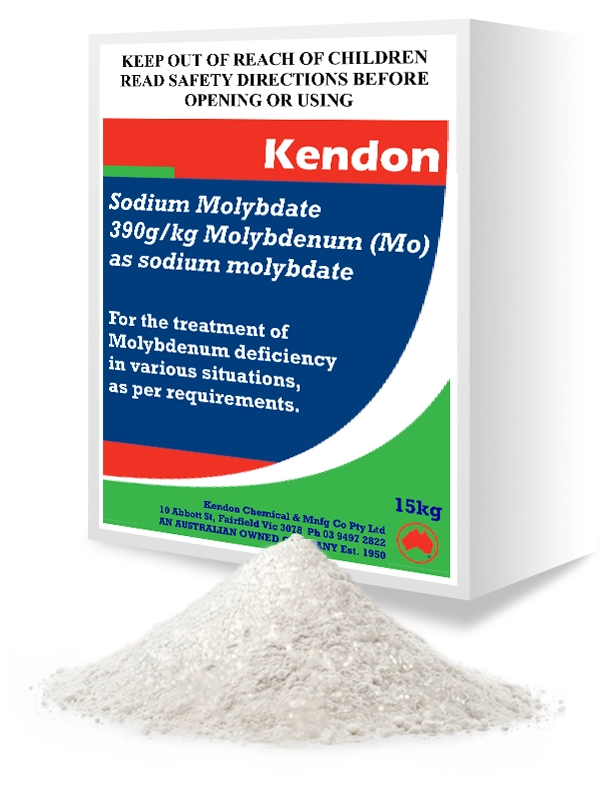
Kendon Sodium Molybdate is developed for the treatment of Molybdenum deficiency in plants.

Sodium Molybdate

Product Type

Plant Nutrients – Fertiliser

Active Ingredient

40% Molybdenum
390g/kg Molybdenum as Sodium Molybdate

Pack Size

500g, 1kg, 2kg, 5kg, 15kg

Application

For the treatment of Molybdenum Deficiency

Target

Legumes, Brassica crops, Leafy vegetables, seedlings, hydroponics

Key Features & Benefits

Symptoms of Molybdenum Deficiency

Kendon Sodium Molybdate Soluble Fertiliser – 390g/kg Molybdenum Trace Element for Legumes and Brassicas - Kendon Chemicals Australia

Application Guide

Annual Crops Rate (g/100L) Comments
General Rate 50-100 Apply in sufficient water to wet foliage.
Apply early in crop life.
Seedlings 40 Apply prior to transplanting.
Hydroponics 2.5ppm can be achieved by mixing 7g of Sodium Molybdate per 1000L of water
Apply Sodium Molybdate following the Application Guide above.
Always download and read the current product label before use and follow all regulatory and safety instructions.

What is Kendon Sodium Molybdate used for?

Kendon Sodium Molybdate is for the treatment of molybdenum deficiency in various situations, as per requirements.
It contains 390g/kg Molybdenum (Mo) as sodium molybdate.
See the Application Guide above for rates. For general use, apply in sufficient water to wet foliage and apply early in crop life. For seedlings, apply prior to transplanting.
Always download and read the current product label before use.
This product is not to be used for any purpose or in any manner contrary to the label unless authorised under appropriate legislation.
  • General rate: 50-100g/100L.
  • Seedlings: 40g/100L.
  • Hydroponics: 2.5ppm can be achieved by mixing 7g of Sodium Molybdate per 1000L of water.
One spray per crop is generally sufficient, except where deficiency is noted. Susceptible crops such as brassicas and cucurbits may require two sprays three weeks apart.
Yes. The label states it may also be mixed with dry fertiliser.
Molybdenum can be toxic when levels become too high. Excessive molybdenum can be harmful to stock. Do not apply fertiliser containing molybdenum on more than 25% of the farm annually. Do not graze for four weeks after application.
  • Older leaves show interveinal yellowing (chlorosis).
  • Leaf margins may curl or develop necrotic spots.
  • Plant growth becomes stunted.
  • Flowering and fruiting are reduced.
  • Nitrogen utilisation is poor, even if soil nitrogen is sufficient.
  • Legumes show weak nodulation.
  • Brassicas may have crinkled or necrotic leaves.
  • Deficiency is common in acidic or sandy soils with low organic matter.
Molybdenum supports nitrogen metabolism, including enzymes involved in nitrogen fixation and nitrate reduction. It is important for legumes and aids symbiotic nitrogen fixation. It helps chlorophyll synthesis and contributes to better flowering, fruiting and seed development.
Additional safety information is listed in the Safety Data Sheet (SDS), which can be requested by clicking the Request SDS button on this page.
You can purchase this product from leading agricultural suppliers throughout Australia. If you are a grower and would like a distributor for larger quantities, send us a message on our contact us page requesting "Sodium Molybdate" distributors near you.

BUY FROM

Our Distributors