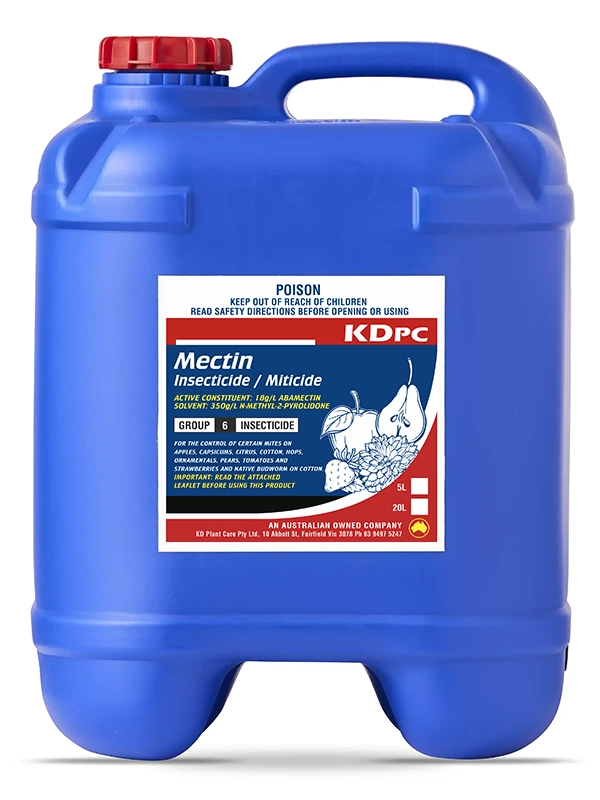
Mectin Insecticide / Miticide
Insecticide & Miticide active by both contact and ingestion, limited systemicity, but exhibits translaminar mobility. Effectively controls certain mites on apples, capsicums, citrus, cotton, hops, ornamentals, pears, tomatoes and strawberries; and Native Budworm on cotton.
| Mectin Insecticide / Miticide | |
|---|---|
Target Pests |
Two Spotted Mite | European Red Mite | Broad Mite | Rust Mite | Spider Mite | Budworm | Tobacco Leaf Mminer |
Product Type |
Insecticide / Miticide |
Active Ingredient |
18g/L Abamectin |
Group |
6 |
Pack Size |
1L, 5L, 20L |
APVMA Registration # |
82498
Search APVMA number at APVMA PubCRIS. |
Profile
Introduced in 1985. Allosterically activates glutamate – gated chloride channels (GluCIs) resulting in increased chloride ion flow and causing paralysis.
Key Features & Benefits
- Highly effective on hard-to-reach pests: Translaminar movement helps control pests hiding on leaf undersides or internal leaf surfaces.
- Fast knockdown: Rapid paralysis of mites and insects helps reduce feeding damage quickly.
- Extended residual control: The active ingredient remains active within leaf tissue for several days, offering ongoing suppression of pest populations.
- Improves crop quality and yield: Effective mite control reduces leaf damage, stress, and potential yield loss.
Toxicity
Acute oral (LD50, mg/kg) rats 6.7
APPLICATION GUIDE
KDPC Mectin Insecticide / Miticide is registered for use across several crop and situation groups, each with its own rates, timings and restraints. Open the General Instructions section below first for mixing, resistance management, compatibility and precautions that apply across all crops. Then open the section for your specific crop or situation for the current label rates, withholding periods and critical comments.
General Instructions
Mode of Action
KDPC Mectin Insecticide / Miticide is not systemic, but moves quickly into leaves following application. Thorough coverage is essential so that the maximum amount of product is deposited on the leaf surface for uptake and subsequent ingestion by sucking mites. Product that is not absorbed by leaves is quickly degraded.
Resistance Management
For insecticide resistance management, KDPC Mectin Insecticide / Miticide is a Group 6 miticide and insecticide. Some naturally occurring insect biotypes resistant to KDPC Mectin Insecticide / Miticide and other Group 6 miticides and insecticides may exist through normal genetic variability in any insect population. Resistant individuals can eventually dominate the mite and insect population if this product or other Group 6 products are used repeatedly, and effectiveness on resistant individuals could be significantly reduced.
It is recommended that this product be applied no more than the following number of times per season/crop, and not used consecutively except where a two-spray schedule is specifically recommended:
- Cotton: no more than twice per season, preferably only once; a second application only where mite pressure is very high
- Apples, Capsicums, Citrus, Hops, Pears: one spray per season
- Tomatoes: two sprays per season if mites are present; five sprays per season if mites are not present
- Strawberries: two sprays per season
KDPC Mectin Insecticide / Miticide should not be applied in two consecutive seasons on the same crop without an unrelated chemical group being used in between. Alternate with approved miticides from other chemical groups.
Mixing
Partially fill the spray tank with water, add the required amount of this product, then add the remainder of the water. If summer oil is recommended, add this after KDPC Mectin Insecticide / Miticide is mixed well. A wetting agent is not required.
Compatibility
This product is compatible with most commonly used insecticides. DO NOT apply with ULV formulations.
Crop Safety
A mixture of this product with summer oil has very occasionally caused slight fruit russetting on some pear varieties, particularly Anjou and other sensitive varieties, when used alone or when other products are applied sequentially. A very small amount of temporary apple fruit blemishing has been associated with low water volume applications.
DO NOT apply this product to apples or pears before or after applications of Delan or Captan. The label instructions on the summer oil label must be strictly followed. Conditions which may contribute to crop damage include unusually hot conditions present or expected within 24 hours of application, poor or slow drying conditions, and application with equipment that may leave large droplets on fruit after application.
Crop Monitoring
It is essential to carry out regular crop monitoring of mite levels — every 2 to 3 days for cotton and every 3 to 5 days for other crops — to ensure the product is applied at the correct timing.
Spray Drift Restraints
DO NOT allow bystanders to come into contact with the spray cloud. DO NOT apply in a manner that may cause an unacceptable impact to native vegetation, agricultural crops, landscaped gardens and aquaculture production, or cause contamination of plant or livestock commodities outside the application site from spray drift. DO NOT apply unless the wind speed is between 3 and 20 kilometres per hour at the application site during the time of application. DO NOT apply if hazardous surface temperature inversion conditions are present at the application site during the time of application.
Precautions
Allow the spray to dry on foliage before re-entry to treated areas. DO NOT allow entry into treated glasshouse areas for 24 hours after treatment; where prior entry is necessary, wear cotton overalls buttoned to the neck and wrist and elbow-length PVC gloves. Dangerous to bees — DO NOT spray any plants in flower while bees are foraging. Dangerous to fish and other aquatic organisms — DO NOT contaminate streams, rivers or watercourses with the chemical or used containers.
Always download and read the current product label before use and follow all regulatory and safety instructions.
Apples & Pears
KDPC Mectin Insecticide / Miticide controls Two Spotted Mite and European Red Mite on apples and pears when applied with summer oil at the rates below. Refer to the summer oil mixing table for the correct oil rate based on your spray volume.
Application Rates
| Situation | Pest | Rate / ha | WHP (days) | Critical Comments |
|---|---|---|---|---|
| Apples, Pears | Two Spotted Mite (Tetranychus urticae) European Red Mite (Panonychus ulmi) |
750mL/ha plus 5L/ha summer oil See Application Rates table below for mixing rates |
14 | For best results, apply using dilute application (spraying to point of run-off). If applying with concentrate applications, efficacy may be compromised. DO NOT apply at more than two times concentrate (ie half the dilute water volume). Apply the same amount of KDPC Mectin Insecticide / Miticide to the target crop whether spraying by dilute or concentrate spray methods. DO NOT apply this product before or after applications of Delan or Captan. In apples, apply this product from 2 to 6 weeks after petal fall if monitoring shows high numbers of overwintering European Red Mite eggs are present or if mites are a problem early in the season. In pears, timing is not as critical and the application should be made as soon as mite numbers have reached a threshold for your area. Maximum mite control is usually reached at 7 days. Moderate to high mite populations will be controlled, but if there are no predatory mites present, re-treatment with another miticide (from another chemical group) may be necessary. Integrated pest control: The effects of abamectin on parasitic wasps and other beneficial insects in Australian orchards are not known. Studies have shown that after application of abamectin, predatory mite populations may not increase for a number of weeks, due to lack of suitable pest mite prey. Predatory mite numbers will increase with any pest mite numbers, allowing the continuation of biological mite control. DO NOT use in IPM programmes unless the pest mite threshold has been reached and predators are unlikely to achieve effective control. |
Summer Oil Mixing Rates
To achieve 750mL KDPC Mectin Insecticide / Miticide plus 5L summer oil / ha, apply spray at the following mixing rates:
| Water Volume | This Product (Quantity per 100L Required) | Summer Oil (Quantity per 100L Required) |
|---|---|---|
| 1000L/ha (minimum) | 75mL | 500mL |
| 1500L/ha | 50mL | 335mL |
| 2000L/ha | 37.5mL | 250mL |
| 2500L/ha | 30mL | 200mL |
- DO NOT apply this product to apples or pears before or after applications of Delan or Captan.
- DO NOT apply at more than two times concentrate (half the dilute water volume).
- DO NOT use in IPM programmes unless the pest mite threshold has been reached and predators are unlikely to achieve effective control.
- The label instructions on the summer oil label must be strictly followed.
- One spray per season is recommended for resistance management.
- Withholding period: DO NOT harvest for 14 days after application.
- DO NOT feed treated product for 14 days after application.
Always download and read the current product label before use and follow all regulatory and safety instructions.
Capsicums
Use the table below for the registered rate, withholding period and critical comments for Two Spotted Mite control in capsicums.
| Situation | Pest | Rate / ha | WHP (days) | Critical Comments |
|---|---|---|---|---|
| Capsicums | Two Spotted Mite (Tetranychus urticae) | 300mL/ha | 3 | Thorough coverage and penetration into the plant canopy is essential. Preferably apply before the build-up of mite numbers. Re-apply as pest numbers indicate. Alternate with other chemical groups. Allow at least 28 days between applications and do not make more than 2 applications per crop. Refer to notes on resistance in the General Instructions section of this label. |
- Withholding period: DO NOT harvest for 3 days after application.
- DO NOT feed treated produce for 3 days after application.
- Allow at least 28 days between applications and do not make more than 2 applications per crop.
Always download and read the current product label before use and follow all regulatory and safety instructions.
Citrus
Use the table below for the registered rate, withholding period and critical comments for citrus.
Application Rates
| Situation | Pest | Rate / ha | WHP (days) | Critical Comments |
|---|---|---|---|---|
| Citrus | Broad Mite (Polyphagotarsonemus latus) Brown Citrus Rust Mite (Tegolophus australis) Citrus Rust Mite (Phyllocoptera oleivora) |
Dilute spray: 15mL/100L or 25mL/100L plus 250mL/100L summer oil Concentrate spray: Refer to the Application Section - Citrus |
7 | Apply as pest pressure indicates as a dilute spray in 3000L to 6000L water/ha. Use the higher rate when pest pressure is high. DO NOT apply more than once per season. Apply by dilute or concentrate spraying equipment. Apply the same amount of product to the target crop whether applying by dilute or concentrate spraying method. |
Citrus Application Method
To be effective this product requires thorough spray coverage. Ensure that equipment is properly calibrated to give an even distribution at the correct volume. The same quantity of product per hectare should be used when spraying either with dilute or concentrate spraying.
| Method | Instructions |
|---|---|
| Dilute spraying | Use a sprayer designed to apply high volumes of water up to the point of run-off and matched to the crop being sprayed. Set up and operate the sprayer to achieve even coverage throughout the crop canopy. Apply sufficient water to cover the crop to the point of run-off. Avoid excessive run-off. The required water volume may be determined by applying different test volumes, using different settings on the sprayer, from industry guidelines or expert advice. Add the amount of product specified in the Directions for Use table for each 100L of water. Spray to the point of run-off. The required dilute spray volume will change and the sprayer set-up and operation may also need to be changed, as the crop grows. |
| Concentrate spraying | Use a sprayer designed and set up for concentrate spraying (that is a sprayer which applies water volumes less than those required to reach the point of run-off) and matched to the crop being sprayed. Set up and operate the sprayer to achieve even coverage throughout the crop canopy using your chosen water volume. Determine an appropriate dilute spray volume (see Dilute Spraying above) for the crop canopy. This is needed to calculate the concentrate mixing rate. The mixing rate for concentrate spraying can then be calculated in the following way: |
| Example only | 1. Dilute spray volume as determined above: for example 1500L/ha. 2. Your chosen concentrate spray volume: for example 500L/ha. 3. The concentration factor in this example is: 3 x (ie. 1500L/500L = 3). 4. If the dilute label rate is 15mL/100L, then the concentrate rate becomes 3 x 15, that is 45mL/100L of concentrate spray. The chosen spray volume, amount of product per 100L of water and the sprayer set up and operation may need to be changed as the crop grows. For further information on concentrate spraying, users are advised to consult relevant industry guidelines, undertake appropriate competency training and follow industry Best Practices. |
- Withholding period: DO NOT harvest for 7 days after application.
- DO NOT apply more than once per season.
Always download and read the current product label before use and follow all regulatory and safety instructions.
Cotton
Use the tables below for the registered rate, withholding period and critical comments for cotton.
Cotton Application Rates
| Situation | Pest | Rate / ha | WHP (days) | Critical Comments |
|---|---|---|---|---|
| Cotton (QLD, NSW & WA only) DO NOT apply to cotton under visible stress |
Carmine Spider Mite (Tetranychus cinnabarinus) | 300mL/ha | 20 | DO NOT make more than two applications to cotton per season, regardless of pest being controlled. Apply when the threshold number of mites has been reached for your region. Apply when mite populations are low. If the mite population is too high at time of application, satisfactory control may not be achieved. Under high pest pressure, a second application may be required 7 to 10 days after the initial application. Thorough coverage is essential. |
| Two Spotted Mite (Tetranychus urticae) | ||||
| Cotton | Native Budworm (Helicoverpa punctigera) | 300mL or 600mL/ha | 20 | DO NOT make more than two applications to cotton per season, regardless of pest being controlled. Use only when Lepton test kit results indicate that no greater than 10% Helicoverpa armigera are present. Use the higher rate alone or the lower rate with a suitable mixing partner. Applications should target brown eggs and newly emerged larvae (neonates). Mixed size larval populations should be avoided. |
Cotton Application Method
| Method | Instructions |
|---|---|
| General | This product may be applied by ground spraying equipment or by fixed wing aircraft. Apply in a minimum of 20L water/ha. Ensure good coverage. |
| Ground application | Apply with inter-row droppers fitted with nozzles spraying towards the cotton rows. The inter-row nozzles should be level with or just below the canopy and spraying at right angles to the ground. |
| Aerial application (fixed wing) | Apply in the cooler parts of the day or night when there is a reliable cross wind to assist with good penetration into the crop canopy. Preferably use aircraft fitted with Micronair atomisers. |
- Withholding period: DO NOT harvest for 20 days after application.
- DO NOT graze or cut for stock food for 20 days after application.
- DO NOT apply to cotton under visible stress.
- DO NOT make more than two applications to cotton per season, regardless of pest being controlled.
Always download and read the current product label before use and follow all regulatory and safety instructions.
Hops
Use the table below for the registered rate, withholding period and critical comments for hops.
| Situation | Pest | Rate / ha | WHP | Critical Comments |
|---|---|---|---|---|
| Hops | Two Spotted Mite (Tetranychus urticae) | 1L/ha | 4 weeks | Apply as a dilute spray in 1000L to 2000L water/ha, depending on crop size as pest pressure indicates. DO NOT apply more than once per season. |
- Withholding period: DO NOT harvest, graze or cut for stockfood for 4 weeks after application.
- DO NOT apply more than once per season.
Always download and read the current product label before use and follow all regulatory and safety instructions.
Ornamentals
Use the table below for the registered rate, withholding period and critical comments for ornamentals including roses, chrysanthemums, carnations and indoor foliage plants.
| Situation | Pest | Rate | WHP | Critical Comments |
|---|---|---|---|---|
| Ornamentals including Roses, Chrysanthemums, Carnations & indoor foliage plants | Two Spotted Mite (Tetranychus urticae) | 50mL/100L to a maximum of 1.5L |
NIL | Spray to wet foliage to near the point of run-off using at least 2000L water/ha (100L/500 square metres). Thorough coverage and penetration into plants is essential. Preferably apply on first appearance of mites. When applied when pest numbers are low to moderate, one application will be sufficient to give efficient control, however if mites are numerous, apply a second application 7 to 10 days later. DO NOT use overhead irrigation within 24 hours after application. DO NOT use on Ferns or Shasta. For ornamentals not listed on this label, small test applications to assess unexpected phytotoxicity should be made before spraying the whole crop. DO NOT use more than 2 times per season. Refer to notes on resistance in the General Instructions section of this label. |
- Withholding period: not required when used as directed.
- DO NOT graze or cut for stockfood.
- DO NOT use overhead irrigation within 24 hours after application.
- DO NOT use on Ferns or Shasta.
- For ornamentals not listed on this label, small test applications to assess unexpected phytotoxicity should be made before spraying the whole crop.
Always download and read the current product label before use and follow all regulatory and safety instructions.
Strawberries
Use the table below for the registered rate, withholding period and critical comments for strawberries.
| Situation | Pest | Rate / ha | WHP (days) | Critical Comments |
|---|---|---|---|---|
| Strawberries | Two Spotted Mite (Tetranychus urticae) | 100mL/100L If spray volume is less than 600L/ha use a minimum of 600mL of this product/ha. DO NOT exceed 1.2L of this product/ha per application. |
3 | Spray to wet all foliage to near the point of run-off. Ensure thorough coverage and penetration into plants. Best results are obtained if application is made at the first sign of mite appearance. When applied at this time, one application may give good control. If mite numbers exceed 3 to 5 mites per leaflet, apply two applications 7 to 10 days apart. Re-apply if required but apply a maximum of 2 sprays of this product per season. If a further treatment is required, apply a product from a different chemical group. Integrated Pest Control: see instructions in Apples and Pears section above. Refer to notes on resistance under General Instructions section of this label. |
- Withholding period: DO NOT harvest for 3 days after application.
- DO NOT feed treated produce for 3 days after application.
- If mite numbers exceed 3 to 5 mites per leaflet, apply two applications 7 to 10 days apart.
- Apply a maximum of 2 sprays of this product per season.
Always download and read the current product label before use and follow all regulatory and safety instructions.
Tomatoes
Use the tables below for the registered rate, withholding period and critical comments for tomatoes.
Trellised or Staked Tomatoes
| Situation | Pest | Rate / ha | WHP (days) | Critical Comments |
|---|---|---|---|---|
| Tomatoes - Trellised or Staked | Two Spotted Mite (Tetranychus urticae) | High volume spraying: 300mL/ha or 450mL/ha using concentrations of 60mL to 90mL/100L |
3 | Spray to wet all foliage to near the point of run-off. Ensure thorough coverage and penetration into plants. Best results are obtained if application is made before build-up of mite numbers. Use the higher rate if mite numbers exceed 5 to 6 mites per compound leaf. Re-apply if required but apply a maximum of 2 sprays of this product per season. Allow at least 28 days between applications of this product. Refer to notes on resistance in the General Instructions section of this label. |
| Tomato Russet Mite (Aculops lycopersici) | Apply as per Two Spotted Mite. The lower rate will control Tomato Russet Mites not apparent at spraying. Use the higher rate if Tomato Russet Mite is evident at time of spraying or is the main pest. |
|||
| Tobacco Leafminer (Potato Moth) (Phthorimaea operculella) | High volume spraying: 600mL/ha using concentrations of 120mL/100L |
Wet foliage to the point of run-off. Thorough coverage and penetration into bushes is essential. Apply at the first sign of pest activity. Re-apply as pest numbers indicate or every 7 to 10 days with a maximum of 5 applications to the crop. If mites are also a problem, DO NOT use more than 2 KDPC MECTIN insecticide / miticide sprays per crop. Refer to the notes on resistance in the General Instructions section of this label. Note: Other IPM strategies to reduce leafminer populations should be employed. |
Field Grown Tomatoes
| Situation | Pest | Rate / ha | WHP (days) | Critical Comments |
|---|---|---|---|---|
| Tomatoes - Field Grown | Two Spotted Mite (Tetranychus urticae) | 300mL or 450mL/ha | 3 | Apply in sufficient volume to obtain even coverage and penetration of plants. Use droppers to direct spray onto plants and away from the inter-row. Best results are obtained if application is made before build-up of mite numbers. Use the higher rate if mite numbers exceed 5 mites per compound leaf. Re-apply if required but apply a maximum of 2 sprays of this product per season. Allow at least 28 days between applications of this product. Refer to notes on resistance in the General Instructions section of this label. |
| Tomato Russet Mite (Aculops lycopersici) | Apply as per Two Spotted Mite. The lower rate will control Tomato Russet Mites not apparent at spraying. Use the higher rate if Tomato Russet Mite is evident at time of spraying or is the main pest. |
|||
| Tobacco Leafminer (Potato Moth) (Phthorimaea operculella) | 600mL/ha | Apply in sufficient volume to obtain even coverage and penetration of plants. Use droppers to direct spray onto plants away from the inter-row. Apply at the first sign of pest activity. Re-apply as pest numbers indicate or every 7 to 10 days with a maximum of 5 applications to the crop. If mites are also a problem, DO NOT use more than 2 KDPC MECTIN insecticide / miticide sprays per crop. Refer to notes on resistance in the General Instructions section of this label. Note: Other IPM strategies to reduce leafminer populations should be employed. |
- Withholding period: DO NOT harvest for 3 days after application.
- DO NOT feed treated produce for 3 days after application.
- For mite control, allow at least 28 days between applications and apply a maximum of 2 sprays of this product per season.
- For Tobacco Leafminer, re-apply as pest numbers indicate or every 7 to 10 days with a maximum of 5 applications to the crop.
- If mites are also a problem, DO NOT use more than 2 KDPC MECTIN insecticide / miticide sprays per crop.
Always download and read the current product label before use and follow all regulatory and safety instructions.
What is KDPC Mectin Insecticide / Miticide used for?
KDPC Mectin Insecticide / Miticide is a liquid insecticide/miticide registered for the control of certain mites on apples, capsicums, citrus, cotton, hops, ornamentals, pears, strawberries and tomatoes, and for Native Budworm on cotton.
What is the active constituent in KDPC Mectin Insecticide / Miticide?
Kendon Mectin contains 18g/L abamectin, with solvents of 350g/L N-methyl-2-pyrrolidone and 300g/L diethylene glycol monobutyl ether, formulated as a liquid concentrate.
How does KDPC Mectin Insecticide / Miticide work?
KDPC Mectin Insecticide / Miticide is a Group 6 insecticide/miticide. Abamectin acts on glutamate-gated chloride channels in insect and mite nerve and muscle cells, causing paralysis and death of the target pest.
How do I apply KDPC Mectin Insecticide / Miticide?
Use the Application Guide above for registered crops, pests, rates, withholding periods and critical comments.
It is important that thorough coverage is achieved, and crop-specific instructions such as dilute or concentrate spraying, water volumes, intervals and seasonal limits must be followed for the relevant use pattern.
Always download and read the current product label before use. This product is not to be used for any purpose or in any manner contrary to the label unless authorised under appropriate legislation.
What is the withholding period for KDPC Mectin Insecticide / Miticide?
The label withholding periods are: cotton 20 days; citrus 7 days; hops 4 weeks; apples and pears 14 days; capsicums, strawberries and tomatoes 3 days.
The label also states: cotton — do not graze or cut for stock food for 20 days after application; hops — do not harvest, graze or cut for stockfood for 4 weeks after application; apples and pears — do not feed treated product for 14 days after application; capsicums, strawberries and tomatoes — do not feed treated produce for 3 days after application; ornamentals — not required when used as directed and do not graze or cut for stockfood.
What restraints and key use limits apply to KDPC Mectin Insecticide / Miticide?
The label restraint states: DO NOT use if rainfall is expected before spray has dried, as reduced efficacy may result.
Other crop-specific limits also apply, including seasonal spray limits, interval requirements, concentrate spray limits in apples and pears, single seasonal application limits in citrus and hops, and crop-specific restrictions in cotton and ornamentals as shown in the Application Guide above.
What resistance advice applies to KDPC Mectin Insecticide / Miticide?
The General Instructions state that early development of mite resistance may occur if one particular miticide from one particular chemical group is continually used.
The label recommends this product be applied no more than twice in one season, preferably only once per season, unless a specific two-spray schedule is recommended.
The Insecticide Resistance Warning also states that this product should not be applied in two consecutive seasons on crops without an unrelated chemical being used in between, and that it should be alternated with approved miticides from other chemical groups.
What personal protective equipment and safety directions apply?
The label states this product is poisonous if absorbed by skin contact or swallowed, will damage eyes, will irritate skin, and spray mist should not be inhaled.
When opening the container, preparing spray and using the prepared spray, wear cotton overalls buttoned to the neck and wrist and a washable hat, elbow-length PVC gloves and goggles.
For space applications, wear cotton overalls buttoned to the neck and wrist and a washable hat, elbow length PVC gloves, goggles and a half face respirator with dust cartridge.
After use and before eating, drinking or smoking, wash hands, arms and face thoroughly with soap and water. After each day’s use, wash gloves, goggles, respirator (and if rubber, wash with detergent and warm water), and contaminated clothing.
What first aid, hazard and storage information applies to KDPC Mectin Insecticide / Miticide?
If poisoning occurs, contact a doctor or Poisons Information Centre on Australia 13 11 26.
If swallowed, do NOT induce vomiting. Give a glass of water. If skin contact occurs, remove contaminated clothing and wash skin thoroughly. If in eyes, hold eyes open, flood with water for at least 15 minutes and see a doctor.
The GHS statements include harmful by inhalation and if swallowed, causes skin irritation and serious eye irritation, may cause respiratory irritation, may damage the unborn child, may cause damage to the Central Nervous System through prolonged or repeated exposure, and is very toxic to aquatic life with long lasting effects.
Store below 30°C in the closed, original container in a cool, well ventilated area, and do not store for prolonged periods in direct sunlight.
How do I request the Safety Data Sheet (SDS) for KDPC Mectin Insecticide / Miticide?
Additional safety information is listed in the Safety Data Sheet (SDS), which can be requested by clicking the Request SDS button on this page.
Where can I buy Kendon KDPC Mectin Insecticide / Miticide?
You can purchase this product from leading agricultural suppliers throughout Australia. If you are a grower and would like a distributor for larger quantities, send us a message on our contact us page requesting "KDPC Mectin Insecticide / Miticide" distributors near you.
BUY FROM
Our Distributors