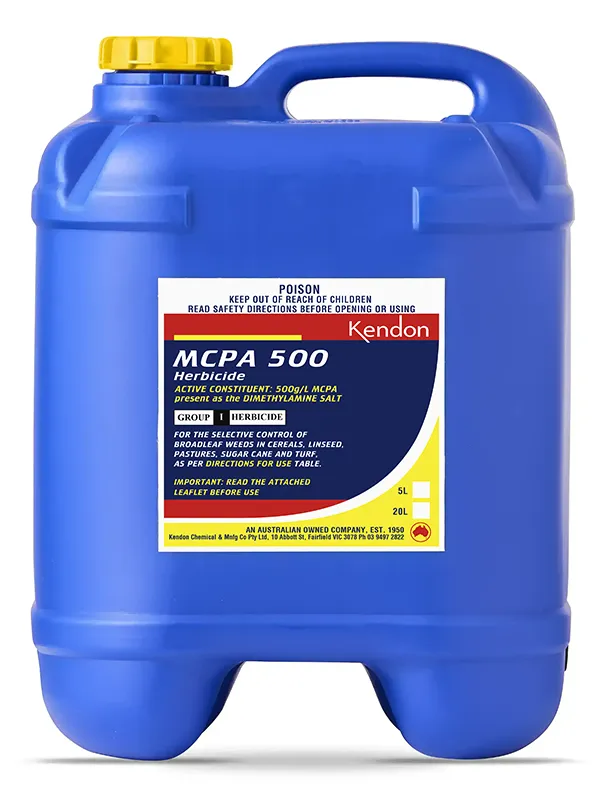
MCPA 500
Selective, systemic, hormone -type herbicide, designed for the control of broadleaf weeds in cereals, pastures, linseed, sugarcane and turf.
Provides effective control without damaging desirable grasses.
Suitable for use in a wide range of agricultural and non-crop settings.
| MCPA 500 | |
|---|---|
Product Type |
Herbicide |
Active Ingredient |
500g/L MCPA present as the dimethylamine salt |
Group |
I |
Pack Size |
5L, 10L, 20L |
APVMA Registration # |
60033
Search APVMA number at APVMA PubCRIS. |
Profile
- First marketed in 1945
- MCPA is absorbed by leaves and roots, translocated acropetally and basipetally in the phloem and xylem accumulating in the meristematic regions
- It disrupts normal auxin balance, leading to uncontrolled growth and abnormal cell division
Key Features & Benefits
Effective control of broad leaf weeds without damaging the grasses.
Toxicity
- Phytotoxic to vines, vegetables, cotton and ornamentals.
- Acute oral Mammalian Toxicity (LD50, mg/kg) - rats > 962–1470
What is Kendon MCPA 500 and what does it control?
Kendon MCPA 500 is a Group I phenoxy herbicide containing 500 g/L MCPA (as the dimethylamine salt) for the selective control of broadleaf weeds in cereals, linseed, pastures, sugar cane and turf. It controls susceptible broadleaf weeds while allowing grass crops to continue growing when used according to the Directions for Use and the Application Guide.
How should I mix and apply MCPA 500?
Half fill the spray tank with clean water, add the required amount of MCPA 500 while agitating, then top up with water and maintain continuous agitation so the spray remains uniform. Apply by boom or aerial sprayer using the water volumes, rates per hectare and crop and weed growth stages specified in the Application Guide and on the label, and always read the full Directions for Use before spraying.
When is the best time to spray MCPA 500 for effective weed control?
For best results, spray weeds when they are actively growing and at their most susceptible stage—generally when annual weeds are small and perennials are treated just before the bud stage. Avoid extremes of cold, drought or waterlogging; spray when soil is moist, weather is fine and rain is unlikely within six hours, and follow the crop timing and “Critical comments” in the Application Guide and label.
Which crops and weeds can I treat with MCPA 500?
MCPA 500 is registered for use in wheat, barley, oats, triticale, cereal rye, linseed, pastures, sugar cane and turf for the control of a wide range of broadleaf weeds listed in the weed table, including capeweed, doublegee, mustards, wild turnip, wild radish and other susceptible species. The Application Guide and Weed Table on the label show which weeds are controlled in each crop and state, and which rates and crop stages apply.
How do I use the weed table with MCPA 500?
The weed table lists individual broadleaf weeds, their susceptibility to MCPA 500 and the recommended timing (such as leaf stage or codes like “E”) for effective control. In the Directions for Use, entries that say “Refer to Weed Table” use that table to avoid repeating weed names and timings, so always consult both the Application Guide and the Weed Table on the label when planning treatments.
What spray water volumes should I use with MCPA 500?
For boom spraying, use 30–120 L of water per hectare, and at least 170 L/ha when spraying linseed, to ensure adequate coverage of the crop and weeds. For aerial application, use 10–90 L/ha, adjusting volume and droplet size to minimise drift and following the spray volume guidance in the application guide and label.
How is MCPA 500 used in pastures and turf?
In established pastures, MCPA 500 is used to selectively control broadleaf weeds while retaining grass species, but care is needed where pasture legumes are present because tolerance varies with species, variety and growth stage. In turf, it is used to control listed broadleaf weeds in grassed areas by applying the rates and water volumes specified in the Application Guide, and users should always refer to the label to confirm suitability for their turf species and weed spectrum.
Can I use MCPA 500 in linseed?
Yes, MCPA 500 can be used in linseed, but linseed is more sensitive than cereals, so water volumes, rates and timing must follow the label closely. Use a minimum of 170 L/ha of water and only spray at the crop growth stages and weed sizes indicated in the Application Guide and Directions for Use to minimise crop damage and maximise weed control.
Can I tank-mix MCPA 500 with other herbicides or pesticides?
MCPA 500 can be tank‑mixed with several products listed on the label, including Ally/Associate, Kamba, Bromicide, flowable diuron, Archer, Sertin, Spray.Seed, flowable terbutryn, Tordon and Tribunil, when used at compatible rates. The effectiveness of insecticides such as Imidan, Le‑Mat/Comrad and dimethoate may be reduced by alkaline hydrolysis if mixed with this product, so the addition of a buffering adjuvant such as Spraymate LI‑700 is recommended in those situations, and all tank mixes must follow the label’s compatibility and mixing instructions.
How do I use MCPA 500 with diuron mixtures in WA cereals?
MCPA 500 can be tank‑mixed with several products listed on the label, including Ally/Associate, Kamba, Bromicide, flowable diuron, Archer, Sertin, Spray.Seed, flowable terbutryn, Tordon and Tribunil, when used at compatible rates. The effectiveness of insecticides such as Imidan, Le‑Mat/Comrad and dimethoate may be reduced by alkaline hydrolysis if mixed with this product, so the addition of a buffering adjuvant such as Spraymate LI‑700 is recommended in those situations, and all tank mixes must follow the label’s compatibility and mixing instructions.
What restraints and crop safety precautions apply to MCPA 500?
Do not apply MCPA 500 if crops or weeds are stressed by dry or excessively moist conditions, and do not spray if rain is likely within six hours. Do not spray crops or weeds outside the growth stages indicated in the “Critical comments” of the application guide, as this can result in crop damage, yield loss or inadequate weed control, and always read the Directions for Use and restraint statements on the label before application.
How does MCPA 500 affect undersown legumes and sensitive crops?
MCPA 500 is generally preferred to 2,4‑D in cereals undersown with some pasture legumes, but legume tolerance varies with species, variety, growing conditions and crop cover. Do not spray cereal crops undersown with lucerne, and avoid spray drift onto susceptible crops and plants such as cotton, tobacco, tomatoes, vines, fruit trees, vegetables, legume crops and pastures, oilseed crops and sensitive trees, following the label’s legume tolerance and drift warnings.
How do I avoid spray drift and protect nearby crops and native plants?
Do not spray in high winds or under conditions that promote fine-droplet drift, and do not use equipment set‑ups that produce excessive drift. Keep MCPA 500 sprays well away from nearby susceptible crops, pasture legumes, native vegetation and waterways, and follow all drift and protection statements on the label to minimise off‑target damage.
How do I manage resistance when using MCPA 500?
MCPA 500 is a Group I herbicide that acts as a disruptor of plant cell growth, and repeated use of Group I herbicides alone can select for resistant weed biotypes in the population. To manage resistance, rotate with herbicides that have different modes of action, integrate non‑chemical weed control practices, and monitor paddocks for survivors, noting that naturally occurring resistant weeds may not be controlled by MCPA 500 or other Group I herbicides.
How should I clean equipment after using MCPA 500?
Equipment used to apply MCPA 500 should not be used on sensitive crops until it has been thoroughly decontaminated. Clean tanks and lines with a tank and equipment cleaner or wash with a 2% solution of cloudy ammonia followed by several clear water rinses, disposing of rinsings according to the label and local regulations.
What safety, storage and disposal steps apply to MCPA 500?
Store MCPA 500 in the closed, original container in a cool, well‑ventilated area out of direct sunlight and out of reach of children, and do not store for prolonged periods in hot conditions. Triple‑rinse or pressure‑rinse empty containers into the spray tank, then recycle or dispose of them at an approved facility or in a suitable disposal pit, never into waterways or by burning, and follow the safety directions and first aid instructions on the label, including contacting a doctor or Poisons Information Centre (13 11 26) if poisoning occurs.
Where can I buy Kendon MCPA 500?
You can purchase this product from leading agricultural suppliers throughout Australia. If you are a grower and would like a distributor for larger quantities, send us a message on our contact us page requesting "Kenbdon MCPA 500" distributors near you.
APPLICATION GUIDE
Kendon MCPA 500 is a Group I phenoxy herbicide for the selective control of broadleaf weeds in cereals, linseed, pastures, sugar cane and turf. Always spray actively growing weeds at their most susceptible stage, avoid extremes of cold, drought or waterlogging, and only treat when soil is moist, weather is fine and rain is unlikely within six hours. Before use, read the full Directions for Use, restraints, compatibility information and safety directions on the product label.
Use the DOWNLOAD THE LABEL button for the final authority for complete Directions for Use, weed tables and safety information for MCPA 500.
Application guide (rates and timing)
Use this application guide together with the MCPA 500 label to choose the correct rate, timing and any tank‑mix partners for each crop and weed situation. Check crop growth stages, weed size and local state recommendations in the ‘Critical comments’ column, and always follow the Directions for Use and restraint statements on the label if there is any difference between this table and the label.
FIELD CROPS
| Situation & Crop | Weed | State | Rate / Ha | Critical Comments |
|---|---|---|---|---|
| Wheat, Barley, Oats, Triticale | Refer to Weed Table | SA & TAS Only | 700ml – 2.1L | Apply through the tillering stage after the crop plants have 5 leaves and before they commence jointing. |
| QLD Only | Apply from early tillering (4–5 fully emerged main stem leaves plus one or more tillers) until before the boot stage (visible swelling of the head at the top of the main stem). | |||
| NSW & ACT Only |
Apply the 700ml rate after the crop has reached the 5‑leaf stage and weeds marked “E” in the weed table have 3–6 leaves. Use higher rates after the first node can be felt at the base of a tiller and before swelling of the head can be felt in a tiller. |
|||
| VIC Only | 700ml – 1.5L |
Apply the 700ml rate after the crop has reached the 2–3 leaf stage and weeds marked “E” in the weed table have 2–4 leaves. Use the higher rate after the crop plants have 5 leaves up to fully tillered. |
||
| WA Only | 900ml – 2L | Apply to the crop from the 5‑leaf stage to flag leaf emergence (Zadoks 15–37). | ||
| Wheat, Barley, Triticale, Cereal Rye | Capeweed, Doublegee, Erodium, Mustard, Rapistrum, Wild Turnip, Wild Radish | WA Only |
400ml MCPA 500 PLUS 350ml Kenso Agcare Diuron 500 |
CROP: 3–4 leaf stage (Zadoks 13–14). |
|
500ml MCPA 500 PLUS 400ml Kenso Agcare Diuron 500 |
CROP: 4–5 leaf stage (Zadoks 14–15). |
|||
|
Apply by aircraft or boom with 20–100 L/ha water when most weeds have germinated and are in the 2–5 leaf stage. Crop and weeds should be dry at time of application. Some temporary yellowing of the crop may occur after application. Undersown sub‑clovers may be slightly retarded. DO NOT apply to undersown medics. |
||||
| Amsinckia (Yellow Burr), Capeweed, Charlock, Deadnettle, Doublegee (Spiny Emex, Three Corner Jack), Erodium spp., Mustard, Turnip Weed,White Ironweed (Corn Gromwell, Sheepweed) Wild Radish, Wild Turnip | NSW, ACT & VIC Only | 500ml PLUS 500ml Kenso Agcare Diuron 500 |
Apply by boom spray on aircraft when the crop is at the leaf 3-5 leaf stage (NSW & SA only) and 5 leaf stage (VIC only). Weeds must be in the 2-5 leaf stage. DO NOT apply to undersown medic or Lucerne. DO NOT use on Kamilaroi, Kite, Olympic or Shortim Wheat. |
|
| Capeweed, Mustard, Three Corner Jack, Turnip Weed, Wild Radish, Wild Turnip, Wards Weed, Common Ice Plant, Pimpernel | SA Only | 350ml PLUS Kenso Agcare Diuron 500 | Do not use on very sandy soils. | |
| Wheat, Barley, Oats, Triticale | Soldier Thistle | SA Only | 700ml PLUS 200ml Archer | Apply to crop at tillering stage after the crop has 5 leaves and before the crop commences jointing. |
| Skeleton Weed | 1L PLUS 500ml Archer | Apply to rosettes and from 5-15cm
diameter when the crop is between 5
leaf and late tillering growth stages. It is essential that all the Skeleton weed is emerged and minimum of 5cm diameter which is usually not before August. This rate will provide control of Skeleton weed until harvest and will substantially reduce seed numbers the following season. |
||
| Linseed | Refer to Weed Table | QLD Only | 700ml - 2.1L |
Apply when crop is 10-15cm tall with at least 170L / Ha of water. Do not spray after buds appear. Some wilting effect may be seen following application but crop usually recovers quickly. DO NOT apply by aircraft. |
| NSW, ACT, VIC, SA & TAS Only | 700ml - 1.1L | |||
| Sugar Cane | Blue Top,Chinese Burr, Flannel Weed, Gambia Pea,Bell Vine, Streaked Rattle Pod, Bindweed, Pink Convolvulus, Cupids Flower, Merremia Vine, Morning Glory | QLD Only | 1.4L | POST EMERGENT: Apply as directed inter-row spray. Do not exceed rates with phenoxy sensitive varieties. |
| As above plus Fat Hen, Noogoora Burr | 2.1L | |||
| All of the above | 10L | PRE EMERGENT: Apply over the row in a 45cm band within 24 hours of planting. | ||
| Flax | Refer to Weed Table | VIC &TAS Only | 490ml | Apply to crop when 8-20cm high. |
| Grass Pastures | Refer to Weed Table | All States | 700ml - 4L |
Apply to established grass based pastures. Damage ay occur to Legumes if present. See “Legume Tolerance” below. NOTE: Capewed, Pattersons Curse & Variegated Thistle may be poisonous to stock after spraying. |
| Salvation Jane | SA Only | 1L PLUS 400ml Kenso Agcare Diuron 500 | Use this mixture only if spraying is delayed until early winter. Rosettes should not exceed 20cm diameter. | |
| Soldier Thistle | SA Only | 700ml - 2.1L | Use low rate on seedlings with no more than 2 true leaves. Use 100L of water for best results. If clover present do not exceed 600ml. | |
| Seedlings & established Horehound | NSW & ACT Only | 3L | Apply in autumn when Hoarhound plants are at the seedling stage. If sub clover or medic plants are present they will be damaged by this application. | |
| Grass Seed Crops | Refer to Weed Table | QLD, SA, TAS, VIC & WA Only | 700ml - 4L | Apply to established grass seed crops. |
| Sub-Clover Seed Crops | Refer to Weed Table | VIC & SA Only | 700ml - 1.5L | Do not exceed rate specified. Spray in autumn and early winter. |
| Pastures Spray / Graze Technique | Caltrop, Capeweed, Charlock, Mustards, Paterson’s Curse, Shepherds Purse, Saffron, Slender, Spear or Variegated Thistle, Turnip Weed, Wild Radish, Wild Turnip | NSW, ACT & VIC Only | 350ml - 1.4L |
Spray actively growing 6-8 week old weeds. Introduce stock 7-10 days after spraying; preferably sheep as cattle are less effective. Use stock rate at least 5 times heavier than normal until weeds have been reduced but before survival of desired pasture species is threatened. Lucerne and medics may be damaged and should be grazed short before spraying. Refer “Legume Tolerance”. PRECAUTION: An increased quantity of poisonous plants may be eaten by stock using Spray/Graze eg. Caltrop, Capeweed, Paterson’s Curse & Variegated Thistle, and deaths could result from causes such as nitrate poisoning. With Paterson’s Curse, preferably graze stock soon destined for slaughter and avoid extended periods of grazing. Avoid grazing with young or breeding stock. Observe Withholding Period of at least 7 days after spraying. |
| TAS Only | 700ml | |||
| Refer to Weed Table | WA Only | 935ml - 1.85L |
||
| Capeweed, Dandelion, Seedling Dock,Three Cornered Jack, Geranium, Erodium, Mustard,Annual Thistles, Turnip Weed, Wild Radish, Wild Turnip | SA Only | 500ml | ||
| Soldier Thistle | 600ml | |||
| Turf | Refer to Weed Table | All States | 500ml, 5ml per 100 square metres |
Newly laid - Delay until well established or at least two months old.
Apply in high volume to actively growing weeds. See “Legume Tolerance”. Buffalo grass is more easily damaged than other grasses. |
| 1.4L-2.8L, 14ml-28ml per 100 square metres |
Established - Apply in high volume to actively growing weeds.
Do not mow for 2 days before application. Some transitory damage may occur to fine turf grasses and strawberry clover. See “Legume Tolerance”. Buffalo grass is more easily |
SPOT SPRAYING
| Situation & Crop | Weed | State | Critical Comments |
|---|---|---|---|
| High Volume Spraying | Refer to Weed Table | All States |
Add 1/10th of rate on Weed Table to 150L of water. Each 150L of mix will cover 1000m2 (1/10th Ha). eg. If rate in Weed Table is 1.4L use 140ml / 150L of water. |
| Knapsack Application |
Add 1/100th of rate on Weed Table to 10L of water. Each 10L of mix will over 100m2 (1/100th Ha). eg. If rate in Weed Table is 1.4L use 14ml / 10L of water. |
NON CROP AREAS, FALLOW LAND, INDUSTRIAL & COMMERCIAL AREAS, RIGHTS-OF-WAY
| Situation & Crop | Weed | State | Rate / Ha | Critical Comments |
|---|---|---|---|---|
| NON CROP AREAS, FALLOW LAND, INDUSTRIAL & COMMERCIAL AREAS, RIGHTS-OF-WAY | Refer to Weed Table | All States | Refer to Weed Table | Apply at rates shown in Weed Table when weeds-only are present and no crop or pasture is involved. |
- Always read the full Directions for Use on the label, including restraints and crop and weed growth stages listed under Critical comments.
- Do not apply MCPA 500 if the crop or weeds are stressed by dry or excessively moist conditions, or if rain is likely within six hours.
- Use the weed table on the label to identify individual weed species and their recommended treatment stage.
Weeds controlled and treatment stages
The weeds controlled by Kendon MCPA 500 are listed in the weed table, along with their relative susceptibility and recommended treatment stages. Use this table with the application guide to match each broadleaf weed to the correct crop, state, rate and timing, and always follow the Directions for Use on the label if you are unsure how a particular weed is coded or when it should be treated.
| Weeds Controlled | VIC | NSW & ACT | SA | TAS | QLD | WA | Critical Comments |
|---|---|---|---|---|---|---|---|
| Ball Mustard | - | - | 1.7L | - | - | - | Apply at rosette stage |
| Bathurst Burr | 2L | 1–2L | 2L | 2L | 2L | 2L | Spray young seedlings only |
| Black Bindweed | - | 1.4L–2L | - | - | 1.4L–2L | - | Apply at young stage prior to flowering |
| California Burr | - | 1–2L | - | 2.2L | - | - | Spray young seedlings only |
| Cape Tulip | - | - | - | - | - | 2L | Apply just prior to flowering. Gives mild supression only. |
| Capeweed | - | 2.1L | 2.1L | 2.1L | 2.1L | - | Apply at seedling stage |
| Carrot Weed | 2L | - | - | - | 2L | - | Apply at seedling stage |
| Charlock | 700ml | 1L E | 700ml | 1L–2.2L | 700ml | - | Spray up to rosette stage |
| Cutleaf Mignonette | - | - | 2.1L | - | - | - | Apply at young rosette stage |
| Dandelion | 2L | 2L | 2L | 2L | 2L | 2L | Apply at young rosette stage |
| Deadnettle | - | 2.1L | - | - | 2.1L | - | Moderately susceptible |
| Docks | 1.5L | - | 2.1L | 2.1L | - | - | Apply at rosette stage and before flower heads emerge. Only the top growth of old established plants will be affected. |
| Fat Hen | 2L | 1L–2L | - | 2L | 2L | - | Spray up to rosette stage |
| Fennel | 2.7L | 2.7L | 2.7L | 2.7L | 2.7L | - | Apply at young stage |
| Field Bindweed | 2L | - | 2L | 2L | 2L | 2L | Apply at bud stage, repeating over several seasons |
| Field Cress | - | - | - | 2.2L | - | - | Apply at young stage |
| Flatweed or Catsear | - | - | - | 2.2L | - | 1.4L | Apply when weeds are 10–15cm high. |
| Fumitory (Red) | 1.4L | 1.4L | 1.4L | - | 1.4L | - | Apply at young stage prior to flowering. |
| Hoary Cress | 4.5L | - | 2.1L | - | 4.5L | - | Apply before flowering. |
| Hoarhound | - | 3L | 2.1L | - | - | - | Apply at rosette stage. |
| Hedge Mustard | 1.1L E | - | 700ml | 700ml | 700ml | 1.25L | Apply at rosette stage. |
| Hexham Scent or Melilotus | 1.5L | 1.2L | 1.4L | - | 1.4L | - | Apply at young seedling stage. |
| Lesser Swinecress | - | - | - | 2.2L | - | - | Apply at young stage. |
| Lincoln Weed | - | - | 700ml | - | - | - | Apply at rosette stage. |
| London Rocket | - | - | - | - | - | 1.25L | |
| Lupins | - | 700ml–1.5L | - | - | - | 1.25L | Spray up to 10cm high. |
| Mintweed | 2L | 2L | - | - | 2L | - | Spray young seedlings only. |
| Mustards | 1.1L E | 1L E | 1.1L | 1.1L | - | 1.25L | Spray up to rosette stage. |
| Noogoora Burr | 2L | 1L–2L | 2L | - | 2L | 2L | Spray young seedlings only. |
| Opium Poppy | - | - | - | 2.2L | - | - | Apply at young stage. |
| Paterson’s Curse | - | 1L–1.5L | - | - | 4L | - | Apply at early rosette stage. |
| Pimpernel | - | - | 700ml | - | - | - | Apply at rosette stage. |
| Plantains | - | 2L | - | 2L | 2L | - | Apply at young stage. |
| Rapeseed | - | 1L–1.5L | - | - | - | - | Spray up to rosette stage. |
| Rough Poppy | - | 700ml–1.5L | - | - | - | - | Spray up to rosette stage. |
| Safflower | - | 700ml–1L | - | - | - | - | Spray up to rosette stage. |
| Shepards Curse | - | - | - | 2.2L | - | - | Apply at rosette stage. |
| Skeleton Weed | - | 1.5L–2L | - | - | - | - | Spray rosettes before aerial growth commences. |
| Sorrel | - | - | 2.1L | - | - | 2L | Apply at rosette stage. |
| Stinkwort | 2L | 1L–1.5L | 2L | - | - | 2L | Apply when weeds are 10–15cm high. |
| Sunflower (seedlings) | - | 1L–1.5L | - | - | - | - | Apply at rosette stage. |
| Thistles | |||||||
| - Artichoke | 1.5L | - | 2.1L | - | 2L | 700ml | Apply at rosette stage. |
| - Nodding | - | 2.5L | - | - | - | - | Apply when weeds are 10–15cm high. |
| - Saffron | 1.5L–2.5L | 1.2L | 1.4L–2.5L | 1.4L–2.5L | 1.4L–2.5L | 1.5L–2.5L | Spray up to rosette stage (September WA). |
| - Scotch or Cotton | 2.5L | - | 700ml–1.4L | 2.2L | - | - | Apply at seedling stage. |
| - Slender | 3L | 1.2L | 1L | 3L | - | 3L | Spray young seedlings only. |
| - Soldier | 1.1L | - | 1.1L | - | - | - | Spray young seedlings. Use higher rate for larger weeds. |
| - Spear | - | 1.5L–2L | - | 2.2L | - | - | Apply at rosette stage. |
| - Star | - | - | 1L–1.4L | - | - | - | Apply at seedling stage. Use higher rate for larger weeds. |
| - Variegated | 1.5L | 1.2L | 700ml–1.4L | 1.5L | 1.5L | 1.5L | Spray young seedlings only. Use 2L / Ha (SA) for well developed weeds. |
| Turnip Weeds | 1.1L E | 1L E | 1L | - | - | - | Spray at rosette stage. |
| Wild Artichoke | - | - | 2.1L | - | - | - | Apply at rosette stage. |
| Wild Radish | 1.4L | 1L E | 1.4L | 2L | 700ml–1.1L | 1.2L | Spray up to rosette stage. |
| Wild Turnip | 1.1L E | 1L E | 700m | 2L | 700ml–1.1L | 900ml | Apply at rosette stage. |
- Use the weed table to identify each broadleaf weed by name and to check its susceptibility before selecting a rate.
- Some weeds in NSW & ACT and VIC cereal programs (Wheat, Barley, Oats, Triticale) are marked with a code “E” in the weed table; this code is explained in the Critical comments for those states in the Application Guide.
- In NSW & ACT: “Apply the 700 mL rate after the crop has reached the 5‑leaf stage and weeds marked ‘E’ in the weed table have 3–6 leaves. Use higher rates after the first node can be felt at the base of a tiller and before swelling of the head can be felt in a tiller.”
- In VIC: “Apply the 700 mL rate after the crop has reached the 2–3 leaf stage and weeds marked ‘E’ in the weed table have 2–4 leaves. Use the higher rate after the crop plants have 5 leaves up to fully tillered.”
- Always follow the state‑specific Critical comments in the Application Guide and the full Directions for Use on the MCPA 500 label (including interpreting “E” entries), and treat the label as the final authority.
BUY FROM
Our Distributors