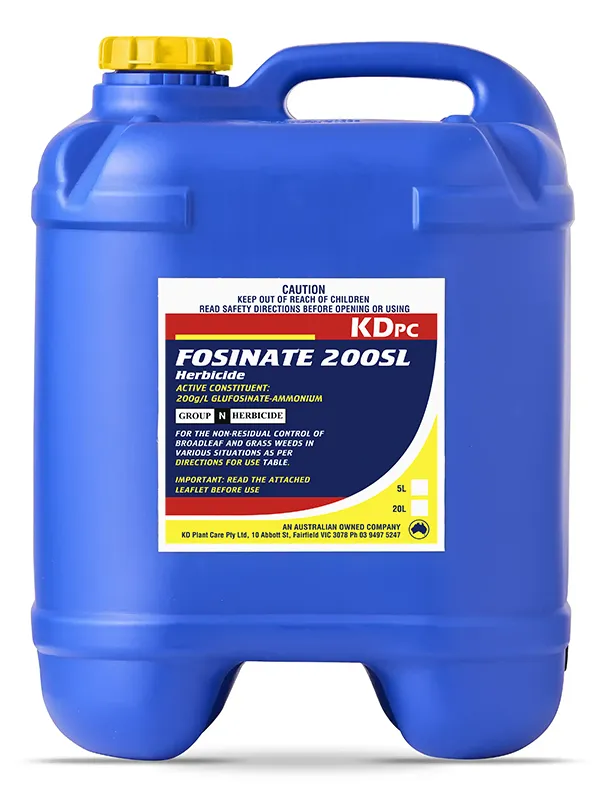
Fosinate 200SL
Non-selective, contact herbicide with some systemic activity. Ideal for effective control of a wide range of annual and perennial broad leaves and grass weeds in agricultural, horticultural, and industrial settings.
| Fosinate 200SL | |
|---|---|
Target Weeds |
Common annual and perennial broad leaf weeds and grasses |
Product Type |
Herbicide |
Active Ingredient |
200g/L Glufosinate Ammonium |
Group |
N |
Pack Size |
1L, 5L, 20L |
APVMA Registration # |
89376
Search APVMA number at APVMA PubCRIS. |
Profile
- Glufosinate is first marketed in 1986. Translocated only within leaves, primarily from the leaf base to the leaf trip
- Irreversible inhibitation of glutamine synthetase resulting in accumulation of ammonia and inhibitation of photosynthesis
Key Features & Benefits
- Provides fast-acting results with minimal soil residual activity
- Suitable for use in glyphosate-resistant weed management programs
- Suitable for orchards, vineyards, plantation crops, and non-crop areas
- Crop Safety: Can be used as a directed spray in certain crops without harming them
Toxicity
- Acute oral Mammalian Toxicity (LD50, mg/kg) - rats (male) - 431 & rats (female) - 1620)
- Acute Dermal Toxicity (LD50, mg/kg) – rats >4000
What is Fosinate 200SL used for?
Fosinate 200SL is a non-selective, contact herbicide (Group N) for controlling a wide range of annual and perennial broadleaf and grass weeds. It is registered for use in fruit and nut orchards, vineyards, plantations, strawberries and cane berries (inter-row), tomatoes (inter-row), and in non-agricultural areas including rights-of-way, commercial and industrial areas and other non-agricultural situations, as set out in the Directions for Use table.
Which weeds does Fosinate 200SL control?
Fosinate 200SL controls many annual and perennial broadleaf and grass weeds listed in Tables 1 and 2 on the label, including species such as barnyard grass, summer grass, ryegrass, wild oats, capeweed, fat hen, wireweed, Caltrop burr, Lesser canary grass, Liverseed grass, Variegated thistle, and Sida weed. Some weeds have specific notes or higher rates in Table 2 for commercial and industrial areas, rights-of-way and other non-agricultural areas, and these must be followed where Table 1 refers you to Table 2.
In which crops and situations can I use Fosinate 200SL?
Fosinate 200SL can be used as a directed or shielded spray in avocado, banana, feijoa, guava, kiwifruit, litchi, mango, pawpaw, passionfruit, pineapple, rambutan, citrus orchards, olive plantations, pome and stone fruit orchards, tree nut plantations and vineyards. It is also registered for inter-row use in strawberries, cane berry fruits and tomatoes, for primocane sucker control in blackberry, boysenberry, loganberry and raspberry, and for use in rights-of-way, commercial and industrial areas and other non-agricultural areas, as detailed in the Directions for Use table.
How do I choose the correct Fosinate 200SL rate?
The recommended rate of Fosinate 200SL is determined by weed species, weed growth stage, weed density and climatic conditions. The label directions explain that lower rates are used on young, succulent weeds and sparse populations, median rates on medium-sized weeds, and higher rates on mature or dense weeds, with additional higher rates for certain weeds in non-agricultural areas as shown in Table 2.
Can I use Fosinate 200SL before planting or between rows?
Yes, Fosinate 200SL can be used in the inter-row area of strawberries, cane berry fruits and tomatoes, and in non-agricultural situations such as rights-of-way, commercial and industrial areas and other non-crop areas, as long as you follow the Directions for Use table. Applications in inter-row situations must be directed or shielded so that spray or spray drift does not contact crop foliage, runners or green bark, and you should also follow the warnings about plastic mulch and fumigated or sterilised soil in the General Instructions.
Can Fosinate 200SL be tank-mixed with other herbicides or adjuvants?
The General Instructions state that Fosinate 200SL is compatible with most residual herbicides such as simazine, diuron, oxyfluorfen, norfluazuron and oryzalin, and with glyphosate and metsulfuron, where such tank mixes are recommended on the label. A non-ionic wetting agent may be added at 25 mL/100 L (or equivalent) on hard-to-wet weeds when higher water rates are used, but residual herbicides or adjuvants must not be mixed with Fosinate 200SL when using controlled droplet (CDA) equipment.
What should I do to avoid spray drift and protect sensitive crops?
The label instructs that Fosinate 200SL must not be applied under weather conditions, or from equipment, that may cause spray drift onto nearby susceptible plants, crops, cropping land or pastures. You must avoid spraying desirable foliage or green (uncalloused) bark, shield young trees and vines less than two years old from spray and spray drift, and avoid treating plastic mulches or recently fumigated or sterilised soils where crop foliage could later contact treated surfaces.
What personal protective equipment (PPE) is recommended when using Fosinate 200SL?
The safety directions require that Fosinate 200SL should only be handled and applied while wearing suitable protective clothing and chemical-resistant gloves, and you must wash hands and exposed skin after use and after handling contaminated clothing. You should not allow contact with skin or eyes, must avoid inhaling spray mist, and must follow any additional PPE instructions on the main container label and Safety Data Sheet.
What are the grazing and harvest withholding periods for Fosinate 200SL?
When Fosinate 200SL is used as directed, a harvest withholding period is not required for avocado, banana, blackberry, boysenberry, citrus fruit, feijoa, grapes, guava, kiwifruit, litchi, loganberry, mango, olives, passionfruit, pawpaw, pineapple, rambutan, raspberry, strawberries, tomatoes and tree nuts. For pome and stone fruit, the label states “do not harvest for 21 days after application”, and you must not graze or cut treated areas for stock food for 8 weeks after application.
How should Fosinate 200SL be stored and how do I dispose of containers?
Fosinate 200SL should be stored in the closed, original container in a cool, well-ventilated area out of direct sunlight and out of reach of children. Triple-rinsed empty containers should be disposed of in accordance with local regulations, for example through an approved drum recovery program, and unused product or washings must not be allowed to enter drains, waterways or sewers.
What should I do in case of a spill or accidental exposure?
In the event of a spill, the label directs you to contain the spill, absorb it with inert material and dispose of collected material according to local regulations, preventing any run-off from entering drains or waterways. If there is accidental exposure, follow the first-aid instructions on the label and Safety Data Sheet, seek medical advice if symptoms occur, and have the product label or container with you when seeking assistance.
Where can I buy Fosinate 200SL?
APPLICATION GUIDE
This Application Guide explains how to use Fosinate 200SL safely and effectively across the approved crop, plantation and non-agricultural situations. Use it together with the Directions for Use table and weed control tables to select the right rate, timing and application method for your situation.
Always read this guide with the product label and Directions for Use leaflet. They remain the legal authority for rates, restraints, withholding periods and safety directions, and must be followed in preference to any summary on this page.
General application notes
- Fosinate 200SL is a non-volatile, non-residual herbicide with activity against many annual and perennial broadleaf weeds and grasses. It is absorbed by foliage and green stems and will only control the parts of the plant contacted by spray; it does not provide residual soil weed control.
- Visible symptoms of control usually appear in 3–7 days, but complete desiccation may take 20–30 days under cool conditions. Best results are achieved when application is made under good growing conditions.
- Avoid spraying weeds that are under severe stress, for example from continuous frost, very dry or waterlogged conditions, or disease.
- When using knapsack or handgun equipment, apply Fosinate 200SL at label rates in sufficient water to thoroughly wet the weeds being sprayed. As a guide, 500–1000 L/ha has given good results, with denser stands needing the higher water rates.
- When using boom or directed sprayers, apply at label rates in enough water to achieve complete coverage. Water volumes of around 300–500 L/ha have given good results under most weed conditions. Avoid setups that create dust and turbulence, which can move spray into non-target areas.
- Controlled Droplet Application (CDA) equipment may be used for row spraying where specified, using a solid impermeable shroud or skirt and rates equivalent to boom or directed sprayers. Apply preferably when weeds are less than 15 cm high and set the dome so it just touches the weed tops. Total spray volumes of about 20–30 L/ha have given good results.
- Do not mix residual herbicides or spray adjuvants with Fosinate 200SL when using CDA equipment. CDA equipment must not be used in cherry orchards. Avoid any contact of the concentrated spray with crop trunks or canopies, and take special care around green or uncalloused bark.
- Fosinate 200SL is compatible with most residual herbicides (for example simazine, diuron, oxyfluorfen, norfluazuron and oryzalin), and with glyphosate and metsulfuron, where tank mixes are recommended on the label. Follow label directions for compatible wetting agents or adjuvants on hard-to-wet weeds when using higher water rates.
Resistance management
Fosinate 200SL is a Group N herbicide. To help delay the development of herbicide resistance, avoid repeated applications of Group N herbicides as the sole form of control and rotate with herbicides from other mode-of-action groups as part of an integrated weed management strategy. Always consult local advice on resistance management where available.
Situations & Crops – Directions for Use
This section summarises where Fosinate 200SL can be used, the approved rate ranges and key comments for each crop, plantation and non-agricultural situation. Use this table to match your situation, then refer to the weed control tables to select the appropriate rate for your target weeds.
Always stay within the situations, rates and timings shown here. Where the Weeds column refers you to Tables 1 or 2, use those tables to confirm which weeds are controlled and which rate applies under the label.
| Crop / Situation | Weeds | State | Rate | WHP | Critical comments |
|---|---|---|---|---|---|
| Rights-of-way, commercial and industrial areas, and other non-agricultural areas | See lists of weeds controlled in Tables 1 and 2 | All States | 1L to 6L/ha | - | Determine the recommended rate of use by considering the criteria weed species, weed stage of growth, weed density and climatic conditions as described above. Do not allow spray or spray drift to contact desirable plants. To avoid potential crop damage, refer to the label sections on Application Equipment and PROTECTION OF CROPS, NATIVE AND OTHER NON-TARGET PLANTS. |
| Line-marking on sports grounds | Turf grasses and other weeds | All States | 250mL to 500mL/100L water | - | Refer to GENERAL INSTRUCTIONS. Fosinate 200SL Herbicide is a non-selective, non-residual herbicide with limited translocation potential. It is therefore ideally suited for line-marking on sports fields where precise weed control is required. Apply at 6–8 week intervals depending on growth of turf. Apply using single boom or hand wand. |
| Blackberry, Boysenberry, Loganberry, Raspberry Primocane sucker control | - | NSW, ACT, VIC, TAS | 500mL/100L water | Nil | Apply as a directed spray to suckers and primocanes. Contact with flowers, developing fruit or desirable foliage will cause damage. Ensure complete coverage of primocanes and suckers by spraying to the point of run-off, preferably when they are less than 15cm high. A non-ionic wetting agent 1000g/L may be added at a rate of 25mL/100L or equivalent. |
| Avocado, Banana, Feijoa, Guava, Kiwifruit, Litchi, Mango, Pawpaw, Passionfruit, Pineapple, Rambutan, Plantations | See lists of weeds controlled in Tables 1 and 2 | QLD, NSW, ACT, VIC, SA, WA, NT only | 1L to 5L/ha | Nil | Apply as a directed or shielded spray. Refer to the label section Application Equipment for specific information on application methods. Controlled Droplet Application (CDA) equipment must not be used for application in cherry orchards. Warnings: DO NOT allow spray or spray drift to contact desirable foliage or green (uncalloused) bark. To avoid potential crop damage, refer to the label sections on Application Equipment and PROTECTION OF CROPS, NATIVE AND OTHER NON-TARGET PLANTS. Fosinate 200SL Herbicide may be used around trees / vines less than two years old, provided they are effectively shielded from spray and spray drift. The recommended rate of use is determined by the following criteria: • WEED SPECIES • WEED GROWTH STAGE • WEED DENSITY • CLIMATIC CONDITIONS WEED SPECIES Apply the appropriate rate to control the least susceptible weed present as per the lists of weeds controlled in the accompanying tables. WEED STAGE OF GROWTH Use the lower rate when weeds are young and succulent (grasses: pre-tillering; broadleaves: cotyledons to 4-leaf) or the population is very sparse. A median rate should be used for medium sized plants (grasses: tillering; broadleaves: 4-leaf to advanced vegetative) and the high rate should be used when weeds are mature (grasses: noding to flowering; broadleaves: budding to flowering). WEED DENSITY Use the higher rates when the weed population is dense. Thorough coverage of weeds is essential for good control. CLIMATIC CONDITIONS Best results are achieved when applied under warm humid conditions. Control will be reduced and/or slower under cold conditions and/or overcast conditions. Good results will be achieved under most other conditions. However, poor results may occur under hot dry conditions (temperature above 33°C with a relative humidity below 50%). Weeds that have been hardened or stunted in growth due to stressed conditions should be treated at the maximum rate. COVERAGE Complete coverage of weeds is essential for good control. Poor coverage may result in re-growth. PERENNIAL WEEDS Apply when weeds are actively growing. Follow-up treatments will be necessary to control re-growth of perennial weeds in most cases. |
| Citrus Orchards | All States | ||||
| Olive Plantations | |||||
| Pome and Stone Fruit Orchards | 21 days (H) | ||||
| Tree Nut Plantations, Vineyards | Nil | ||||
| Strawberries, Cane Berry Fruits (Inter-row) | See lists of weeds controlled in Tables 1 and 2 | All States | 1L to 5L/ha | Nil | Apply as a directed or shielded spray to the inter-row area. Take care not to allow spray or spray drift to contact the crop, including strawberry runners. Refer to GENERAL INSTRUCTIONS for warnings concerning plastic mulch and fumigated or sterilised soil. Determine the recommended rate of use by considering the criteria weed species, weed stage of growth, weed density and climatic conditions, as described above. |
| Tomatoes (Inter-row) |
Important notes:
- Do not apply by aircraft.
- Do not apply when rain is expected within 6 hours.
- Do not apply to weeds under stress due to, for example, very dry, very wet, frosty or diseased conditions.
- Do not apply under hot, dry conditions where temperatures are above 33°C and relative humidity is below 50%.
- Do not apply under weather conditions, or from spraying equipment, that may cause spray drift onto nearby susceptible plants, crops, cropping lands or pastures.
- Do not apply on desirable foliage or allow spray to drift onto the foliage of desirable plants, trees or vines, as damage will occur.
- Do not allow product to contact green or uncalloused bark, or cut, cracked, damaged or wounded tissue where the affected surface is not adequately healed.
- Do not allow desirable plant foliage to contact any inert surface, such as plastic mulches, which have been treated with Fosinate 200SL Herbicide.
- Do not apply Fosinate 200SL Herbicide to recently fumigated or sterilised soil.
Withholding periods - Harvest
- Avocado, banana, blackberry, boysenberry, citrus fruit, feijoa, grapes, guava, kiwifruit, litchi, loganberry, mango, olives, passionfruit, pawpaw, pineapple, rambutan, raspberry, strawberries, tomatoes, tree nuts: harvest withholding period is not required when Fosinate 200SL is used as directed.
- Pome and stone fruit: do not harvest for 21 days after application.
Withholding periods - Grazing
- Do not graze or cut treated areas for stock food for 8 weeks after application.
Label authority
Fosinate 200SL must not be used for any purpose, or in any manner, contrary to the product label unless authorised under appropriate legislation. This page is a guide only and does not replace the registered label & leaflet Directions for Use.
Weeds controlled – ANNUAL broadleaf and grass weeds (Table 1)
ANNUAL WEEDS
Table 1 lists the annual broadleaf and grass weeds controlled by Fosinate 200SL, with the common name, scientific name and the recommended application rates for boom or directed sprayers, handguns and knapsacks. Use this table together with the relevant Application Guide section to match the target weed to the approved crop or non-crop situation and application method.
Some entries in Table 1 include a note reference or a direction to Table 2. Follow those references exactly as they appear on the leaflet, particularly where the weed is directed to Table 2 for commercial and industrial areas, rights-of-way and other non-agricultural situations.
| Common name | Scientific name | Application Rates | ||
|---|---|---|---|---|
| Boom or Directed Sprayer (L/ha) | Handgun (mL/100L) | Knapsack (mL/15L) | ||
| Amaranthus spp. | Amaranthus spp. | 2 to 5 | 500 | 75 |
| Apple of Peru | Nicandra physalodes | 1.5 to 3 | 300 | 45 |
| Argentine Peppercress | Lepidium bonariense | 2 to 3 | 300 | 45 |
| Awnless Barnyard Grass | Echinochloa colona | 2.5 to 3.5 | 350 | 53 |
| Barley Grass | Hordeum leporinum | 2 to 3 | 300 | 45 |
| Barnyard Grass | Echinochloa crus-galli | 2 to 5 | 500 | 75 |
| Billy Goat Weed | Ageratum conyzoides | 2 to 5 | 500 | 75 |
| Bitter Cress | Cardamine hirsute | 2 to 5 | 500 | 75 |
| Black Bindweed (Buckwheat) (refer Note 2) |
Fallopia convolvulus | 1.8 to 5 | 500 | 75 |
| Bladder Ketmia | Hibiscus trionum | 3 to 5 | 500 | 75 |
| Bordered Panic | Entolasia marginata | 2 to 4 | 400 | 60 |
| Brome Grass (refer Note 1) |
Bromus spp. | 2 to 3 | 300 | 45 |
| Calopo | Calopogonium mucanoides | 2 to 5 | 500 | 75 |
| Caltrop Burr (refer also Table 2) |
Tribulus terrestris | 3 to 5 | 500 | 75 |
| Capeweed | Arctotheca calendula | 1.5 to 5 | 500 | 75 |
| Clover (Subterranean) | Trifolium subterranean | 1.8 to 3 | 300 | 45 |
| Cobblers Peg | Bidens pilosa | 2 to 5 | 500 | 75 |
| Common Storksbill | Erodium cicutarium | 1.5 to 4 | 400 | 60 |
| Crowsfoot Grass | Eleusine indica | 3 to 5 | 500 | 75 |
| Deadnettle (refer also Table 2) |
Lamium amplexicaule | 2 to 5 | 500 | 75 |
| Dwarf Crumbweed | Chenopodium pumilo | 3 to 5 | 500 | 75 |
| Fat Hen | Chenopodium album | 3 to 5 | 500 | 75 |
| Fumitory | Fumaria officinalis | 1.8 to 5 | 500 | 75 |
| Green Crumbweed | Chenopodium carinatum | 2 to 5 | 500 | 75 |
| Lesser Canary Grass (refer also Table 2) |
Phalaris minor | 3 to 5 | 500 | 75 |
| Liverseed Grass (refer also Table 2) |
Urochloa panicoides | 1.5 to 5 | 500 | 75 |
| Medics (annual) | Medicago spp. | 1 to 5 | 500 | 75 |
| Milk Thistle | Sonchus oleraceus | 2 to 5 | 500 | 75 |
| Mint Weed | Salvia reflexa | 3 to 5 | 500 | 75 |
| New Zealand Spinach | Tetragonia tetragoniodes | 2 to 5 | 500 | 75 |
| Patterson’s Curse | Echium plantagineum | 1 to 3 | 300 | 45 |
| Peanuts | Arachis hypogaea | 1.5 to 3 | 300 | 45 |
| Pigweed | Portulaca oleracea | 3 to 5 | 500 | 75 |
| Pinkburr | Urena lobata | 2 to 5 | 500 | 75 |
| Potato Weed | Galinsoga parviflora | 2 to 5 | 500 | 75 |
| Prairie Grass (refer Note 1) |
Bromus unioloides | 4 to 5 | 500 | 75 |
| Prickly Lettuce | Lactuca serriola | 3 to 5 | 500 | 75 |
| Red Natal Grass | Rhynchelytrum repens | 2 to 5 | 500 | 75 |
| Ryegrass (annual) | Lolium rigidum | 2 to 5 | 500 | 75 |
| Saffron Thistle | Carthamus lanatus | 1.5 to 5 | 500 | 75 |
| Sago Weed | Plantago cunninghamii | 2 to 3 | 300 | 45 |
| Scarlet Pimpernel | Anagallis arvensis | 2 to 5 | 500 | 75 |
| Setaria | Setaria italica | 2 to 5 | 500 | 75 |
| Sheep Thistle | Carduus tenuiflorus | 2 to 5 | 500 | 75 |
| Silver Grass | Vulpia myuros | 2 to 5 | 500 | 75 |
| Sorghum Sudax | Sorghum bicolor | 2 to 5 | 500 | 75 |
| Square Weed | Spermacoce latifolia | 2 to 5 | 500 | 75 |
| St Barnaby’s Thistle | Centaurea solstitialis | 1.5 to 5 | 500 | 75 |
| Stagger Weed | Stachys arvensis | 2 to 5 | 500 | 75 |
| Star of Bethlehem | Ipomoea quamoclit | 2 to 5 | 500 | 75 |
| Summer Grass | Digitaria ciliaris | 2 to 5 | 500 | 75 |
| Thickhead | Crassocephalum crepidioides | 3 to 5 | 500 | 75 |
| Three Cornered Jack | Emex australis | 2 to 5 | 500 | 75 |
| Tomato | Lycopersicon esculentum | 2 to 5 | 500 | 75 |
| Turnip Weed | Rapistrum rugosum | 3 to 5 | 500 | 75 |
| Wild Oats (refer also Table 2) |
Avena spp. | 3 to 5 | 500 | 75 |
| Wild Radish | Raphanus raphanistrum | 5 | 500 | 75 |
| Wire Weed (refer also Table 2) |
Polygonum aviculare | 1.5 to 5 | 500 | 75 |
Important notes:
- Use the lower rate when weeds are young and succulent, including grasses at the pre‑tillering stage and broadleaf weeds from cotyledon to 4‑leaf stage.
- Use a median rate on medium‑sized plants, including tillering grasses and broadleaf weeds from 4‑leaf to advanced vegetative stage.
- Use the higher rate when weeds are mature, when weed density is high, or where weeds have been hardened or stunted in growth due to stressed conditions.
- Thorough coverage of weeds is essential for good control, and poor coverage may result in re‑growth.
- Best results are achieved under warm, humid conditions; control may be reduced or slower under cold or overcast conditions.
- Note 1: Well‑established clumps of Prairie Grass and Brome grasses may only be suppressed at these rates, and follow‑up treatments may be necessary to control re‑growth.
- Note 2: Good control of Black Bindweed (Buckwheat) will be achieved on small and medium‑sized plants only in non‑crop situations.
- Where an entry says (refer also Table 2), check Table 2 for the relevant rates in commercial and industrial areas, rights‑of‑way and other non‑agricultural areas.
Weeds controlled – PERENNIAL weeds (Table 1)
PERENNIAL WEEDS
This section of Table 1 lists the perennial weeds controlled or suppressed by Fosinate 200SL, with the common name, scientific name and the recommended application rates for boom or directed sprayers, handguns and knapsacks. Use this table together with the relevant Application Guide sections above to match the target perennial weed to the approved crop or situation and application method.
Perennial weeds should be treated when they are actively growing, as directed on the label and leaflet. Follow-up treatments will be necessary to control re-growth of perennial weeds in most cases, and weeds that are hardened or stunted by stressed conditions should be treated at the maximum rate.
| Common name | Scientific name | Application Rates | ||
|---|---|---|---|---|
| Boom or Directed Sprayer (L/ha) | Handgun (mL/100L) | Knapsack (mL/15L) | ||
| Blady Grass | Imperata cylindrica | 3 to 4 | 400 | 60 |
| Cape Tulip | Homeria spp. | 2 to 3 | 300 | 45 |
| Centro | Centrosema pubescens | 1 to 5 | 500 | 75 |
| Clover Glycine | Glycine latrobeana | 1 to 3 | 300 | 45 |
| Couch Grass | Cynodon dactylon | 2.5 to 5 | 500 | 75 |
| Cow Pea | Vigna unguiculata | 1 to 3 | 300 | 45 |
| Giant Sensitive Plant | Mimosa invisa | 2 to 5 | 500 | 75 |
| Greenleaf Desmodium | Desmodium intortum | 1 to 3 | 300 | 45 |
| Johnson Grass | Sorghum halepense | 3 to 5 | 500 | 75 |
| Panicum spp. | Panicum spp. | 2 to 5 | 500 | 75 |
| Paspalum spp. | Paspalum spp. | 3 to 5 | 500 | 75 |
| Perennial Bindweed | Convolvulus arvensis | 2 to 3 | 300 | 45 |
| Shamrock | Oxalis corymbosa | 3 | 300 | 45 |
| Sida Weed (refer also Table 2) |
Sida retusa | 3 to 5 | 500 | 75 |
| Silver Leaf Desmodium | Desmodium uncinatum | 4 to 5 | 500 | 75 |
| Siratro | Macroptilium atropurpureum | 1 to 3 | 300 | 45 |
| Stink Grass | Eragrostis cilianensis | 3 to 5 | 500 | 75 |
| Variegated Thistle (refer also Table 2) |
Silybum marianum | 2.5 to 5 | 500 | 75 |
| White Clover | Trifolium repens | 3 to 5 | 500 | 75 |
| White Eye | Richardia brasiliensis | 3 to 5 | 500 | 75 |
| Willow Herb | Epilobium spp. | 4 to 5 | 500 | 75 |
Important notes – perennial weeds:
- Apply Fosinate 200SL to perennial weeds when they are actively growing.
- Follow‑up treatments will be necessary to control re‑growth of perennial weeds in most cases.
- Use the higher rate where perennial weeds are dense, more advanced in growth, or have been hardened or stunted by stressed conditions.
- Thorough coverage of weeds is essential for good control, and poor coverage may result in re‑growth.
- Best results are achieved under warm, humid conditions; control may be reduced or slower under cold or overcast conditions.
- Note 1: Well‑established clumps of Prairie Grass and Brome grasses may only be suppressed at these rates, and follow‑up treatments may be necessary to control re‑growth.
- Where an entry says (refer also Table 2), check Table 2 for the relevant rates in commercial and industrial areas, rights‑of‑way and other non‑agricultural areas.
Weeds controlled in non‑crop areas – commercial & industrial, rights‑of‑way and other non‑agricultural areas (Table 2)
Table 2 shows the application rates for specific annual and perennial weeds in commercial and industrial areas, rights-of-way and other non-agricultural areas, when these weeds are referred from Table 1. Use this table together with the Directions for Use for “rights-of-way, commercial and industrial areas and other non-agricultural areas” on the label, and always follow the restraint and spray-drift instructions on the leaflet.
| Common name | Scientific name | Application Rates | ||
|---|---|---|---|---|
| Boom or Directed Sprayer (L/ha) | Handgun (mL/100L) | Knapsack (mL/15L) | ||
| ANNUAL WEEDS | ||||
| Caltrop Burr | Tribulus terrestris | 4 to 5 | 500 | 75 |
| Dead Nettle | Lamium amplexicaule | 6 | 600 | 90 |
| Lesser Canary Grass | Phalaris minor | 4 to 6 | 600 | 90 |
| Liverseed Grass | Urochloa panicoides | 1.5 | 150 | 23 |
| Variegated Thistle | Silybum marianum | 6 | 600 | 90 |
| Wild Oats | Avena spp. | 5 to 6 | 600 | 90 |
| Wire Weed | Polygonum aviculare | 2 to 5 | 500 | 75 |
| PERENNIAL WEEDS | ||||
| Sida Weed | Sida retusa | 4 to 5 | 500 | 75 |
Important notes – non-agricultural areas:
- Use this table only when Table 1 directs you to Table 2 for commercial and industrial areas, rights-of-way and other non-agricultural areas.
- Determine the rate within the range by considering weed species, weed growth stage, weed density and climatic conditions, as described in the General Instructions.
- Apply to weeds that are actively growing, and use the higher rate when weeds are large, dense or have been hardened or stunted by stressed conditions.
- Thorough coverage of weeds is essential for good control; poor coverage may result in re-growth.
- Best results are achieved under warm, humid conditions; control may be reduced or slower under cold or overcast conditions.
- Do not allow spray or spray drift to contact desirable plants, crops, trees or other non-target vegetation in or adjacent to these non-agricultural areas.
BUY FROM
Our Distributors