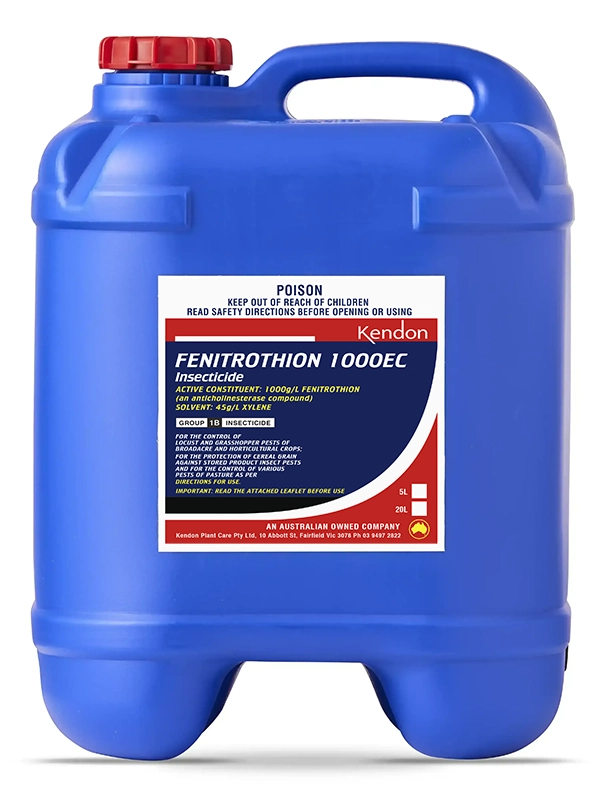
Fenitrothion 1000EC
Non-systemic insecticide active by both contact and ingestion. Effectively controls locust and grasshopper pests of broadacre and horticultural crops, various pests of pasture and the protection of cereal grain from stored product insect pests.
| Fenitrothion 1000EC | |
|---|---|
Target Pests |
Wingless Grasshopper | Spur-throated locust | Migratory locust | Australian Plague Locust | Corbie | Sitona Weevil | Pasture Cockchafer | Beetles & Weevils in grain stores |
Product Type |
Insecticide |
Active Ingredient |
1000g/L Fenitrothion |
Group |
1B |
Pack Size |
500ml, 1L, 5L, 20L |
APVMA Registration # |
56170
Search APVMA number at APVMA PubCRIS. |
Profile
Introduced in 1962. Fenitrothion inhibits acetylcholinesterase (AChE) by covalent (irreversible) reaction with the enzyme at the acetylcholine binding site, blocking hydrolysis of acetylcholine and resulting in hyperexcitation.
Key Features & Benefits
- Concentrated formula: Provides high efficacy at the specified dosage.
- Versatile application: Can be used on-farm or by bulk grain handlers, applied to grain, grain storage structures, or equipment.
- Approved for cereal grains: Suitable for use on a variety of major cereal grains.
- Long-term grain protection: Helps protect grain for up to six months, preventing damage and spoilage.
- Reduces crop damage: Minimizes grain weight loss, reduced germination, and potential fungal attack.
Toxicity
Acute oral (LD50, mg/kg) rats (male) 1700; rats (female) 1720
APPLICATION GUIDE - (Buffer Zones)
Fenitrothion 1000EC is registered for use across four distinct situations — stored grain and grain storage facilities, broiler poultry houses, locust and grasshopper control in broadacre and horticultural crops, and pasture pest management. Select the relevant section below for rates, state registrations and critical comments. Many registrations are state-specific, so always check the State column before use. In Western Australia, use in stored grain is restricted to bulk handling authorities only.
For all field applications, buffer zones are mandatory when applying upwind of sensitive areas including natural streams, rivers, waterways, human dwellings and neighbouring properties. Distances vary by application method and rate — refer to the table below before any broadacre, pasture or horticultural application.
| Application Method | Rate | Minimum Buffer Zone (upwind of sensitive areas) |
|---|---|---|
| Aerial | Up to 350ml/ha (maximum permitted rate by aircraft) | 300m |
| Above 350ml/ha | DO NOT apply by aircraft | |
| Boom spray / electrostatic | 350ml/ha and below | 50m |
| Above 350ml/ha | 100m | |
| Misters / air-assisted | 350ml/ha and below | 100m |
| Above 350ml/ha | 300m |
Apply Fenitrothion 1000EC following the Application Guide above.
Always download and read the current product label before use and follow all regulatory and safety instructions.
Stored Grain & Grain Storage Facilities
Fenitrothion 1000EC controls a broad range of stored product insect pests in cereal grain storage facilities including farms, produce stores, feed and flour mills, warehouses, processing plants, transport equipment and animal feed bins. In Western Australia, use in stored grain is restricted to bulk handling authorities only.
Maximum product efficiency in grain protection depends on the following conditions being met:
- Even distribution of the product through the grain.
- Absence of infestation at uptake.
- Grain moisture content below 12%.
- Storage temperature below 27°C.
Mixing and application instructions:
- Mixing: Mix the required amount of spray for immediate use. Slowly add Fenitrothion 1000EC to the required volume of water in the tank and agitate well before commencing to spray.
- Equipment: Apply through specialised grain spraying equipment. The spray nozzle must be capable of delivering an even spray pattern.
- Spray rate (in-flow grain protection): The spray rate in litres per hour must equal the auger or elevator uptake in tonnes per hour — for example, for an uptake of 20 tonnes per hour, the nozzle(s) must deliver 20L per hour.
- Cleaning: On completion, wash out spray equipment, mixing vessels and measuring utensils with water.
| Situation | Pest | State | Rate | WHP | Critical Comments |
|---|---|---|---|---|---|
| Structural Treatments Cereal grain storage on farms, produce stores, feed and flour mills, warehouses and processing plants, transport equipment and animal feed bins. |
Stored product insect pests, including susceptible and maldison resistant grain weevils, flour beetles, saw-toothed grain beetle, tropical warehouse moth and Indian meal moth (but not lesser grain borer). |
All States (In W.A. for use by bulk handling authorities only) |
1L in 100L water | 90 Days (for processing into food for human consumption or stock food) |
Apply 1L of spray over 20 square metres of surface or to the point of runoff. |
| Grain Protection All cereal grains stored in bulk for periods of 3–6 months. |
1.2L in 100L water (12ppm)* | Apply 1L diluted spray per tonne to the grain flow. The spray rate in litres per hour must equal the auger or elevator uptake in tonnes per hour — e.g. for an uptake of 20 tonnes per hour, the nozzle(s) must deliver 20L per hour. |
|||
| Grain Protection All cereal grains stored in bulk for periods less than three months. |
600ml in 100L water (6ppm)* | ||||
| Surface Treatment Bulk stored cereal grain, stacks of bags etc. |
1L in 100L water | At monthly intervals during summer and 2–3 month intervals during winter, apply 1L of spray over 20 square metres exposed grain surface or to the point of runoff on bags. | |||
| Grain Protection All cereal grains stored in bulk (including where lesser grain borer is present). |
Pests as above plus lesser grain borer. | Rates as above plus Sumithrin Synergised Grain Protectant at the recommended rate | Apply 1L of mixture per tonne of grain. |
*ppm = parts per million Fenitrothion on grain (mg/kg).
Apply Fenitrothion 1000EC following the Application Guide above.
Always download and read the current product label before use and follow all regulatory and safety instructions.
Broiler Poultry Houses
Fenitrothion 1000EC controls lesser mealworm (litter beetle) and darkling beetle (black beetle) in broiler poultry house litter, walls, roof and feed sheds. There is no withholding period for this use. Apply after each batch of broilers is taken out and shortly before re-stocking.
- Apply diluted spray to shed litter, walls and roof. Spray feed sheds and other places where beetles may hide.
- Spray old litter before spreading new litter — improved results may be obtained where spray is incorporated into the litter.
- DO NOT house layer birds in recently treated sheds.
- Avoid contamination of chicken feed and do not allow spray to reach birds in a neighbouring shed.
| Situation | Pest | State | Rate | WHP | Critical Comments |
|---|---|---|---|---|---|
| Broiler poultry house litter, walls, roof and feed sheds. | Lesser mealworm (litter beetle), Darkling beetle (Black Beetle). |
All States | 1L / 100L water (10L diluted spray treats 70m²) |
NIL | Apply diluted spray to broiler poultry shed litter, walls and roof. Spray feed shed and other places where beetles may hide. Spray old litter before spreading new litter. Improved results may be obtained where spray is incorporated into the litter. DO NOT house layer birds in recently treated sheds. Avoid contamination of chicken feed and do not allow spray to reach birds in neighbouring shed. Spray sheds after each batch of broilers is taken out shortly before re-stocking. |
Apply Fenitrothion 1000EC following the Application Guide above.
Always download and read the current product label before use and follow all regulatory and safety instructions.
Locusts & Grasshoppers — Broadacre, Pasture & Horticultural Crops
Fenitrothion 1000EC controls spur-throated locust, migratory locust, Australian plague locust and wingless grasshopper across pasture, broadacre and horticultural crops. Registrations are state-specific — check the State column carefully before use. For vines, apples, cabbages, cherries, grapes, lettuce, soybean and tomatoes, use is restricted to locust and grasshopper control only — DO NOT use for any other pest on these crops.
- Application limit — pasture and forage crops: Apply a maximum of 3 sprays per paddock per year.
- Application limit — cereal crops: Apply a maximum of 3 sprays per field per growing season.
- Re-application interval: DO NOT apply at intervals of less than 14 days for all crops in this section.
- Rate: Use the higher rate through a suitable boom sprayer in dense crops when targeting adult grasshoppers.
- Buffer zones: Observe the buffer zone distances in the table above before applying. Refer to the full label for complete buffer zone requirements.
| Situation / Crop | Pest | State | Rate | WHP | Critical Comments |
|---|---|---|---|---|---|
| Pasture, Pasture Seed Crops, Forage Crops Including Grazing Sorghum, Lucerne, Soybeans, Cereal Crops | Spur-throated locust, Migratory locust |
QLD, NSW, VIC, SA & WA Only | 270ml–550ml / ha | 14 Days (H) 14 Days (G) |
Use the higher rate through suitable boom sprayer in dense crops against adult grasshoppers. Pasture and forage crops: Maximum 3 sprays per paddock per year. Cereal crops: Maximum 3 sprays per field per growing season. Refer to Crop Safety note below for sorghum varieties. |
| Wingless Grasshopper | NSW, VIC, SA & WA Only | 300ml / ha | |||
| Apples, Cabbages, Cherries, Grapes, Lettuce and Tomatoes Locust and grasshopper control only — DO NOT use for any other pest on these crops. |
Spur-throated locust, Migratory locust |
NSW, VIC, SA & WA Only | 270ml–550ml / ha | Use the higher rate through suitable boom sprayer in dense crops against adult grasshoppers. Maximum 3 sprays per paddock per year. |
|
| Wingless Grasshopper | NSW, VIC, SA & WA Only | 300ml / ha | |||
| Pasture, Pasture Seed Crops, Forage Crops Including Grazing Sorghum, Lucerne, Cereal Crops, Soybeans, Apples, Cabbages, Cherries, Grapes, Lettuce and Tomatoes | Australian Plague Locust | NSW, QLD, VIC, SA & WA Only | 270ml–400ml / ha | Use higher rate through suitable boom sprayer in dense crops against adult grasshoppers. Refer to Crop Safety note below for sorghum varieties. |
|
| Crop Safety — Sorghum: Fenitrothion 1000EC may cause discolouration on many varieties of sorghum. Leaves of some sorghum varieties may become spotted after spraying. Pioneer 845, Alpha strains and Golden Acres varieties may be severely damaged, especially at later growth stages. Check with the manufacturer or other appropriate source before application to newer varieties. | |||||
(H) = Harvest withholding period. (G) = Grazing / slaughter withholding period. Refer to the full label for all WHP conditions applicable to your situation.
Apply Fenitrothion 1000EC following the Application Guide above.
Always download and read the current product label before use and follow all regulatory and safety instructions.
Pasture Pests
Fenitrothion 1000EC controls a range of pasture pests including Sitona Weevil in lucerne, Blackheaded Pasture Cockchafer, Corbie, Winter Corbie, Underground Grass Grub and Oxycanus Grub. Registrations and rates are state-specific — check the State column carefully before use.
- Application limit: Only 1 application per paddock per year is permitted for Pasture Cockchafer, Corbie, Winter Corbie, Underground Grass Grub and Oxycanus Grub.
- Re-application intervals (pasture and lucerne): DO NOT apply at intervals of less than 7 days when used for grazing; DO NOT apply at intervals of less than 14 days when cut for stock feed or where stock may be oversprayed.
- Rate: Always use the lowest rate possible to achieve effective control. Spot spraying is to be used where possible.
- Buffer zones: Observe the buffer zone distances in the table above before applying. Refer to the full label for complete buffer zone requirements.
| Situation / Crop | Pest | State | Rate | WHP | Critical Comments |
|---|---|---|---|---|---|
| Lucerne | Sitona Weevil | VIC | 250ml / ha | 14 Days (G) | Apply October to December or in autumn when adults occur in damaging numbers. Use the lowest rate possible to achieve effective control. Observe any use limitations advised by state authorities. |
| NSW, TAS & WA Only | 650ml / ha | ||||
| SA Only | 300ml / ha | ||||
| Pasture | Pasture Cockchafer | NSW & TAS Only | 700ml / ha | Only 1 application per paddock per year. Spray April to July as a rainfall of more than 7mm is required before cockchafers surface and feed — spray when rainfall is imminent. Spot spraying is to be used where possible. Use the lowest rate possible to achieve effective control. |
|
| SA Only | 480ml / ha | ||||
| Pasture | Corbie, Winter Corbie |
TAS Only | 800ml–1.3L / ha | Only 1 application per paddock per year. Spray May to July for Winter Corbie and August to September for Corbie when damaging numbers occur. Spot spraying is to be used where possible. Use the lowest rate possible to achieve effective control. |
|
| Pasture | Underground Grass Grub | NSW & VIC Only | 500ml–800ml / ha | Only 1 application per paddock per year. Spray April to July when opening rains have stimulated feeding activity. Use the lowest rate possible to achieve effective control. |
|
| SA Only | 800ml–1L / ha | ||||
| Pasture | Oxycanus Grub | NSW, VIC, SA & TAS Only | 1.2L–1.3L / ha | Only 1 application per paddock per year. Spray April to late June when grubs are causing pasture damage. Use the lowest rate possible to achieve effective control. |
(G) = Grazing / slaughter withholding period. Refer to the full label for all WHP conditions applicable to your situation.
Apply Fenitrothion 1000EC following the Application Guide above.
Always download and read the current product label before use and follow all regulatory and safety instructions.
What is Fenitrothion 1000EC and what is it used for?
Fenitrothion 1000EC is a non-systemic organophosphate insecticide registered for three main use areas:
- Locust and grasshopper control — spur-throated locust, migratory locust, Australian plague locust and wingless grasshopper across pasture, broadacre and horticultural crops in nominated states.
- Cereal grain protection — structural treatments, grain protection (in-flow and surface) and combination treatments in cereal grain storage facilities on farms, produce stores, warehouses, mills, processing plants and transport equipment.
- Pasture pest control — Sitona Weevil in lucerne, Blackheaded Pasture Cockchafer, Corbie, Winter Corbie, Underground Grass Grub and Oxycanus Grub in pasture, in nominated states.
It is also registered for control of lesser mealworm (litter beetle) and darkling beetle (black beetle) in broiler poultry houses.
What is the active constituent in Fenitrothion 1000EC?
How does Fenitrothion 1000EC work?
Fenitrothion 1000EC is a Group 1B insecticide. It is non-systemic and acts by both contact and ingestion. Fenitrothion inhibits acetylcholinesterase (AChE) by covalent (irreversible) reaction with the enzyme at the acetylcholine binding site, blocking hydrolysis of acetylcholine and resulting in hyperexcitation and death of the target insect.
For insecticide resistance management, some naturally occurring insect biotypes resistant to Group 1B insecticides may exist through normal genetic variability in any insect population. Resistant individuals can eventually dominate if Group 1B insecticides are used repeatedly. Contact your local supplier, Kendon representative or local department of agriculture agronomist for further information on resistance strategies.
How do I apply Fenitrothion 1000EC?
Application method and rate depend on the situation. Refer to the Application Guide above for full rates, state registrations and critical comments for each use area. General mixing and application instructions are as follows:
- Mixing: Mix the required amount of spray for immediate use. Slowly add Fenitrothion 1000EC to the required volume of water in the tank and agitate well before commencing to spray.
- Ground application (locusts/pasture): Apply by air-assisted, misting, electrostatic or boom sprayers. A vehicle with an enclosed cab should be used where practicable.
- Aerial application: DO NOT apply at rates greater than 350ml/ha by aircraft. Refer to buffer zone requirements in the label before use.
- Grain protection: Apply through specialised grain spraying equipment capable of delivering an even spray pattern. On completion, wash out spray equipment, mixing vessels and measuring utensils with water.
- Poultry houses: Apply diluted spray to shed litter, walls and roof after each batch of broilers is removed, shortly before re-stocking.
Always download and read the current product label before use. This product is not to be used for any purpose or in any manner contrary to the label unless authorised under appropriate legislation.
What are the buffer zone requirements for Fenitrothion 1000EC?
Buffer zones must be observed when applying upwind of sensitive areas, including natural streams, rivers, waterways, human dwellings and neighbouring properties. Requirements vary by application method:
- Aerial application: DO NOT apply at rates greater than 350ml/ha. Maintain a buffer zone of at least 300m upwind of sensitive areas.
- Boom sprays and electrostatic: At least 50m at rates of 350ml/ha and below; at least 100m where rates exceed 350ml/ha.
- Misters and air-assisted: At least 100m at rates of 350ml/ha and below; at least 300m where rates exceed 350ml/ha.
DO NOT apply under meteorological conditions or from spraying equipment that could be expected to cause spray drift or run-off onto sensitive areas.
What are the withholding periods for Fenitrothion 1000EC?
Withholding periods (WHPs) vary by situation:
- Stored cereal grain (12ppm treatment): Hold treated grain in store for 90 days before use for processing into food for human consumption or stock feed.
- Crops for human consumption (apples, cabbages, cherries, grapes, lettuce, soybean, tomatoes, cereal crops): DO NOT harvest for 14 days after application.
- Pasture and lucerne (stock not oversprayed): DO NOT graze for 7 days after application, or withhold stock from slaughter for 14 days after application, whichever is appropriate. DO NOT cut for stock feed for 14 days after application.
- Pasture and lucerne (stock oversprayed): DO NOT slaughter for 14 days after application.
- Sorghum, cereal straw and fodder, pasture seed crops, forage crops: DO NOT graze or cut for stock feed for 14 days after application.
- Broiler poultry houses: NIL.
Always download and read the current product label for all withholding period conditions applicable to your specific situation before use.
What are the key restraints for Fenitrothion 1000EC?
The following restraints apply to all uses of Fenitrothion 1000EC:
- For vines, apples, cabbages, cherries, grapes, lettuce, soybean and tomatoes: DO NOT use for any purpose (pest) other than locust and grasshopper control.
- DO NOT apply by aircraft at rates greater than 350ml/ha.
- In stored grain in Western Australia: for use by bulk handling authorities only.
- Re-application intervals apply — for pasture and lucerne, DO NOT apply at intervals of less than 7 days when used for grazing, or less than 14 days when cut for stock feed or where stock may be oversprayed. For all other registered crops, DO NOT apply at intervals of less than 14 days.
- For pasture, forage crops and cereal crops in locust/grasshopper situations: apply a maximum of 3 sprays per paddock or field per year/growing season.
- For pasture soil pest situations (Cockchafer, Corbie, Underground Grass Grub, Oxycanus Grub): only 1 application per paddock per year is permitted.
What PPE and safety directions apply when using Fenitrothion 1000EC?
Fenitrothion 1000EC is poisonous if absorbed by skin contact, inhaled or swallowed. Repeated minor exposure may have a cumulative poisoning effect.
- When opening the container, preparing spray and using the prepared spray: wear cotton overalls buttoned to the neck and wrists, a washable hat, elbow-length PVC gloves and a face shield.
- When using in enclosed areas: also wear goggles and a half-face piece respirator with combined dust and gas cartridge.
- Avoid contact with eyes and skin. DO NOT inhale spray mist.
- If product contacts skin, immediately wash the area with soap and water.
- After use and before eating, drinking or smoking: wash hands, arms and face thoroughly with soap and water.
- After each day's use: wash contaminated clothing, gloves, face shield, goggles and respirator; wash rubber items with detergent and warm water.
- For ground spraying operations, use a vehicle equipped with an enclosed cab where practicable. It is highly desirable that closed mixing/loading systems and enclosed cabs fitted with air conditioning and pesticide filters are in place.
Additional safety information is listed in the Safety Data Sheet (SDS), which can be requested by clicking the Request SDS button on this page.
What are the first aid measures for Fenitrothion 1000EC?
If swallowed, splashed on skin or in eyes, or inhaled, contact a Poisons Information Centre — phone Australia 131 126 — or a doctor at once. Remove any contaminated clothing and wash skin thoroughly. If swallowed, activated charcoal may be advised. Give Atropine if instructed.
Fenitrothion 1000EC is a flammable liquid and vapour. It is harmful if swallowed, causes serious eye irritation and may cause damage to organs through prolonged or repeated oral exposure.
How should Fenitrothion 1000EC be stored and how should empty containers be disposed of?
Store in the closed, original container in a cool, well-ventilated area. DO NOT store for prolonged periods in direct sunlight.
For container disposal:
- Triple or preferably pressure rinse containers before disposal. Add rinsings to the spray tank. DO NOT dispose of undiluted chemical on site.
- If recycling: replace cap and return clean containers to a recycler or designated collection point.
- If not recycling: break, crush or puncture and bury empty containers in a local authority landfill. If no landfill is available, bury below 500mm in a disposal pit specifically marked and set up for this purpose, clear of waterways, desirable vegetation and tree roots.
- Empty containers and product should not be burnt.
Is Fenitrothion 1000EC dangerous to bees, fish or aquatic life?
Yes. Fenitrothion 1000EC is very toxic to aquatic life with long lasting effects and is dangerous to fish and bees. The following precautions are mandatory:
- DO NOT apply under meteorological conditions or from spraying equipment that could be expected to cause spray drift or run-off onto sensitive areas such as natural streams, rivers, wetlands, natural surface waters, waterways, human dwellings or neighbouring properties.
- DO NOT contaminate streams, rivers or waterways with the chemical or used containers.
- DO NOT spray any plants in flower while bees are foraging.
- Observe all buffer zone requirements as per the label — refer to the Application Guide above for buffer zone distances by application method.
Where can I buy Kendon Fenitrothion 1000EC?
BUY FROM
Our Distributors