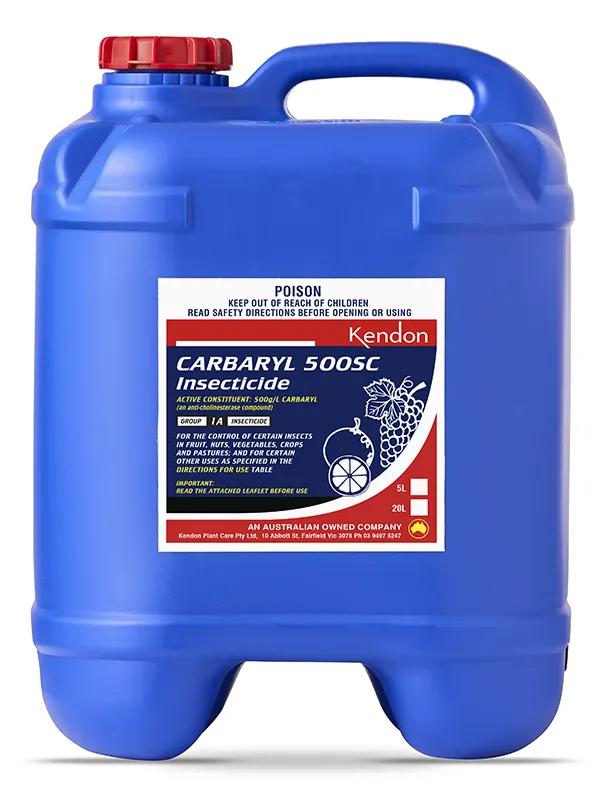
Carbaryl 500SC Insecticide
Insecticide active by contact and ingestion with slight systemic mobility. Effectively controls Lepidoptera, Coleoptera and other chewing and sucking insects in fruit, nuts, vegetables, crops and pastures.
| Carbaryl 500SC Insecticide | |
|---|---|
Product Type |
Insecticide |
Active Ingredient |
500g/L Carbaryl |
Group |
1A |
Pack Size |
5L, 20L |
APVMA Registration # |
69359
Search APVMA number at APVMA PubCRIS. |
Profile
Introduced in 1956. Carbaryl inhibits acetylcholinesterase (AChE) by covalent (irreversible) reaction with the enzyme at the acetylcholine binding site, blocking hydrolysis of acetylcholine and resulting in hyperexciattion.
Key Features & Benefits
- Provides rapid knockdown and broad-spectrum control for a wide range of pests.
- Easy to handle: The flowable formulation makes measuring, mixing, and application simpler and more convenient .
- Dual action: Effective upon contact and as a stomach poison, increasing the likelihood of killing pests.
- Addresses resistance: Effective against some insects that have developed resistance to other insecticides.
- Can be used in fruit thinning for apples, but care needs to be taken due to russeting.
Toxicity
Acute oral (LD50, mg/kg) rats (male) 264; rats (female) 500; rabbits 710
What is Carbaryl 500SC Insecticide and how does it work?
Carbaryl 500SC is a broad-spectrum insecticide containing 500g/L carbaryl, approved for use on fruit, vegetables, field crops, and pastures. It controls chewing and sucking insects by inhibiting acetylcholinesterase and is registered for numerous Australian crops and pests.
What pests and rates does Carbaryl 500SC control in tree and vine crops?
- Avocados: Red shouldered leaf beetle, wingless grasshopper. 200 mL/100L. WHP: 3 days. Apply when infestation first observed and repeat as needed.
- Citrus (oranges, lemons): LBAM, yellow peach moth, fruit sucking moth, orange fruit borer, citrus leaf-eating caterpillar, Fulle’s rose weevil, wingless grasshopper, spined citrus bug, bronze orange bug, pink/white wax scale. 160–200 mL/100L for general pests; 140 mL + 1L summer oil/100L for scale. WHP: 3 days. Apply at first sign and repeat as pressure dictates.
- Grapes (butt treatments): Cutworms. 160–200 mL/100L. Apply at first attack, use higher rate where heavy infestation. Spray base of plants thoroughly.
- Stone fruit (apricots, nectarines, peaches, plums, prunes): Green treehopper, LBAM, oriental fruit moth, pear/cherry slug, redshouldered leaf beetle, heliothis, orange fruit borer, fruit-tree borer, wingless grasshopper, European earwig. 160–200 mL/100L. WHP: 5 weeks. Apply as pests appear; spot spray as needed; special directions for borer.
- Pome fruit (apples, pears): Helio, codling moth, LBAM, pearleaf blister mite, wingless grasshopper, early fruit caterpillars, fruit thinning, pear/cherry slug. 160–200 mL/100L. WHP: 11 weeks. Note critical fruit thinning/flowering/variety safety restrictions.
- Macadamias, mangoes, pecans, feijoa, guava, jackfruit, loquat, litchi, longan, jaboticaba, rambutan, coconut: See label for full pest/rate/WHP/timing. Most are 140–200 mL/100L (macadamias, mangoes, etc.)
- Critical comments: See label for details on thinning, phytotoxicity, concentrate/dilute spraying instructions, and reentry periods. Do not use on cherries; do not use certain varieties/periods. Always read and follow label for each crop and pest.
Trees & Vine Crops Application Guide
Rate: All rates in the following table are for dilute spraying. For concentrate spraying, refer to the Application section in the General Instructions in the Label.
Critical Comments: Where appropriate, apply by dilute or concentrate spraying equipment. Always apply the same total amount of product to the crop, regardless of method.
| Crop | Pest | Rate (diluted spraying) | WHP | Critical Comments |
|---|---|---|---|---|
| Avocados | Red shouldered leaf beetle, Wingless grasshopper | 200ml / 100L water | 3 days (H) | Apply when infestation is first observed and repeat as swarms re-infest. |
| Citrus (oranges and lemons only) | Lightbrown apple moth, Yellow peach moth, Fruit piercing moth (fruit Sucking moth), Orange fruit borer, Citrus leaf-eating caterpillar, Fuller's rose weevil, Wingless grasshopper | 160ml to 200ml / 100L water | 3 days (H) | Apply at first sign of pest activity and repeat at intervals of 2 weeks or as necessary. Use higher rate when higher insect pressure occurs. Fuller's rose weevil: Spray lower parts of the trees and ground beneath. |
| Spined citrus bug, Bronze orange bug | 100ml / 100L water | |||
| Pink wax scale, White wax scale | 140ml plus 1L Summer oil spray per 100L water | Spray trees thoroughly to dripping point in late November to early December followed by a second application in late January to early February. Add the summer oil to water in vat before Kendon Carbaryl 500SC Insecticide. Keep the mixture agitated while spraying. Note: Concentrate spraying is not appropriate for this use. | ||
| Coconut (non-flowering / non-fruiting trees only) | Palm leaf beetle | 200ml / 100L water OR 2.2L / ha | - | Apply at first sign of pest activity and repeat as necessary. |
| Feijoa, Guavas (non-flowering / non-fruiting trees only) | Orange fruit borer, Wingless grasshopper | 200ml / 100L water | - | Spray trees thoroughly to dripping point in late November to early December followed by a second application in late January to early February. Add the summer oil to water in vat before Kendon Carbaryl 500SC Insecticide. Keep the mixture agitated while spraying. Note: Concentrate spraying is not appropriate for this use. |
| Grapes (butt treatments only) | Cutworms | 160ml to 200ml / 100L water | - | Spray around base of plants when attack first noticed. Use higher rate where high insect pressure occurs. |
| Jaboticaba, Jackfruit (non-flowering / non-fruiting trees only) | Swarming leaf beetle, Wingless grasshopper | 200ml / 100L water | - | Several applications may
be needed. DO NOT apply after comencement of flowering. |
| Loquats | Fruit thinning | 200ml / 100L water | - | Only to be used for fruiit thinning, up to fruit size 10mm. |
| Longans, Litchis (non-flowering / non-fruiting trees only) | Castor oil looper, Leaf eating looper, Macadamia nutborer, Redshouldered leaf beetle, Swarming leaf beetle, Yellow peach moth, Monolepta beetles, Rhyparida beetles, Leafroller, Wingless grasshopper | 200ml / 100L water | - | Apply at first sign of pest activity and repeat spray as necessary. |
| Macadamias | Macadamia nutborer, Macadamia twig-girdler, Redshouldered leaf beetle, Cornelian (butterfly), Macadamia cup moth, Macadamia nut moth, Yellow peach moth | 200ml / 100L water | - | Apply a preventative spray after moths have been flighting. |
| Wingless grasshopper | Spray infested area thoroughly as required. | |||
| Mangoes | Fig leafhoppers | 200ml / 100L water | 7 days (H) | Apply when large populations appear on leaf stalks (October to November). |
| Wingless grasshopper | Spray infested area thoroughly as required. | |||
| Flattid plant hoppers, Pink wax scale, Common mango scale | 140ml / 100L water | Apply in December | ||
| Pecans | Orange fruitborer, Yellow peach moth | 200ml / 100L water | - | Apply to mature trees carrying nuts. Direct spray to clusters of nuts where pests build up. |
| POME FRUIT
Apples, Pears Refer to the “POME FRUIT” section in GENERAL INSTRUCTIONS of the Label download for information on crop safety. | Early fruit caterpillars (heliothis), Codling moth, Lightbrown apple moth, Pearleaf blister mite, Wingless grasshopper | 160ml to 200ml / 100L water | 11 weeks (H) | Apply at first sign of pest activity. Repeat spray at 21 day intervals during the season. Use higher rate where high insect pressure occurs.
A reduction in fruit set may occur if application is made within 30 days after full bloom. DO NOT apply to apples and pears within 30 days AFTER full bloom if reduction in fruit set is not desired. |
| Fruit thinning | A careful appraisal of all factors likely to thin the crop should be made before spraying. If reduction in fruit set is desired, apply between 7 to 28 days after full bloom. | |||
| Pear and cherry slug | 200ml / 100L water | Apply as pest populations indicate. | ||
| Rambutans
(non-flowering / non-fruiting trees only) | Castor oil looper, Redshouldered leaf beetle, Swarming leaf beetle, Wingless grasshopper | 200ml / 100L water | - | Apply at first sign of pests and repeat as required. |
| Raspberries | Grasshoppers, Heliothis, Mealy bug, Rutherglen bug, Weevils, Armyworm, Lightbrown apple moth, Raspberry fruit caterpillar, Wingless grasshopper | 200ml / 100L water | 7 days (H) | Apply at first sign of pests and repeat as required. |
| STONE FRUIT Apricots, Nectarines, Peaches, Plums, Prunes only DO NOT use on Cherries | Green treehopper, Lightbrown apple moth, Oriental Fruit moth, Pear and cherry slug, Redshouldered leaf beetle, Orange fruit borer, Heliothis (budworms) | 160ml to 200ml / 100L water | 5 weeks (H) | Apply at first sign of pest activity and repeat at intervals of 2 weeks or as necessary. Use higher rate where high insect pressure occurs. Spot spraying may be all that is required to control red shouldered leaf beetle. |
| Wingless grasshopper | 200ml / 100L water | Spray infested area thoroughly as required. | ||
| Fruit-tree borer | 290ml / 100L water | Apply to areas of trunks and limbs showing damage by borer.
Ensure that protective webbing and surrounding bark is saturated. Allow spray to enter larvae tunnel. Apply by coarse spray twice at 21 day intervals during winter. Note: Concentrate spraying is not appropriate for this use. | ||
| European earwig | 200ml / 100L water | Apply when pests are present and repeat as necessary. |
How do I use Carbaryl 500SC for fruits and vegetables?
- Beetroot, cucurbits, sweet potatoes, turnip/swede, strawberries (runner only): Many beetles, moths, grasshoppers, armyworms, bugs, weevils. 160–300 mL/100L (2.2L/ha for potatoes). WHP: 3 days for most (see specifics).
- Tomatoes, beans, peas, brassicas: Heliothis, caterpillars, loopers, aphids, bugs, beetles, ladybirds—see label for pest, rate, WHP per crop.
- Potatoes: Potato moth, grasshopper, green vegetable bug, helio, ladybird, cutworms, earwig, rutherglen bug, armyworms. 200 mL/100L or 2.2L/ha. WHP: 3 days.
- Critical comments: Use sufficient water for full coverage; reapply as pest pressure dictates. Do not apply during flowering for pollinator safety. Read all crop-specific restrictions and intervals.
Fruit and Vegetables Application Guide
Rate: All rates in the following table are for dilute spraying. For concentrate spraying, refer to the Application section in the General Instructions in the Label.
Critical Comments: Where appropriate, apply by dilute or concentrate spraying equipment. Always apply the same total amount of product to the crop, regardless of method.
| Crop | Pest | Rate (diluted spraying) | WHP | Critical Comments |
|---|---|---|---|---|
| Beetroot | Vegetable weevil | 300ml / 100L water | 3 days (H) | Apply at first sign of pest activity and repeat as necessary. |
| Wingless grasshopper, Green vegetable bug, Heliothis (budworms), Leaf eating ladybird, Cutworms, European earwig, Potato moth, Rutherglen bug, Armyworms | 160ml to 200ml / 100L water | Apply at first sign of pest activity and repeat as necessary. Use higher rate where high insect pressure occurs. | ||
| Cucurbits (Melons and other cucurbits, prior to flowering only) | Heliothis (budworms), Pumpkin beetle, 28-spotted ladybird, Cucurbit stemborer, Wingless grasshopper, Green vegetable bug, Leaf eating ladybird, Cutworms, European earwig, Potato moth, Rutherglen bug, Armyworms | 200ml / 100L water | - | Apply at first sign of pest activity and repeat as necessary. Use higher rate where high insect pressure occurs. |
| Rosella (non-food crops) | Leaf eating beetles, Wingless grasshopper, Green vegetable bug, Heliothis (budworms), Leaf eating ladybird, Cutworms, European earwig, Potato moth, Rutherglen bug, Armyworms | 200ml / 100L water | - | Apply at first sign of pest activity and repeat as necessary. Use higher rate where high insect pressure occurs. |
| Potatoes | Potato moth, Wingless grasshopper, Green vegetable bug, Heliothis (budworms), Leaf eating ladybird, Cutworms, European earwig, Rutherglen bug, Armyworms | 200ml / 100L water OR 2.2L / ha | 3 days (H) | Apply at first sign of pest activity. Use sufficient water for good coverage. One or two later sprays at 3 to 4 week intervals could be required. |
| Sweet Potato | Sweet potato weevil | 200ml / 100L water OR 2.2L / ha | 3 days (H) | Apply at first sign of pest activity and repeat as necessary. |
| Turnips (Swede) | Vegetable weevil, Wingless grasshopper, Cabbage white butterfly, Green vegetable bug, Heliothis (budworms), Pumpkin beetle, Leaf eating ladybird, Cutworms, European earwig, Potato moth, Rutherglen bug, Armyworms, Cabbage moth | 300ml / 100L water | 3 days (H) | Apply at first sign of pest activity and repeat as necessary. |
| Strawberry (runner production only) | Grasshoppers | 200ml / 100L water | - | Apply at first sign of pest activity and repeat as necessary. |
How does Carbaryl 500SC perform in cereals, pastures, maize, sorghum, lucerne, cotton, rice, kenaf, rosella?
- Cereals including maize, sorghum: Armyworms, cutworms, heliothis, leaf beetle, rutherglen bug, grasshopper, locusts. 160–200 mL/100L or 1.8–2.2L/ha. WHP: 14 days.
- Lucerne: Leafroller, sitona weevil, lucerne flea. 1.8–2.2L/ha (flea: 500 mL/ha). WHP: 7 days.
- Pastures: Grasshoppers, armyworms, bugs, cutworms. 160–200 mL/100L (1.6–2.2L/ha). WHP: 7 days. Special notes for tropical legumes and cockchafer.
- Cotton: Rough bollworm, sunflower scarab. 200 mL/100L or 2.2L/ha. WHP: 3 days. Do not use after 25% bolls open. Feed restrictions apply.
- Rice: Brown planthopper. 2.2L/ha. WHP: 14 days. Phytotoxicity possible with propanil—see label.
- Critical comments: Apply when pests present. For details and rates, always consult the "Directions for Use" table in the label.
Field Crops and Pastures Application Guide
Rate: All rates in the following table are for dilute spraying. For concentrate spraying, refer to the Application section in the General Instructions in the Label.
Critical Comments: Where appropriate, apply by dilute or concentrate spraying equipment. Always apply the same total amount of product to the crop, regardless of method.
| Crop | Pest | Rate (diluted spraying) | WHP | Critical Comments |
|---|---|---|---|---|
| Cereals, including Sorghum, and Maize | Armyworms, Cutworms, Heliothis (budworms), Redshouldered leaf beetle, Rutherglen bug, Wingless grasshopper | 160ml to 200ml / 100L water OR 1.8L to 2.2L / ha | 14 days (G & H) | Apply when pest appears and repeat as necessary. Use higher rate where high insect pressure occurs. |
| Australian plague locust, Migratory locust, Yellow winged locust | 1.2L to 1.4L / ha | Apply when pest appears and repeat as necessary. Use higher rate on adults. | ||
| Cotton | Rough bollworm, Black sunflower scarab | 200ml / 100L water OR 2.2L / ha | 3 days (H) | Apply when pest
appears and repeat at 7 to 14 day intervals as necessary. DO NOT use on cotton after 25% of bolls have opened. |
| Duboisia | Australian plague locust, Cluster caterpillar, Grasshoppers, Leaf eating ladybirds, Sandal-box hawk moth | 200ml / 100L water OR 2.2L / ha | - | Apply when pest appears and repeat as necessary. |
| Kenaf (non food crops) | Redshouldered leef beetle | 2.2L / ha | - | Apply as pest pressure indicates. |
| Lucerne | Lucerne leaf roller, Sitona weevil | 1.8L / ha | 7 days (G) | Apply at first sign of pest activity and repeat as necessary. Use sufficient water for adequate coverage. |
| Heliothis (budworms), Leafhoppers (jassids) | 2.2L / ha | |||
| Lucerne flea | 500ml / ha | |||
| Pastures, Pasture seed crops | Wingless grasshopper | 160ml / 100L water | 7 days (G) | Spray infested areas thoroughly as required. |
| Grass caterpillar | 1.1L / ha | Apply when pest appears and repeat when necessary. DO NOT use excessively in areas where grass is germinating. Use higher rate on adult locusts or when high insect pressure occurs. Pasture cockchafer: Apply about 4 weeks after opening rains. WARNING: Some cultivars of tropical pasture legumes may develop phytotoxic symptoms after use. |
||
| Pasture leafhopper | 200ml / 100L water OR 1.6L / ha | |||
| Migratory locust, Yellow winged locust, Australian plague locust | 1.2L to 1.4L / ha | |||
| Cutworms, Sitona weevil, Pasture cockchafer, Armyworms, Heliothis (budworms) | 2.2L / ha | |||
| Lucerne leafroller, Armyworms, Cutowrms, Sitona weevil | 1.8L to 2.2L / ha OR 200ml / 100L water | |||
| Lucerne flea | 500ml / ha | Apply 3-5 weeks after opening autumn rains and repeat as necessary. | ||
| Rice | Brown planthopper | 2.2L / ha | 14 days (G & H) | Apply as pest populations indicate. Under heavy pressure, re-treatment after 14 days may be necessary. Phytotoxicity may occur if applied within 15 days before or after use of propanil. DO NOT apply before heading if propanil has been or will be applied. |
| Sorghum | Sorghum midge, Heliothis (budworms) | 160ml to 200ml / 100L water OR 1.8L to 2.2L / ha | - | Make first application when 1 to 2 midges are present per head and when 90% heads emerged.
Further applications at 4 day intervals may be required depending on crop potential. Aerial Application: Apply in not less than 15 to 20L water. |
What pests and uses does Carbaryl 500SC cover in ornamentals?
- Ornamentals: Beetles, caterpillars, chewing insects, aphids, moths, bugs, loopers, ladybirds, potato moth, white wax scale. 150–200 mL/100L, plus summer oil for scale. NOTE: Safety varies by variety, always test on small area first.
- Roses/elm/Indian sandalwood: Cluster caterpillar, LBAM, leaf beetle. 175–200 mL/100L. See comments on plant damage.
Ornamentals Application Guide
Rate: All rates in the following table are for dilute spraying. For concentrate spraying, refer to the Application section in the General Instructions in the Label.
Critical Comments: Where appropriate, apply by dilute or concentrate spraying equipment. Always apply the same total amount of product to the Situation, regardless of method.
| Situation | Pest | Rate (diluted spraying) | Critical Comments |
|---|---|---|---|
| Ornamentals | Beetles, Caterpillars, Chewing insects, Cabbage moth, Cabbage white butterfly, Cutworms, European earwig, Green vegetable bug, Heliothis (budworms), Leaf eating ladybirds, Leafroller moths, Loopers, Potato moth, Pumpkin beetle, Rutherglen bug, Sucking insects, Tobacco leaf miner | 200ml / 100L water OR 2.2L / ha | Apply when pests appear and
repeat as necessary.
The product may be used as often
as necessary with predatory mites
(Phytoseiulus persimilis).
NOTE: Because of the wide range of ornamentals and their pests, phytotoxicity and efficacy of this product cannot be guaranteed, so use a small test area before widespread use. |
| Wingless grasshopper | 175ml / 100L water | Spray infested areas thoroughly
as required. NOTE: Because of the wide range of ornamentals and their pests, phytotoxicity and efficacy of this product cannot be guaranteed, so use a small test area before widespread use. | |
| White wax scale | 150ml PLUS 1L Summer Oil spray per 100L water | Apply in late November
to early December.
An additional application in late January to early February may be required.
NOTE: Because of the wide range of ornamentals and their pests, phytotoxicity and efficacy of this product cannot be guaranteed, so use a small test area before widespread use. | |
| Roses | Cluster caterpillar, Lightbrown apple moth | 200ml / 100L water | Apply at first sign of pest activity and then as necessary. Spray to point of wetness. Some plant damage may occur with close interval spraying. |
| Elm Trees in non-crop situations | Elm leaf beetle | 200ml / 100L water | Apply when pests appear and repeat as necessary. |
| Indian Sandalwood (Santalum album) plantations and sandalwood nurseries | Browsing insects, Redshouldered leaf beetles | Apply at a maximum rate of 2.2L / ha applied aerially or via ground based shrouded spray rigs | Use shrouds and directed spray nozzles where spraying occurs amongst the crop.
DO NOT apply more than twice in one year. |
What pests and uses are there for Carbaryl 500SC in non-food/industrial situations?
- Industrial/outdoor/domestic: Grasshoppers, European earwig, vespulid wasp, honey bees (in concealed nests)—see label for detailed rate, safety and environmental directions. Strict environmental restrictions apply near water, bee exposure, and reentry periods for treated surfaces.
Industrial and External Areas Application Guide
Rate: All rates in the following table are for dilute spraying. For concentrate spraying, refer to the Application section in the General Instructions in the Label.
Critical Comments: Where appropriate, apply by dilute or concentrate spraying equipment. Always apply the same total amount of product to the situation, regardless of method.
| Situation | Pest | Rate (diluted spraying) | Critical Comments |
|---|---|---|---|
| Non-crop Commercial and Industrial areas, rights of way | Wingless grasshoppers | 160ml / 100L water | Thoroughly spray infested areas as required. Apply by high volume ground spray using sufficient spray to get good coverage (220L to 1100L / ha). |
| Grasshoppers | 1.1L to 1.4L / 100L water | ||
| European earwig | 80ml / 15L water | Apply liberally to exterior surfaces of buildings, fences, wood piles, rockeries and other breeding areas. Repeat application 4 weeks later. | |
| Industrial and external domestic areas | European earwig | 80ml / 15L water | Apply liberally to exterior surfaces of buildings, fences, wood piles, rockeries and other breeding areas. Repeat application 4 weeks later. |
| Grasshoppers | 1.1L to 1.4L / 100L water | Apply by high volume ground equippment to control swarms. Use sufficient water for good coverage, usually 220L to 1100L / ha. | |
| Vespulid (European and English) wasps in concealed nests | 130ml to 320ml per L water | Pour or squirt into entrance of underground nest, or spray semi-concealed nest. Apply prefereably at night and wear protective clothing and veil to avoid stings. | |
| Honey bees in concealed hives | 1.1L / 100L water | Spray into nests in the open and in enclosed cavities where the nest is close to the entrance used by the bees. Destroy the nest if accessible. DO NOT use honeycomb - destroy or bury it. Apply prefereably at night and wear protective clothing and veil to avoid stings. | |
| Tobacco bulk sheds in non-crop situations | Ants, European earwig, Fleas, Moths, Tobacco, Beetle, Weevils | 200ml / 10L water | Spray thoroughly surfaces to be treated. Five litres of spray should cover 100m². |
What are the harvest and grazing withholding periods for Carbaryl 500SC?
- Harvest (H):
- Pome fruit: 11 weeks
- Stone fruit: 5 weeks
- Citrus: 3 days
- Mango, raspberry: 7 days
- Beetroot, cotton, lemon, orange, potato, swede, sweet potato, turnip: 3 days
- Cereals: 14 days
- Other (see label): Many have “not required when used as directed”
- Grazing (G):
- Field crops, pasture, lucerne: 7 days
- Cereals: 14 days
- Feed restrictions: Do not feed cotton trash, stubble or fodder to livestock.
What are the essential resistance, mixing, safety, and storage guidelines for Carbaryl 500SC?
To use Carbaryl 500SC responsibly and effectively:
- Resistance management: Rotate with non-Group 1A insecticides. Do not exceed four applications per season to prevent pest resistance.
- Mixing/application: Shake the container well before use. Add to a half-filled tank and top up with water, agitating continuously. Compatible with many fungicides and oils, but avoid alkaline products or mixing with lime sulphur. Check label for compatibility and always jar test if uncertain.
- Safety/PPE: Always wear cotton overalls, gloves, hat, face/eye protection, and a disposable mist respirator. Avoid skin or eye contact and inhalation. Wash hands and all equipment thoroughly after use.
- Environmental/safety intervals: DO NOT use near water or pollinators, or graze treated areas before reentry/harvest intervals stated on the label. Notify beekeepers before use. Observe all withholding periods.
- Storage/disposal: Store in the original container in a cool, dry place away from children, animals, food, and feed. Triple rinse, puncture, and properly dispose of all containers; never re-use or burn.
Can Carbaryl 500SC be used to control bees?
Carbaryl 500SC is registered for use against bees only in concealed nests in industrial, outdoor, or domestic locations. This use is strictly prohibited in agricultural crops or orchard/pasture environments and must comply with all local, state, and federal regulations. Always notify wildlife authorities and neighboring beekeepers before treatment.
Note: Bees are essential pollinators in agricultural systems—Carbaryl is highly toxic and must never be used on crops when bees are present.
Where can I get more information or support about Carbaryl 500SC?
How does Carbaryl 500SC differ from Carbaryl 800WG?
Carbaryl 500SC is a 500 g/L suspension concentrate insecticide, while Carbaryl 800WG is a higher‑strength 800 g/kg wettable granule insecticide; the two products have overlapping but not identical crop and pest listings, rates and withholding periods. Always choose the product whose label specifically lists your crop, pest and situation, and use it strictly according to that label’s Directions for Use.
Where can I buy Carbaryl 500SC?
You can purchase this product from leading agricultural suppliers throughout Australia. If you are a grower and would like a distributor for larger quantities, send us a message on our contact us page requesting " Carbaryl 500SC" distributors near you.
BUY FROM
Our Distributors