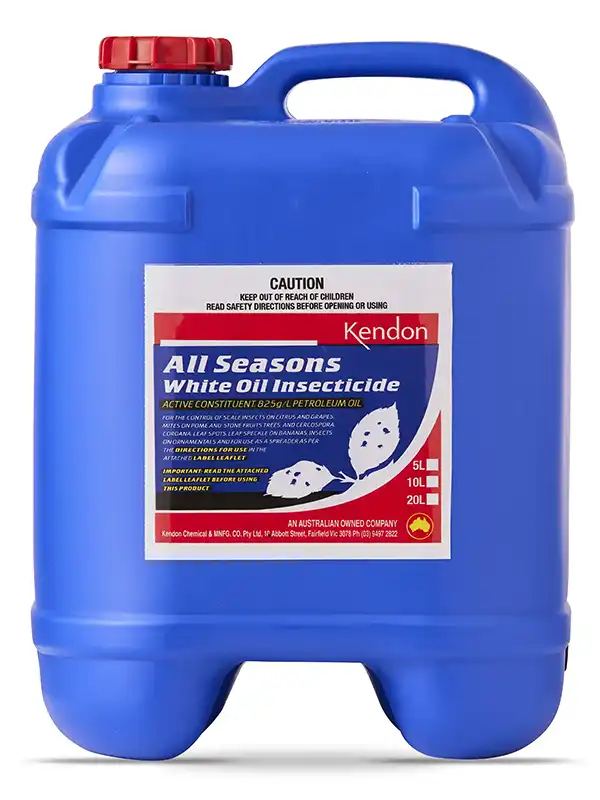
All Seasons White oil
For control of scale insects
Non-systemic acaricide, insecticide and adjuvant, active by contact. Effectively controls a variety of soft-bodied pests like aphids, mites, mealybugs, scale insects, citrus leaf miner on Citrus, other fruit trees, grapes, roses and ornamentals.
| All Seasons White Oil | |
|---|---|
Product Type |
Insecticide |
Active Ingredient |
825g/L Petroleum Oil |
Pack Size |
500ml, 1L, 5L, 20L |
Target Pests |
Aphids, mites, mealybugs, scale insects, citrus leaf miner on Citrus, Other Tree Crops, Grapes, Roses & Ornamentals |
APVMA Registration # |
49333
Search APVMA number at APVMA PubCRIS. |
Profile
First used as a pesticide in 1922. Toxic effects are physical, not chemical. May block spiracles of insects resulting in asphyxiation. Interacts with fatty acids resulting in disruption of cell membrane structure and function. Smothers fungi, reducing spore germination and stopping fungal growth.
Key Features & Benefits
- Broad-spectrum
- Rapid action
- Quick knockdown
- Environmentally friendly
- Low toxic as there is no residue
- One day withholding period on all edible produce, so it can be sprayed up to harvest
- Use on indoor plants, ornamental shrubs, Daphne, roses, deciduous fruit trees and citrus
- Enhancement of herbicidal activity as an adjuvant
Toxicity
Some plants can be phytotoxic to All season white oil. Therefore, must be used only during the dormant period.
Acute dermal (LD50, mg/kg) rabbits > 5000
What is Kendon All Seasons White Oil and what does it control?
Kendon All Seasons White Oil is an 825 g/L petroleum spray oil for control of scale insects on citrus and grapes, mites on pome and stone fruit trees, leaf diseases on bananas, and insects on ornamentals and other listed crops. It can also be used as a spray adjuvant (spreader) with certain pesticides, as outlined in the Directions for Use on the label and in the Application Guide on this page.
How should I mix and apply All Seasons White Oil?
Fill the spray tank with the required amount of clean water, then add Kendon All Seasons White Oil and agitate well, maintaining continuous agitation while spraying so the oil stays evenly dispersed. Apply as a thorough cover spray, wetting both sides of leaves and all branches, and use the Application Guide table below and the Directions for Use on the label to select the correct rate, spray volume and any tank‑mix partners for your crop, pest and region.
When should I use All Seasons White Oil on different crops?
Apply All Seasons White Oil when trees and plants are in good condition, typically 7–10 days after rain or irrigation, and never when soil is dry or plants are under moisture stress. Timing varies by crop and pest—for example, citrus is treated during active flush growth, pome and stone fruit from dormancy to green tip or bud swell, and bananas at defined intervals through the main disease risk period—so always consult the Application Guide and the Directions for Use on the label for crop‑specific timing.
Which crops and pests is All Seasons White Oil registered for?
All Seasons White Oil is registered for use on citrus (excluding some sensitive mandarin varieties), grapes, pome fruit, stone fruit, bananas, shade trees, shrubs, ornamentals and other listed plants. It controls a range of pests and diseases including soft and hard scales (such as red scale, white wax scale and pink wax scale), mites, citrus leafminer, mealy bugs and Cercospora, Cordana and leaf spot diseases on bananas, as detailed in the Application Guide table and on the product label.
Can I mix All Seasons White Oil with other garden chemicals?
All Seasons White Oil can be tank‑mixed with certain products where specified in the Application Guide and label, including mancozeb and Propicol 250EC on bananas, and methidathion, carbaryl, promecarb, soda ash or washing soda in some citrus scale programs, as well as being used as a spreader with parathion, malathion, thiram and ziram at low oil strengths. Do not mix it with sulphur or lime sulphur within at least one month, avoid combinations such as Sertin 186EC with methazole or ioxynil where crop damage may occur, and always check the Application guide accordion and the Directions for Use on the label to confirm which tank mixes are permitted and at what rates.
What is the withholding period for All Seasons White Oil?
The withholding period for All Seasons White Oil is one day, so it must not be applied later than one day before harvest on treated crops. Always follow the withholding period instructions in the Directions for Use on the label for each crop before picking or marketing produce.
Are there any restraints or phytotoxicity precautions I should know about?
Do not spray All Seasons White Oil when shade temperatures exceed 30 °C, when soil is dry, or when trees are suffering from moisture stress, as damage may occur. Oil can remove the glaucous (blue) bloom from some evergreens, should not be used on walnut foliage, and higher oil strengths must be timed carefully in relation to sulphur or lime sulphur sprays, so always check the restraints and precaution notes in the label Directions for Use.
Can I use All Seasons White Oil as a spreader?
Yes, All Seasons White Oil can be used as a spreader at 500 mL per 100 L of spray solution in the listed states to improve coverage when used with compatible pesticides such as parathion, malathion, thiram and ziram. Refer to the “As a spreader” row in the Application Guide and the Directions for Use on the label to confirm rates, compatible products and any restrictions.
What safety, storage and disposal steps should I follow?
Store All Seasons White Oil in the closed, original container in a cool, well‑ventilated place out of direct sunlight and out of reach of children, and do not dispose of undiluted chemical on site or into waterways. Triple‑rinse empty containers into the spray tank, then crush or puncture and dispose of them in accordance with local regulations, and if poisoning occurs contact a doctor or Poisons Information Centre on 13 11 26, following the first aid instructions on the label.
Where can I buy Kendon All Seasons White Oil?
APPLICATION GUIDE
Kendon All Seasons White Oil is a petroleum spray oil for scale, mites and listed leaf diseases on fruit trees, grapes, bananas, ornamentals and shrubs. For best results, only spray healthy, well‑watered plants and always follow the Directions for Use on the label and the Application Guide tables below for the correct rate, timing and spray volume.
Application guide (rates and timing)
Use this table with the product label to select the correct rate, timing and any tank‑mix partners for your crop and pest. Check state and regional restrictions carefully.
| Crop | Pest | State | Rate | Critical Comments |
|---|---|---|---|---|
| Citrus, except ‘Glen Retreat’ variety Mandarins | Citrus Leafminer | QLD, NSW, ACT, VIC, TAS, SA & WA | For control of
Citrus Leafminer use 500ml / 100L.
If there is also a need to control other pests eg. Red Scales, then use 500ml - 1L / 100L | During each flush cycle spray every 5 to 14 days. In summer and early autumn, spraying will be needed more frequently than in mid
to late autumn. Sprays must be applied thoroughly, ensuring that susceptible leaves are covered on both sides.
PRECAUTIONS: if petroleum spray oil is applied more than once from spring to autumn, either alone or in combination with other materials, the total strength of oil used in commercial orchards should not exceed 2L in Queensland and South Australia and 2.5L in NSW and Victoria. DO NOT spray citrus with sprays containing 1L to 1.2L product / 100L water before October or after mid March. DO NOT spray when the soil is dry: trees must not be suffering from moisture stress when sprayed. Ensure that oil-water mixtures held in spray tanks or containers during application are continually agitated or stirred to prevent the oil separating from the water. Petroleum oil sprays greater than 250ml product / 100L water should not be applied for at least one month after spraying with sulphur or lime sulphur, as severe injury may occur, especially if the oil is applied in hot weather. |
| Red Scale | VIC, SA & WA | 1.2L / 100L | Apply between mid December and mid March. | |
| NSW & ACT | 1.3L - 2L / 100L | |||
| QLD | 1L - 1.7L / 100L | Application late November to early December. Another application late January to early February if required. Tank mix with methidathion 50g / 100L. | ||
| White Wax Scale, Pink Wax Scale | VIC, WA | 1.2L / 100L | Apply between mid December and mid March. | |
| NSW & ACT | 1.3L - 2L / 100L | |||
| QLD | 1L / 100L | Application late November to early December. Another application late January to early February, if required. Tank mix with methidathion 50g/100L, carbaryl 70g/100L, promecarb 50g/100L, soda ash 500g-750g/ 100L or washing soda 500g-750g/100L. | ||
| Black Scale | TAS & WA | 1.8L - 2.5L / 100L | Application mid December to early January. Apply again in February. | |
| Soft Brown Scale | TAS & WA | 1.8L - 2.5L / 100L | Application January / April. | |
| Bananas | Cercospora Leaf Spot | NSW | 4L / Ha | Apply in combination with mancozeb at 2.4kg - 4.5kg / Ha in 200L - 500L of water. Apply at 3-4 week intervals from December until late April. In Nth QLD the intervals may be reduced to 10-14 days in the wet season. |
| QLD | 3.5L / Ha | |||
| Cercospora Leaf Speckle, Leaf Spot | NSW & Sth QLD | 12L / Ha | As above in a minimum of 12L of water. Starting in November, early December, apply as a mist at intervals of not more than 3 weeks until April. Spray both sides of leaves. | |
| NSW & Sth QLD | 5L / Ha | Apply with Propicol 250EC at 200ml - 400ml / Ha. Begin spraying in December and apply 4-5 times at 21 day intervals. If required, use alternative fungicides after this. Spray both sides of leaves. | ||
| Cercospora Leaf Spot, Leaf Speckle, Cordana Leaf Spot | Nth QLD | 5L / Ha | Apply with Propicol 250EC at 200ml - 400ml / Ha. Spray from the start of the wet season in December every two weeks for a maximum of 6 applications. If required, use alternative fungicides after this. Spray both sides of leaves. | |
| Scale Insects | QLD, NSW & WA | 2L / 100L | Use when heavy scale populations are present on foliage, fruit or stems. If trees need watering, do not apply. Efficacy is best against young crawler stages. | |
| Avocado | Scale Insects | QLD | 1.2L
OR 1.6L / 100L |
Use when heavy scale populations are present on foliage, fruit or stems. If trees need watering, do not apply. Efficacy is best against young crawler stages. |
| NSW & WA | 2L / 100L | |||
| Kiwi Fruit | Scale Insects | QLD | 1L - 1.6L / 100L | |
| NSW & WA | 2L / 100L | |||
| Custard Apple | Scale Insects | QLD | 1L - 1.7L / 100L | |
| NSW & WA | 2L / 100L | |||
| Mango | Scale Insects | QLD | 1.25L / 100L | |
| NSW & WA | 2L / 100L | |||
| Grapes | Grapevine Scale | QLD, NSW, ACT, VIC, SA & WA | 3L / 100L | Control is possible if the dormant vines are sprayed in winter, preferably after pruning. |
| Roses | Scale, Aphids, Mites & Mealy Bugs | All | 2L / 100L | Apply in winter after pruning and before bud burst or at other times when pests appear. |
| Shade Trees* and Shrubs, including Conifers, Deciduous, Broadleaf Evergreens and Woody Ornamentals, Ornamental Trees*. Shrubs along city streets, other rights of way, including Deciduous and Broadleaf Evergreens | Aphids, Scales (immature), Spider Mites, Whitefly (immature) | NSW, VIC, SA, WA & TAS | 2L - 4L (Winter) 1L - 3L (Summer) | Winter dormant period as needed for plants that
become dormant in winter. Summer (foliar or cover) as needed. * Oil removes the glaucous (blue ) from some evergreens. Always use lower dosage or test spray oil sensitive plants first. Do not spray Walnut foliage. |
| As a Spreader | All pests above | QLD, NSW, VIC, TAS, SA & WA | 500ml / 100L | Use in conjunction with parathion, malathion, thiram and ziram, if used at low oil strengths. Spray coverage is improved with the inclusion of Kendon All Seasons White Oil. |
- Always read the full Directions for Use on the label before spraying, including restraints, compatibility and regional recommendations.
- Do not spray when shade temperatures exceed 30 °C or when trees are suffering from moisture stress.
Spray volumes and additional instructions
These spray volume guidelines and notes help ensure thorough coverage and correct seasonal use when applying Kendon All Seasons White Oil.
| Pest | Sprayer | Volume of Spray (L/Ha) | ||
|---|---|---|---|---|
| 500ml** | 1L** | 2L** | ||
| Red Scale | Oscillating Boom with Outrigger | 8000-12000 | ||
| Airblast with Tower | 9000-14000 | |||
| Rotary Atomiser | 8000-12000 | |||
| Young Soft Scales | Oscillating Boom with Outrigger | 6000-10000 | 6000-10000 | |
| Airblast with Tower | 6000-10000 | 6000-10000 | ||
| Rotary Atomiser | 6000-8000 | 6000-8000 | ||
| Citrus Red Mite | Oscillating Boom with Outrigger | 7000-10000 | 5000-8000 | |
| Airblast with Tower | 7000-10000 | 5000-8000 | ||
| Rotary Atomiser | 7000-8000 | 4500-6500 | ||
| Rust Mites | Oscillating Boom with Outrigger | 7000-10000 | 5000-8000 | |
| Airblast with Tower | 7000-10000 | 5000-8000 | ||
| Rotary Atomiser | 7000-8000 | 4500-8000 | ||
| Citrus Leaf Miner | Oscillating Boom with Outrigger | 3000-4000 | ||
| Airblast with Tower | 3000-4000 | |||
| Rotary Atomiser | 3000-4000 | |||
| Young Mealy Bugs* | Oscillating Boom with Outrigger | 10000 | 10000-12000 | |
| Airblast with Tower | 10000 | 10000-14000 | ||
| Rotary Atomiser | 8000 | 8000-10000 | ||
| Greenhouse Thrips* | Oscillating Boom with Outrigger | 10000-12000 | ||
| Airblast with Tower | 10000-12000 | |||
| Rotary Atomiser | 8000-12000 | |||
- Spray volumes are based on mature, four‑metre orange trees (approximately 250 single‑planted or 500 double‑planted trees per hectare), and are intended to give thorough coverage of the whole canopy, including the tops of trees.
- Volumes shown in bold type indicate that the same spray may need to be applied twice in one season; volumes in normal type generally require only one spray per season under typical conditions.
- Where a range of spray volumes is given, the lower volume is suitable for low to medium infestations when natural enemies are active, while the higher volume is intended for heavy infestations and may also be used where fruit is being produced for fresh markets.
- * Single‑season applications, or the first of two sprays, for greenhouse thrips and mealy bugs should be made post‑harvest in late spring or early summer, before new season fruit starts to touch.
- ** Volume of Kendon All Seasons White Oil per 100 L of water. Runoff should not be considered as wastage, as it is generally better to apply higher spray volumes with less oil than lower volumes with more oil. Thorough coverage is very important and must include the tops of trees, and continuous agitation should be maintained while spraying.
BUY FROM
Our Distributors