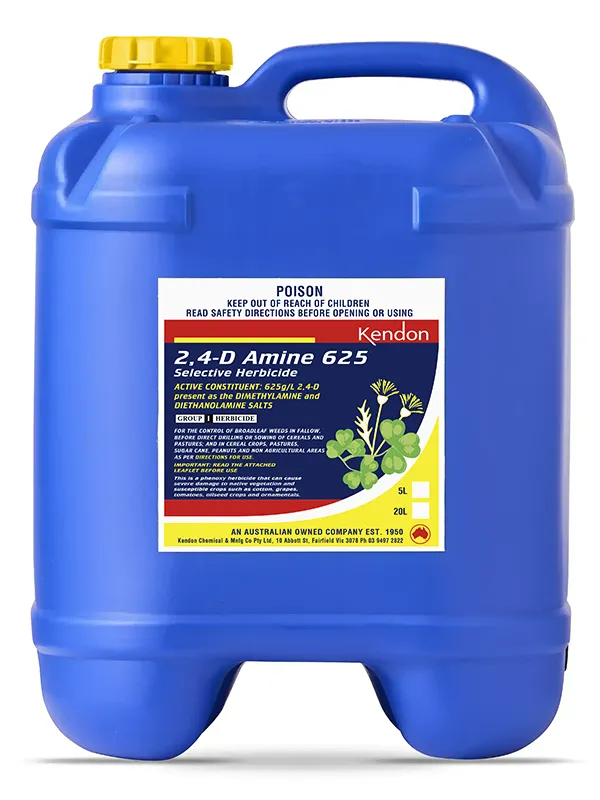
2,4-D Amine 625
Selective, systemic herbicide used for effective control of broadleaf weeds in fallow before direct drilling or sowing of cereals and pastures, and in cereal crops, pastures, sugar cane, peanuts and non-agricultural areas.
| 2,4-D Amine 625 Selective Herbicide | |
|---|---|
Target Weeds |
Capeweed, Thistles, Wild Radish and many other broadleaf weeds |
Product Type |
Herbicide |
Active Ingredient |
625g/L 2,4-D present as dimethylamine and diethanolamine salts |
Group |
I |
Pack Size |
1L, 5L, 20L |
APVMA Registration # |
60394
Search APVMA number at APVMA PubCRIS. |
Profile
- 2,4-D 625 Amine is first marketed in 1945
- Salt is readily absorbed by roots whilst esters are readily absorbed by the foliage, translocated throughout the plant via both the symplastic and apoplastic systems with accumulation primarily in the merismatic regions of shoots and roots
- Salt can also be a growth regulator at very small dose rates
Key Features & Benefits
- Proven Active Ingredient - Widely used herbicide to manage broad leaves
- Efficient high-Strength Formula
- Breaks down quickly in soil, leaving no long-term residues, (DT50 <1Day)
- Delivers broad-spectrum control at a competitive price
Toxicity
What is 2,4-D Amine 625 used for?
2,4‑D Amine 625 is a selective Group I herbicide used for controlling broadleaf weeds in fallow paddocks, before direct drilling or sowing of cereals and pastures, and in established cereal crops, pastures, sugar cane, peanuts and certain non‑agricultural areas when used as directed. It contains 625 g/L 2,4‑D present as the dimethylamine and diethanolamine salts.
What weeds does 2,4-D Amine 625 control?
2,4‑D Amine 625 controls a wide range of broadleaf weeds, including common problem species such as capeweed, wild radish, wild turnip, various thistles, Paterson’s curse, dock, doublegee, cape tulip and other weeds listed in the Directions for Use. The exact weeds controlled, and the best rate and timing, depend on the crop or pasture, the state, and the growth stage of both crop and weeds, so you must follow the weed tables on the Application Guide and Directions for Use for your specific situation.
In which crops and situations can I use it?
2,4‑D Amine 625 can be used:
- In fallow and stubble situations before sowing.
- Before direct drilling or sowing of winter cereals and pastures.
- In cereal crops such as wheat, barley, oats, cereal rye, triticale and millet.
- In pastures, including spray‑graze programmes.
- In sugar cane and peanuts, under specific timing and rate restrictions.
- In certain non‑agricultural situations such as rights‑of‑way and industrial areas, as per the Directions for Use.
Always check that your intended crop, situation and state are covered in the current Directions for Use before applying.
Can I use 2,4-D Amine 625 before sowing or direct drilling?
Yes. 2,4‑D Amine 625 can be used in fallows, stubble sprays and conservation tillage situations before sowing or direct drilling of cereals, grain legumes, canola and pastures where these uses are listed. You must observe the specified plant‑back periods and any additional restrictions for particular crops, states or dryland pre‑emergent uses.
Can 2,4-D Amine 625 be tank-mixed with other herbicides?
In some pre‑sowing and fallow situations, 2,4‑D Amine 625 may be tank‑mixed with other herbicides such as chlorsulfuron or paraquat‑based products (for example Sprayquat) as examples only where grasses are present and such mixtures are allowed. It may also be used in combination with other herbicides (for example certain dicamba or diuron products) where this is supported by the Directions for Use and the partner label.
Always check both product directions for the specific crop, rate, timing and tank‑mix compatibility before mixing and applying.
What are the key spray drift and sensitive crop warnings?
2,4‑D Amine 625 is a phenoxy herbicide and can cause severe damage to native vegetation and susceptible crops such as cotton, grapes, tomatoes, oilseed crops and ornamentals if spray drifts off target. Do not apply in a manner that may cause off‑target drift, do not spray unless wind speed at the application site is between 3 and 20 km/h, and do not apply under hazardous surface temperature inversion conditions. You must also observe any specified buffer distances and equipment requirements for boom spraying or aerial application given in the Directions for Use.
What protective clothing and equipment do I need?
When opening containers, preparing spray or handling undiluted concentrate, you must wear chemical‑resistant waterproof clothing over normal clothing, a washable hat, elbow‑length chemical‑resistant gloves, impervious footwear and a full face‑piece respirator with an organic vapour/gas cartridge or canister.
For application:
- With enclosed‑cab boom spray equipment with air filtration, or for aerial application, wear cotton overalls buttoned to the neck and wrist (or equivalent clothing) and elbow‑length chemical‑resistant gloves.
- With open‑cab boom spray equipment or hand‑held equipment, wear chemical‑resistant waterproof clothing over normal clothing, a washable hat, elbow‑length chemical‑resistant gloves and a full face‑piece respirator.
After use, wash exposed skin and contaminated clothing as directed in the safety directions.
What grazing and re-entry restrictions apply?
For pasture and cereal crops, stock must not graze or be fed cut fodder from treated areas for 7 days after application. In fallow situations, treated areas should not be grazed, cut or cultivated for at least 21 days after spraying. For sugar cane, workers must not hand‑harvest for at least 1 day after application, and if early re‑entry is required before spray deposits have dried, suitable clothing and water‑resistant footwear should be worn as specified.
How should I store and dispose of 2,4-D Amine 625?
Store the product in the closed, original container in a cool, well‑ventilated area, and do not store it for prolonged periods in direct sunlight. Triple‑rinse containers before disposal, adding rinsings to the spray tank, and do not dispose of undiluted chemical on site. Clean containers with the drumMUSTER logo that are dry and free of residues may be recycled through an approved programme; otherwise dispose of empty containers at an approved waste management facility, or in a disposal pit set up in accordance with local regulations where this is permitted.
What should I do in case of poisoning or a spill?
If poisoning occurs, contact a doctor or Poisons Information Centre immediately on 13 11 26 in Australia. Additional safety and spill response information is available in the Safety Data Sheet, and Kendon can provide specialist emergency advice on (03) 9497 2822; in a transport emergency you should dial 000 for police or fire brigade.
Where can I find full Directions for Use and safety information?
Full use instructions, including weed tables, crop‑ and state‑specific use patterns, application restraints, plant‑back periods, spray‑drift restrictions, safety directions, first aid and storage and disposal instructions are provided in the Directions for Use leaflet supplied with 2,4‑D Amine 625. Always read and follow this documentation before using the product in any crop or situation.
Where can I buy 2,4‑D Amine 625?
APPLICATION GUIDE
This Application Guide brings together the main use patterns for 2,4-D Amine 625 across fallow, cereals and grain crops, sugar cane, peanuts, harvest-aid use in winter cereals, pastures and spray-graze programmes, and non-crop or non-agricultural areas.
Each section is designed to help users quickly find the relevant crop or situation, typical rate range, and the main timing or use notes drawn from the current Directions for Use. It is intended as a practical navigation aid only and must always be used together with the full product label, including all restraints, withholding periods, spray drift requirements, grazing directions and appendices.
Fallow and pre-sowing uses
2,4-D Amine 625 is used in fallow and pre-sowing programmes to control broadleaf weeds before planting winter cereals, grain legumes, canola and pastures in approved situations. Use it as part of a planned fallow or stubble spray and always follow the plant-back periods and restraints in the current Directions for Use.
This product controls a range of broadleaf weeds commonly found in fallows and before sowing, including species such as capeweed, wild radish, wild turnip, thistles and many other broadleaf weeds listed in the Directions for Use. The best rate depends on the crop to be sown, the target weeds, their growth stage and your state or region.
| Situation / Crop | Target Weeds | State | Rate / Ha | Critical Comments |
|---|---|---|---|---|
| Fallow and pre-sowing before winter cereals, grain legumes, canola and pastures (including peanuts in suitable regions) | Broadleaf weeds such as capeweed, wild radish, wild turnip, thistles and other weeds listed for this use | All applicable States | 225mL – 1.7L | Select the rate according to the target weeds, their size and density, and the crop to be planted. Observe all plant-back periods and any crop- or state-specific restrictions in the Directions for Use. |
| Fallow or pre-sowing where grass weeds are also present | Broadleaf weeds in mixed infestations with grass weeds (as listed in the Directions for Use) | As specified in Directions for Use | As per selected use rate | May be tank-mixed with suitable partner herbicides such as chlorsulfuron, Kendon Sprayquat 250, dicamba, diuron and paraquat/diquat formulations where these uses are permitted. Always check the Directions for Use for both products to confirm the crop, rate, timing and tank-mix compatibility before mixing and applying. |
| Skeleton weed in fallow prior to sowing | Skeleton weed | As specified in Directions for Use | Refer to weed table for rate | Apply 6–8 weeks before the planned sowing date and keep subsequent cultivation to a minimum to support control. Follow any additional restraints and use patterns given for skeleton weed in the Directions for Use. |
Important notes:
- Do not apply if heavy rain or storms are forecast within 3 days.
- Do not irrigate to the point of runoff for at least 3 days after application.
- Do not apply if crops or weeds are stressed by dry or excessively wet conditions.
- Always use this Application Guide together with the full Directions for Use to confirm the correct rate, spray volume, timing and any tank-mix partners for your crop, weeds and region.
Cereals and grain crops
2,4-D Amine 625 is used in post-sowing programmes in wheat, barley, oats, cereal rye, triticale and millet to control a range of broadleaf weeds in approved situations. Apply only within the crop growth stages and rates specified for your state, and always follow the Directions for Use.
This product controls broadleaf weeds commonly found in cereal crops, including species such as capeweed, wild radish, wild turnip, thistles and many other weeds listed in the Directions for Use. The best rate depends on the crop, target weeds, their growth stage and your state or region, so always match the rate and timing to your specific situation.
| Situation / Crop | Target Weeds | State | Rate / Ha | Critical Comments |
|---|---|---|---|---|
| Wheat | Broadleaf weeds (refer to weed table) | NSW, ACT, SA, VIC, QLD, TAS |
NSW, ACT, SA: 320mL – 1.7L VIC: 225mL – 1.4L QLD: 560mL – 1.4L TAS: 800mL – 1.4L |
Apply after the first node can be felt at the base of a tiller and before swelling of the head can be felt in a tiller (NSW, SA). In VIC apply from tillering to boot stage; in QLD from mid tillering to before boot stage; in TAS from 5 leaf to fully tillered. Use the weed table to select a rate suited to weed species and size. |
| Barley | Broadleaf weeds (refer to weed table) | NSW, ACT, SA, VIC, QLD, TAS |
NSW, ACT, SA: 320mL – 1.4L VIC: 225mL – 1.4L QLD: 560mL – 1.4L TAS: 800mL – 1.4L |
Apply within the barley growth stages corresponding to the wheat timings above for the relevant state. Use higher rates for larger or denser infestations as indicated in the weed table. |
| Cereal rye and triticale | Broadleaf weeds (refer to weed table) | NSW, ACT, SA, VIC |
NSW, ACT, SA: 320mL – 1.4L VIC: 225mL – 1.4L |
Apply during the recommended post-emergent period for these crops in your state, following the same timing principles as wheat and barley. Select rates using the weed table for the weeds present and their growth stage. |
| Oats | Broadleaf weeds (refer to weed table) | NSW, ACT, SA, VIC |
NSW, ACT, SA: 320mL – 800mL VIC: 225mL – 800mL |
Apply in the nominated growth window for oats in each state. Use the lower end of the rate range on young, actively growing weeds and the higher end on larger or denser infestations, in line with the weed table. |
| Cereals (wheat, oats, barley) – Cape tulip and listed weeds (WA only) | Cape tulip, docks, flatweed, saffron thistle, Indian hedge mustard, London rocket, lupin, matricaria, Rapistrum, wild radish, wild turnip, capeweed, doublegee, erodium and other listed species | WA only |
640mL – 1.3L (Cape tulip) and up to 1.1L, 800mL or 640mL as per weed table |
For Cape tulip, apply from the 5 leaf stage up to jointing (Zadoks 15–33). Apply after the 6 leaf stage (Z.16) for Cranbrook, Jacup, Aroona and Spear wheat and Mortlock oats to avoid crop damage. Do not spray if lucerne is present. Weed stage should generally be 10–15cm, and docks should be sprayed before the 5 leaf stage. Follow weed-table rates for each listed species. |
| Wheat and barley – wild radish | Wild radish | VIC, SA, ACT, NSW | 80mL + partner herbicide as directed | Apply 2–6 weeks after sowing and not later, and only where compatible partner herbicides are registered for this use. Do not use in crops undersown with lucerne. Follow the partner product label as well as the Directions for Use for this product. |
| Millet and related crops | Broadleaf weeds (refer to weed table) | NSW, ACT, VIC, SA, QLD |
NSW, ACT, VIC, SA: 560mL – 1.1L QLD: 560mL – 900mL |
Spray when secondary roots have developed, when plants are fully tillered and before heads start to form at the base of the tillers. Do not use on Panorama millet or Panicum. Use weed-table guidance to select the rate within the range. |
Important notes:
- Use only on crops and varieties for which this product is registered in your state.
- Do not apply outside the crop growth stages listed in the Directions for Use.
- Use the weed table to match the rate to weed species, size and density.
- Always use this Application Guide together with the full Directions for Use to confirm the correct rate, spray volume, timing and any tank-mix partners for your crop, weeds and region.
Sugar cane uses
2,4-D Amine 625 is used in sugar cane to control a range of broadleaf vines and weeds, including bell vine, morning glory, convolvulus-type species, Bindy Eye (Star Burr), Blue top and other listed species, in approved regions and varieties. Use only on varieties and in districts where this use is supported, and always follow the timing restrictions in Appendix 3 of the Directions for Use.
Rates, timings and varietal restrictions for sugar cane depend on the target weeds, local region (for example Wet Tropics, Burdekin, Mackay–Whitsunday, Mary–Burnett) and cane variety (for example Q80, Q96, H56). Some uses are not supported in certain regions or varieties. Always match the rate and timing to the weeds present, the cane growth stage and the regional timing restrictions in Appendix 3.
| Situation / Crop | Target Weeds | State / Region | Rate / Ha | Critical Comments |
|---|---|---|---|---|
| Sugar cane (Q80, Q96, H56 and other listed varieties) | Bell vine | QLD & NSW (as per Directions for Use) | 280mL / 100L water | Apply in spring using directed spray equipment, targeting the vine foliage while minimising contact with cane leaves. Follow Appendix 3 for any regional timing restrictions that apply to the variety and district. |
| Sugar cane – established crop | Morning glory | QLD & NSW (as per Directions for Use) | 560mL – 1.1L / Ha | Apply in summer using high-clearance tractor equipment, ensuring good coverage of the vine foliage. Check Appendix 3 for any restrictions on timing in your region. |
| Sugar cane – aerial application | Pink convolvulus, Star of Bethlehem | QLD & NSW (as per Directions for Use) | 1.1L / Ha | Apply in autumn by suitable aircraft misters. Observe all spray drift restraints and buffer zones for aircraft, and follow Appendix 3 timing restrictions for spraying sugar cane in your region. |
| Sugar cane – Bindy Eye and associated weeds | Bindy Eye (Star Burr), Blue top (Blue heliotrope), cobblers pegs, fleabanes, jute, Leucas, needle burr, spear thistle, water primrose, Ipomoea vines, convolvulus vines, Chinese mint, Blue snakeweed | QLD & NSW (as per Directions for Use) | 1.8L – 3.5L / Ha (up to 3.5L for heavy infestations) | Add 60–120mL non-ionic surfactant per 100L of spray mixture and agitate well. Do not use on cane varieties Q63, Q67, Q80 or Q96 where this is stated. Usage restrictions apply – refer to Appendix 3 for permitted timing in regions such as the Wet Tropics, Burdekin, Mackay–Whitsunday, Mary–Burnett and for any districts where use is not supported. |
Important notes:
- Usage restrictions apply in sugar cane; always consult Appendix 3 for timing rules in your region.
- Do not use on cane varieties where the Directions for Use state that this product is not supported (for example some Q varieties).
- Observe all spray drift restraints and buffer zones for boom and aircraft applications when spraying sugar cane.
- Always use this Application Guide together with the full Directions for Use and Appendix 3 to confirm the correct rate, spray volume, timing, cane variety and any regional limitations.
Peanuts – band and overall sprays
2,4-D Amine 625 is used in peanuts to control broadleaf weeds and certain grass weeds in band-sprayed and overall pre-emergent programmes in approved regions. Uses are subject to specific timing restrictions and usage conditions, so always consult Appendix 1 and the Directions for Use before applying in peanuts.
In peanuts, this product controls broadleaf weeds (except Noogoora burr) and grass weeds (except Mossman burr) when used at the correct rate and timing. The choice between band spraying and overall spraying, and the rate within the range, depends on whether the crop has emerged, the weed spectrum, soil and seasonal conditions, and the timing rules for your region.
| Situation / Crop | Target Weeds | State / Region | Rate / Ha | Critical Comments |
|---|---|---|---|---|
| Peanuts – band spray after planting | Broadleaf weeds (except Noogoora burr) | QLD & NT (as per Directions for Use) | 1.8L – 3.6L / Ha (band equivalent) | Lower rate: apply as a band spray as soon as possible after planting in a 55cm band over the seed row. Ensure accurate band width and nozzle setup so the band rate matches the intended per-hectare dose. Usage restrictions and timing rules apply – see Appendix 1 for regional timing for dryland and irrigated peanuts. |
| Peanuts – overall pre-emergent spray | Grasses (except Mossman burr) and broadleaf weeds listed for this use | QLD & NT (as per Directions for Use) | Within 1.8L – 3.6L / Ha range as directed | Higher rate: apply as an overall spray after planting and before crop emergence. Some crop damage may occur if heavy rain falls between application and crop emergence. Follow Appendix 1 timing restrictions for specific regions (for example Cape York, Northern Gulf and Northern Territory) and ensure the soil surface is even and free from large clods at application. |
Important notes:
- Usage restrictions and timing rules apply in peanuts; always consult Appendix 1 before spraying.
- Do not apply to peanuts outside the listed regions or time windows in the Directions for Use.
- Monitor crops closely where heavy rain occurs between application and emergence, as some crop damage may occur.
- Always use this Application Guide together with the full Directions for Use and Appendix 1 to confirm the correct rate, spray volume, band width, timing and any regional limitations.
Harvest aid / salvage spray in winter cereals
2,4-D Amine 625 can be used as a harvest aid or salvage spray in winter cereals to help desiccate broadleaf weeds prior to harvest in approved situations. This use is restricted to specific growth stages and rates, and is not a substitute for normal in-crop weed control.
The harvest aid application targets surviving broadleaf weeds late in the season to assist with harvesting and reduce contamination from problem species. Timing is critical – sprays must only be applied once the crop has reached the dough stage, and all withholding periods and harvest intervals must be observed.
| Situation / Crop | Target Weeds | State | Rate / Ha | Critical Comments |
|---|---|---|---|---|
| Harvest aid / salvage spray – winter cereals | Desiccation of broadleaf weeds in winter cereals | All States (where listed) | 1.2L – 1.7L | Apply after the crop reaches the dough stage, as a harvest aid or salvage spray to desiccate surviving broadleaf weeds. Do not apply earlier than the specified growth stage. Observe all withholding periods and any specific harvest or grazing intervals given in the Directions for Use before cutting or grazing treated crops. |
Important notes:
- Use only as a salvage or harvest-aid treatment in winter cereals, not as a routine in-crop spray.
- Apply strictly after the dough stage as specified; earlier applications may damage yield or quality.
- Observe all label restraints, spray drift requirements and withholding periods before harvest or grazing.
- Always use this Application Guide together with the full Directions for Use to confirm the correct rate, timing, and any harvest or grazing intervals for your situation.
Pastures – spray‑graze techniques
2,4-D Amine 625 is used in established pastures to control a range of broadleaf weeds and thistles, including through spray-graze programmes in southern states. These uses rely on both correct spraying and follow-up grazing pressure, and are subject to specific usage restrictions and timing rules, so always consult Appendix 2 and the Directions for Use before applying to pastures.
In pastures, target weeds include Amsinckia, capeweed, doublegee, mustards, Paterson's curse, wild turnip, wild radish, docks, geranium, erodium and a range of annual and spear thistles, as listed in the Directions for Use. Effective control depends on weed growth stage, correct rate selection, and maintaining the recommended high stocking rates after spraying.
| Situation / Crop | Target Weeds | State | Rate / Ha | Critical Comments |
|---|---|---|---|---|
| Pastures – spray-graze programme (SA) | Amsinckia, thistles, capeweed, doublegee, mustards, Paterson's curse, wild turnip, wild radish, docks, geranium, erodium | SA only | 560mL / Ha | Apply from 6 weeks after the opening autumn rains and continue until the end of August. Seven days after spraying, stock the paddock at 4–5 times the normal rate, preferably with sheep, and maintain this level of grazing for around 6 weeks or until the pasture shows signs of overgrazing. Then return to normal stocking levels. See Appendix 2 for full spray-graze timing guidance. |
| Pastures – spray-graze (VIC & TAS) | Annual thistles, capeweed, doublegee, mustards, Paterson's curse, turnip, saffron thistle, spear thistle, geranium, slender thistle | VIC & TAS only | Within label rate range (refer to Table 3) | Apply to actively growing weeds at the recommended growth stage as per Table 3, then implement high stocking rates in the following spring to prevent weeds from flowering. Repeat spray-graze treatments may be required for 2–3 years to achieve complete control. See Appendix 2 for application and timing restrictions for pastures. |
| Pastures – spray-graze (WA) | Amsinckia, seedling docks, capeweed, doublegee, mustard, wild radish, wild turnip, Paterson's curse, annual thistles, spear thistle, saffron thistle | WA only | 600mL – 800mL / Ha (up to 1.2L for some thistles) | Apply to actively growing weeds at the stages specified in Table 3. For saffron thistle, apply at about 1.2L/Ha at the end of September when plants are running up to flower. Sub‑clovers may be damaged at this rate and use is not recommended for all medic pastures. Heavy stocking on young melons sprayed with 1.6L/Ha plus 800mL/Ha and 1% oil provides effective control. Follow all usage restrictions and spray-graze notes in Appendix 2. |
Important notes for pastures and spray-graze:
- Spray-graze programmes can increase the amount of poisonous plants eaten by stock (for example Caltrop, capeweed, Paterson's curse, variegated thistle), and deaths can result from causes such as nitrate poisoning; use care when planning grazing.
- With Paterson's curse, preferably graze stock soon destined for slaughter and avoid extended grazing; avoid grazing with young or breeding stock and do not graze horses or pigs on Paterson's curse.
- Always follow Appendix 2 for application and timing restrictions for pastures, including recommended stocking rates and duration.
- Always use this Application Guide together with the full Directions for Use and Appendix 2 to confirm the correct rate, spray volume, timing, grazing strategy and any regional limitations.
Non‑crop, non‑agricultural areas, roadsides and rights‑of‑way
2,4-D Amine 625 is used in non-crop situations such as agricultural non-crop areas, commercial and industrial sites, roadsides, rights-of-way and other non-agricultural areas to control a range of broadleaf weeds. These uses help manage problem weeds in fence lines, around buildings, in transport corridors and in other areas where crop selectivity is not required.
Target weeds in non-crop areas include thistles, capeweed, Paterson's curse, wild radish, wild turnip, docks and other broadleaf species listed in the Directions for Use, as well as Pimelea spp. in specific districts. Rates and timing vary with the weed species, growth stage and the sensitivity of nearby crops, pastures and native vegetation, so always follow the Directions for Use carefully.
| Situation / Use Area | Target Weeds | State / Region | Rate / Ha | Critical Comments |
|---|---|---|---|---|
| Agricultural non-crop areas, commercial and industrial areas, roadsides and rights-of-way | Broadleaf weeds including thistles, capeweed, Paterson's curse, wild radish, wild turnip, docks and other species listed for non-agricultural areas | All States where use is permitted | Within label rate range (refer to Table 3 and weed table) | Apply to actively growing weeds, selecting the rate according to weed species, size and density. Use calibrated ground equipment and avoid drift onto sensitive crops, pastures and native vegetation. Observe all spray drift restraints, buffer zones and no-spray areas specified for non-agricultural uses. |
| Non-agricultural areas – Pimelea spp. | Pimelea species (as listed in the Directions for Use) | Relevant districts only (refer to label) | Up to 800mL / Ha (as directed) | Apply to actively growing Pimelea plants at the growth stages specified for your district. Consult local advice where Pimelea is a serious problem and follow any specific regional guidance on timing and pasture management after spraying. Avoid grazing stock on treated areas until Pimelea plants have sufficiently broken down, as per the Directions for Use. |
Important notes for non-crop and non-agricultural areas:
- Always observe spray drift restraints, buffer zones and no-spray areas when treating roadsides, rights-of-way and other public places, and comply with any local government or authority requirements for weed control in public areas.
- Take particular care near sensitive crops, pastures, waterways and native vegetation, as 2,4-D can cause severe damage to susceptible species such as cotton, grapes, tomatoes, oilseeds and ornamentals.
- When treating Pimelea or other poisonous plants, follow all grazing and re-entry directions in the label to protect livestock.
- Always use this Application Guide together with the full Directions for Use (including Table 3 and the weed table) to confirm the correct rate, spray volume, timing and any regional or access restrictions.
BUY FROM
Our Distributors