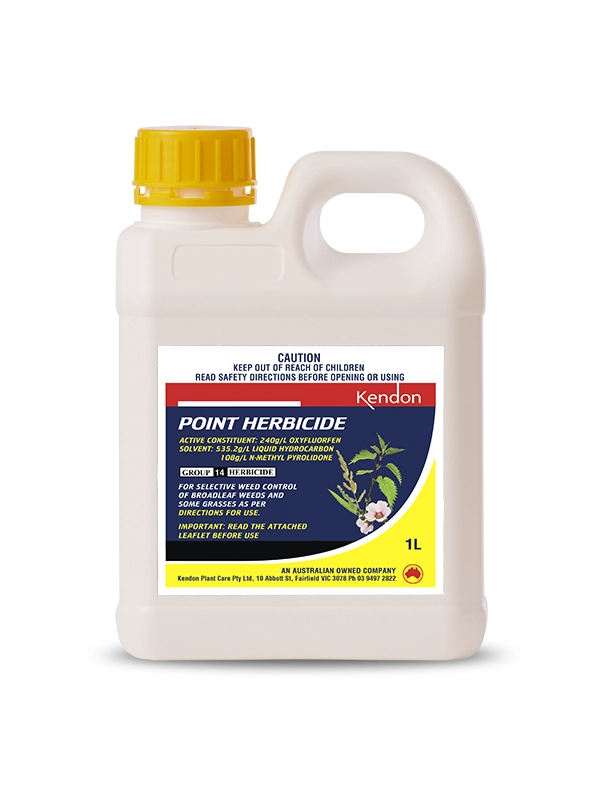
Point Herbicide
Selective, contact pre- and early post-emergent herbicide formulated for broad-spectrum control of annual broadleaf and grassy weeds. Ideal for use in orchards, vineyards, fallow land, and non-crop areas.
| Point Herbicide | |
|---|---|
Target |
Common broadleaf and grass weeds, before germination or during seedling stage |
Product Type |
Herbicide |
Active Ingredient |
240g/L Oxyfluorofen |
Group |
G |
Pack Size |
1L, 2.5L, 5L |
APVMA Registration # |
53222
Search APVMA number at APVMA PubCRIS. |
Profile
First marketed in 1976. Oxyfluorfen is primarily absorbed through the foliage and young shoots, with minimal uptake through the roots and limited movement within the plant. It works by inhibiting the enzyme protoporphyrinogen oxidase (PPO), leading to the build-up of light-sensitive porphyrins. When exposed to light, these compounds react with oxygen to produce reactive oxygen species that damage cell membranes through lipid peroxidation, ultimately causing the plant cells to break down and die.
Key Features & Benefits
- Pre- and Post-Emergent Action: Controls weeds both before and after germination for flexible application.
- Residual Control: Forms a protective layer in the soil, preventing new weeds from emerging for extended periods.
- Broad-Spectrum Activity: Effective against a wide range of broadleaf and some grassy weeds.
- Low Water Solubility: Minimises leaching, ideal for long-lasting action in stable conditions.
Toxicity
Phytotoxicity – Soybeans and cotton may be injured by contact Oxyfluorfen. Acute oral Mammalian Toxicity (LD50, mg/kg) rats > 5000; dogs > 5000
APPLICATION GUIDE
Application Guide
POINT Herbicide is a selective, contact pre- and early post-emergent herbicide. It controls a broad spectrum of annual broadleaf weeds and some annual grasses, both before germination and at the seedling stage up to 4 to 6 true leaves. Activity is primarily through foliage and young shoots, with minimal uptake through roots. The tables below provide registered crop situations, application rates, and critical comments drawn directly from the APVMA-registered product label.
General instructions — apply to all situations:
- Soil condition: Best results are achieved when applied to moist soil. Where soil is dry, irrigation or rainfall is required prior to application for activation.
- Drift restraint: Do not apply under conditions that may cause spray to drift onto nearby waterbodies, susceptible plants or crops, cropping lands or pastures.
- Waterways and environment: This product is highly toxic to wildlife and fish. Do not contaminate streams, rivers or waterways with the chemical or used containers.
- Grazing: Do not graze treated weeds.
- Resistance management: POINT Herbicide is a Group G herbicide (Diphenyl ether — PPO inhibitor). Rotate with herbicides from other groups as part of an integrated weed management programme.
Select the accordion section below that matches your crop situation and refer to the rate column and critical comments for your specific application.
WEEDS CONTROLLED LIST
Weeds Controlled by POINT Herbicide
The accordion sections below reference this list. Check your target weed here before selecting your crop situation.
| Before Germination | Seedlings (less than 4 true leaves) |
|---|---|
| Amsinckia Amsinckia spp. | Amsinckia Amsinckia spp. |
| Barley grass Hordeum leporinum | Bellvine Ipomoea spp. |
| Barnyard grass Echinochloa spp. | Capeweed Arctotheca calendula |
| Blackberry nightshade Solanum nigrum | Common cotula Cotula australis |
| Bladder ketmia Hibiscus trionum | Crowsfoot grass Eleusine indica |
| Burrgrass Cenchrus australis | Deadnettle Lamium amplexicaule |
| Caltrop Tribulus terrestris | Groundsel Senecio vulgaris |
| Capeweed Arctotheca calendula | Liverseed grass Urochloa panicoides |
| Chickweed Stellaria media | Marshmallow Malva parviflora |
| Crowsfoot grass Eleusine indica | Pigweed Portulaca oleracea |
| Deadnettle Lamium amplexicaule | Potato weed Galinsoga parviflora |
| Fat hen Chenopodium album | Redshank Amaranthus cruentus |
| Giant pigweed Trianthema portulacastrum | Shepherd's purse Capsella bursa-pastoris |
| Liverseed grass Urochloa panicoides | Sowthistle Sonchus oleraceus |
| Lovegrass Eragrostis spp. | Stinging nettle Urtica urens |
| Pigeon grass Setaria spp. | Stinkgrass Eragrostis cilianensis |
| Pigweed Portulaca oleracea | Wild radish Raphanus raphanistrum |
| Prickly lettuce Lactuca spp. | |
| Red Natal grass Rhynchelytrum repens | |
| Redshank Amaranthus cruentus | |
| Ryegrass Lolium spp. | |
| Sesbania pea Sesbania cannabina | |
| Shepherd's purse Capsella bursa-pastoris | |
| Smallflower mallow Malva parviflora | |
| Soursob Oxalis pes-caprae | |
| Sowthistle Sonchus oleraceus | |
| Starburr Acanthospermum hispidum | |
| Stinkgrass Eragrostis cilianensis | |
| Summer grass Digitaria spp. | |
| Thornapple Datura stramonium | |
| White eye Richardia brasiliensis | |
| Wild mustard Sisymbrium spp. | |
| Wild radish Raphanus raphanistrum | |
| Wireweed Polygonum aviculare |
Note: Chickweed is listed as controlled before germination but POINT Herbicide will not provide consistent control of chickweed in pyrethrum.
How to use this Application Guide
- Confirm your target weed appears in the Weeds Controlled list above.
- Select the accordion section below that matches your crop or situation.
- Check the Time of Application column — apply to weed free soil for pre-emergent residual control, or follow the stated crop growth stage for early post-emergent control.
- Use the Rate column for your situation, noting any lower/higher rate guidance in the Critical Comments.
- Read all Critical Comments before mixing or applying — they contain crop safety restraints, tank mix instructions and DO NOT statements specific to that situation.
Treefruit, Nuts and Vines
Apply as a dormant application to trees, nuts and vines not less than 3 years old. Do not apply once bud swell has occurred. Choose the application method below based on weed status at the time of spraying.
| Crop Situation | Weeds Controlled | Time of Application | Rate | Critical Comments |
|---|---|---|---|---|
| Treefruit, Nuts and Vines not less than 3 years old DORMANT APPLICATION Almonds, Apples, Apricots, Grape Vines, Macadamias, Peaches, Pears, Pecans, Plums, Walnuts |
Refer to Weeds Controlled list | Weed free soil | 3 or 4L/ha | DO NOT apply POINT Herbicide once bud swell has occurred. Apply to freshly cultivated weed free soil. Use the higher rate when longer residual control is required (up to 4 months). Where grass weeds are expected to be a major problem, or when control of a wider weed spectrum is required, mix the lower rate with 4.5L SURFLAN 500 per treated hectare. |
| Emerged weeds present | DO NOT apply POINT Herbicide once bud swell has occurred. Use the higher rate when longer residual control is required (up to 4 months). When light infestations of weeds are present, apply as a tank mix with KnockOut 360 (or similar glyphosate formulation) to produce both knockdown and residual control. Where weed growth is large and dense, weeds must be eliminated prior to application of POINT Herbicide, using KnockOut or mechanical means. |
|||
| Almonds, Apples, Apricots, Grape Vines, Macadamias, Peaches, Pears, Pecans, Plums, Walnuts | Refer to KnockOut label | Apply as a tank mix with KnockOut | 75mL/ha plus KnockOut at recommended label rates | Addition of POINT Herbicide to KnockOut (glyphosate 360g/L) will improve knockdown and increase the speed at which treated weeds develop visible symptoms of phytotoxicity, and give control of annual Nettles, Urtica spp. and Marshmallow, Malva parviflora. For rates of KnockOut, refer to the appropriate label. DO NOT apply the tank mix of KnockOut and POINT near trees or vines less than 3 years old unless they are effectively shielded from spray and spray drift. |
Apply POINT Herbicide as a directed treatment to the base of tree and vine crops following the Application Guide above.
Always download and read the current product label before use and follow all regulatory and safety instructions.
Tropical and Sub-Tropical Fruit
Registered for use under Avocado, Custard Apple, Kiwi Fruit, Longan, Lychee, Mango, Passionfruit, Pawpaw and Rambutan. Choose the application method below based on weed status at the time of spraying.
| Crop Situation | Weeds Controlled | Time of Application | Rate | Critical Comments |
|---|---|---|---|---|
| Tropical and Sub-Tropical Fruit (Inedible Peel) Avocado, Custard Apple, Kiwi Fruit, Longan, Lychee, Mango, Passionfruit, Pawpaw, Rambutan |
Refer to Weeds Controlled list | Weed free soil | 4L/ha | Best results are obtained when applied to moist soil free of weeds. |
| Emerged weeds present | Apply as a tank mix with recommended rates of KnockOut (glyphosate 360g/L), SPRAYQUAT or Spray-Seed. Read and follow all label directions. |
Apply POINT Herbicide as a directed treatment following the Application Guide above.
Always download and read the current product label before use and follow all regulatory and safety instructions.
Brassica Crops
Apply to prepared ground prior to transplanting of Broccoli, Cabbages and Cauliflower. Minimise soil disturbance after application.
| Crop Situation | Weeds Controlled | Time of Application | Rate | Critical Comments |
|---|---|---|---|---|
| Brassica Crops Broccoli, Cabbages, Cauliflower |
Refer to Weeds Controlled list | Weed free soil — apply to prepared ground 4 to 7 days prior to transplanting | 1.5 to 2L/ha | Apply to prepared ground 4 to 7 days prior to transplanting. If soil is dry, irrigation or rainfall is required prior to transplanting for activation. Utilise transplanting techniques which cause minimal soil disturbance. Excessive soil disturbance will lessen herbicidal activity. Use the higher rate where weed pressure is known to be heavy. |
Apply POINT Herbicide following the Application Guide above.
Always download and read the current product label before use and follow all regulatory and safety instructions.
Onions (Seeded)
Two sequential applications are registered for seeded onions. The total dose must not exceed 2L/ha in one season. Best results are obtained when the hook leaf stage treatment is followed by a further application at the 1½ to 2½ true leaf stage.
| Crop Situation | Weeds Controlled | Time of Application | Rate | Critical Comments |
|---|---|---|---|---|
| Onions (seeded) | Black nightshade | Hook leaf stage | 50–100mL/ha | Do not exceed 100mL/ha at the hook leaf stage as excessive crop damage may occur. |
| Dock, Crowfoot, Fumitory (Pinkweed), Hogweed (Wireweed), Plantain, Sorrel, Volunteer Potato, Potato Weed, Milk Thistle, Deadnettle, Common Cotula, Groundsel | 1½ to 2½ true leaf stage | 350–500mL/ha | Apply in at least 100L/ha water at pressures below 150kPa. DO NOT exceed 150kPa pressure as excessive crop damage could result. Multiple treatments may be applied provided the total dose does not exceed 2L/ha in one season. For control of other weeds, use in a programme with other registered herbicides. NOTE: Can cause flecking, twisting or stunting of onion plants although such symptoms are normally short-lived. DO NOT apply in conditions of very high humidity. DO NOT apply to weeds or crops stressed by prevailing weather conditions, disease or mechanical damage. DO NOT use wetting agents or other adjuvants. |
Apply POINT Herbicide following the Application Guide above.
Always download and read the current product label before use and follow all regulatory and safety instructions.
Tobacco
For weed control along spray lines only. POINT Herbicide must not be applied directly to the tobacco crop. Apply to soil after the solid-set irrigation system has been laid out in the field.
| Crop Situation | Weeds Controlled | Time of Application | Rate | Critical Comments |
|---|---|---|---|---|
| Tobacco — spray lines only DO NOT apply to tobacco crop |
Refer to Weeds Controlled list | Weed free soil — apply after solid-set irrigation system has been laid out | 4L/ha | DO NOT apply to tobacco crop — spray lines only. Apply to a moist soil after the solid-set irrigation system has been laid out. Where very small weeds (2–3 leaf) emerge prior to spraying, addition of a wetting agent to the spray mixture is necessary for effective control. Should weeds be more advanced, the addition of 2L TRYQUAT 200 is required. Avoid spray drift. |
Apply POINT Herbicide following the Application Guide above.
Always download and read the current product label before use and follow all regulatory and safety instructions.
Coffee
Apply after transplanting coffee plants or under established bushes. Apply as a directed spray to avoid contact with coffee plants. Mature established weeds must be eliminated by mechanical or chemical means prior to application.
| Crop Situation | Weeds Controlled | Time of Application | Rate | Critical Comments |
|---|---|---|---|---|
| Coffee | Refer to Weeds Controlled list | Weed free soil | 2 to 4L/ha | Apply after transplanting or under established bushes. Use the higher rate where longer residual activity (up to 4 months) is required. Best results are achieved when applied to moist soil with follow-up irrigation. |
| Weeds at the 2 to 4 true leaf stage | Apply as a tank mix with SPRAYQUAT to produce both knockdown and residual control. Use KENDRAL 600 at 250mL/100L in the spray mixture. Apply as a directed spray to avoid contact with coffee plants. |
Apply POINT Herbicide as a directed spray following the Application Guide above.
Always download and read the current product label before use and follow all regulatory and safety instructions.
Forestry Trees
For the establishment of trees for approved farm practices including windbreaks, erosion control, woodlots and forestry plantings. Do not apply under hot or windy conditions.
| Crop Situation | Weeds Controlled | Time of Application | Rate | Critical Comments |
|---|---|---|---|---|
| Forestry Trees | Broadleaf weeds and grasses | Post-plant — direct spray to base of seedlings or shield seedlings | 4L/ha or 4mL/10m² | For windbreaks, erosion control, woodlots and forestry plantings. When applying as a post-plant spray, ensure spray is directed to the base of seedlings, or that seedlings are protected. Do not apply under hot or windy conditions. |
Apply POINT Herbicide following the Application Guide above.
Always download and read the current product label before use and follow all regulatory and safety instructions.
Pyrethrum
For bare rooted transplants or seedlings. Apply prior to final soil preparation and incorporate into weed free soil worked to a fine tilth. POINT Herbicide will not provide consistent control of chickweed.
| Crop Situation | Weeds Controlled | Time of Application | Rate | Critical Comments |
|---|---|---|---|---|
| Pyrethrum — bare rooted transplants or seedlings | Refer to Weeds Controlled list (except chickweed) | Pre-plant — incorporated into weed free soil worked to a fine tilth | 4 or 6L/ha | Apply prior to final soil preparation. Preferred implements: multiple tyne cultivator or rotary harrows. Use the 6L rate for heavy black clay soils only (as found in the Derwent and Coal River Valleys). POINT Herbicide will not provide consistent control of chickweed. |
Apply POINT Herbicide following the Application Guide above.
Always download and read the current product label before use and follow all regulatory and safety instructions.
Duboisia
Apply after transplanting young seedlings or after harvest of mature plants. Over-the-top application will be tolerated. Established larger weeds must be eliminated by mechanical means prior to application.
| Crop Situation | Weeds Controlled | Time of Application | Rate | Critical Comments |
|---|---|---|---|---|
| Duboisia | Refer to Weeds Controlled list | Weed free soil | 4 or 8L/ha | Apply after transplanting young seedlings or after harvest of mature plants. Use the higher dosage where longer residual control (up to 6 months) is required. "Over-the-top" application will be tolerated. |
| Weeds at the 4 to 6 true-leaf stage | Best results are achieved when applied to moist soil free of weeds. However, some recently germinated small seedling grasses and broadleaf weeds (4 to 6 true leaves) will be controlled with these rates. Established larger weeds must be eliminated by mechanical means prior to application of POINT Herbicide. Add a non-ionic surfactant (KENDRAL 600 at 250mL/100L spray solution) to enhance activity. |
Apply POINT Herbicide following the Application Guide above.
Always download and read the current product label before use and follow all regulatory and safety instructions.
Prior to Sowing — Winter Cereals and Cotton
Apply as a tank mix with KnockOut or Ken-Up CT prior to sowing. Refer to the appropriate labels for rates and directions.
| Crop Situation | Weeds Controlled | Time of Application | Rate | Critical Comments |
|---|---|---|---|---|
| Prior to Sowing — Winter Cereals | Refer to Ken-Up CT or KnockOut label | Apply as a tank mix with KnockOut or Ken-Up CT | 75mL/ha plus KnockOut or Ken-Up CT at recommended label rates | Addition of POINT Herbicide to Ken-Up CT or KnockOut (glyphosate 360g/L) will improve knockdown and increase the speed at which treated weeds develop visible symptoms of phytotoxicity (compared to results achieved with KEN-UP CT or KnockOut applied alone), and give control of annual Nettles, Urtica spp. and Marshmallow, Malva parviflora. Refer to the appropriate Ken-UP CT or KnockOut label and read and follow all label directions. |
| Prior to Sowing — Cotton | Refer to Ken-Up CT or KnockOut label (glyphosate forms) |
Apply POINT Herbicide as a tank mix following the Application Guide above.
Always download and read the current product label before use and follow all regulatory and safety instructions.
What is POINT Herbicide and what is it used for?
What is the active constituent in POINT Herbicide?
How does POINT Herbicide work?
What weeds does POINT Herbicide control?
How do I apply POINT Herbicide?
Refer to the Application Guide above for registered crop situations, rates, and timing. The following general instructions apply across all situations.
Mixing and tank filling
- Fill the spray tank at least one-third full with clean water.
- Add the recommended amount of POINT Herbicide while the pump and agitator are running, then complete filling the spray tank.
- When tank mixing with SURFLAN 500, add SURFLAN 500 to the one-third filled tank first, then add POINT Herbicide during the filling operation.
- When tank mixing with KEN-UP CT or KnockOut, add these after POINT Herbicide during the filling operation.
- If a non-ionic surfactant is required by label directions, add it near the end of the filling process to minimise foaming.
- Maintain agitation during mixing and until spraying is completed.
Spray equipment and water volumes
- Calibrate spray equipment carefully before use.
- Apply uniformly using flat fan or off-centre nozzles as a directed treatment to the base of tree and vine crops.
- Bare soil treatments: use 250–500L/ha water volume.
- Where seedling weeds (4 to 6 leaf stage) are present: use 100–1,350L/ha. Ensure both weed foliage and the soil surface are sprayed. Use the higher volumes where weed density is high.
- Tank mixtures of 75mL/ha POINT Herbicide with KEN-UP CT or KnockOut glyphosate herbicides: apply in 30–200L/ha spray volume.
- Complete coverage of seedling weeds is required for maximum knockdown effect.
Residual control
- For maximum residual control, POINT Herbicide should NOT be incorporated or disturbed after application.
- Weed control for up to 6 months is expected, but spot treatment with knockdown herbicides for escape weeds and perennial grasses may be necessary.
When using POINT Herbicide in combination with KEN-UP CT, KnockOut or SURFLAN 500, refer to the appropriate label and read and follow all label directions. Always download and read the current product label before use. This product is not to be used for any purpose or in any manner contrary to the label unless authorised under appropriate legislation.
What are the withholding periods for POINT Herbicide?
What are the key restraints and environmental precautions for POINT Herbicide?
- DO NOT apply to treefruit, nuts or vines once bud swell has occurred (at rates greater than 1L/ha).
- DO NOT apply the tank mix of KnockOut and POINT near trees or vines less than 3 years old unless they are effectively shielded from spray and spray drift.
- DO NOT apply POINT Herbicide directly to a tobacco crop — apply to spray lines only.
- DO NOT apply to onions in conditions of very high humidity.
- DO NOT apply to weeds or crops which are stressed by prevailing weather conditions, disease or mechanical damage.
- DO NOT use wetting agents or other adjuvants when applying to onions.
- DO NOT exceed 150kPa pressure when applying to onions, as excessive crop damage could result.
- DO NOT exceed a total dose of 2L/ha in one season when applying to onions.
- DO NOT apply under weather conditions, or from spraying equipment, that may cause spray to drift onto nearby waterbodies, susceptible plants or crops, cropping lands or pastures.
- This product is highly toxic to wildlife and fish. DO NOT contaminate streams, rivers or waterways with the chemical or used containers. Use care when applying in areas frequented by wildlife or adjacent to any body of water.
- Use with care when applying in areas frequented by stock.
What PPE, safety directions and first aid apply to POINT Herbicide?
POINT Herbicide will damage eyes and skin, and repeated exposure may cause allergic disorders. The following GHS hazard statements apply: Causes skin irritation. Causes serious eye irritation. May cause respiratory irritation. May cause drowsiness or dizziness. May be harmful if swallowed and enters airways. Repeated exposure may cause skin dryness or cracking. May damage the unborn child. Suspected of causing cancer. Very toxic to aquatic life with long lasting effects.
When opening the container and preparing and using the spray, wear cotton overalls buttoned to the neck and wrist, a washable hat, elbow-length butyl rubber gloves and goggles. Avoid contact with eyes and skin. Do not inhale vapour or spray mist. After use, wash hands. After each day's use, wash gloves, goggles and contaminated clothing.
If poisoning occurs, contact a doctor or the Poisons Information Centre on 13 11 26. If swallowed, do NOT induce vomiting — give a glass of water. If in eyes, hold eyes open, flood with water for at least 15 minutes and see a doctor.
How should POINT Herbicide be stored and disposed of?
Where is the Safety Data Sheet (SDS) for POINT Herbicide?
Where can I buy Kendon POINT Herbicide?
BUY FROM
Our Distributors