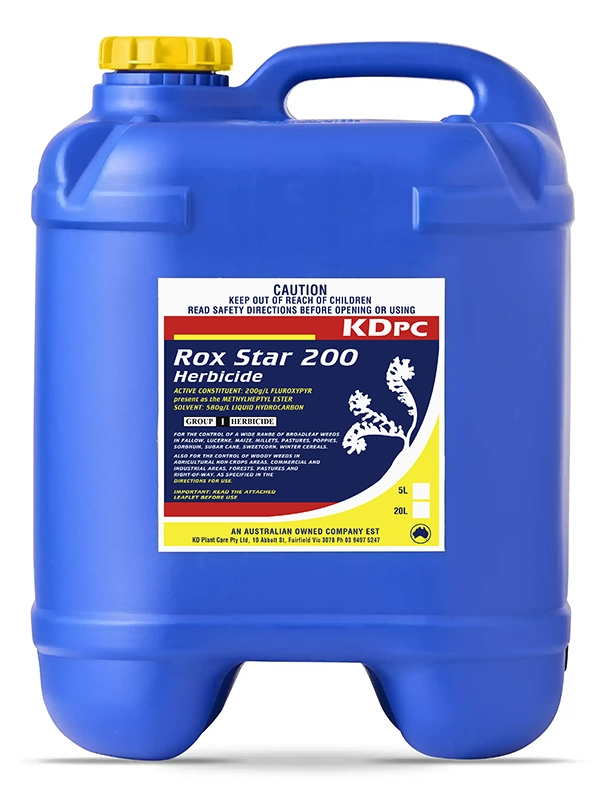
Rox Star 200
Selective, systemic post-emergent herbicide, designed for effective control of broadleaf weeds in cereal crops, pastures, and non-crop areas. Provides rapid uptake and systemic action, targeting weeds while being safe on desirable grasses.
| Rox Star 200 | |
|---|---|
Target |
Broad leaf weeds such as Sisal hemp, Mimosa pigra, Limebush etc. Woody weeds such as Noogoora burr, Bathurst burr, Blackberry etc. |
Product Type |
Herbicide |
Active Ingredient |
200g/L Fluroxypyr |
Group |
I |
Pack Size |
1L, 2.5L, 5L, 20L |
APVMA Registration # |
64008
Search APVMA number at APVMA PubCRIS. |
Profile
First marketed in 1985. It is mainly absorbed through the foliage and moves both upward (acropetally) and downward (basipetally) through the plant’s phloem and xylem, reaching other tissues. The herbicide mimics natural plant hormones (auxins), triggering abnormal growth patterns. This synthetic hormone action leads to uncontrolled cell division and elongation, ultimately causing the weed to die.
Key Features & Benefits
- Selective post-emergent herbicide: Controls broadleaf weeds without harming grasses in pastures, cereals, and turf.
- Systemic action: Moves into roots, crowns, and stems to control perennial and woody weeds.
- Reduces competition: Improves pasture and crop growth, yield, and quality. Flexible application: suitable for pastures, non-crop areas, and tank mixes to broaden weed control.
Request for SDS please
Toxicity
Non -phytotoxic to the crops for which its use is recommended. Acute oral Mammalian Toxicity (LD50, mg/kg) – rats 2400
APPLICATION GUIDE
Rox Star 200 is registered for use across a wide range of crop, pasture, fallow and woody weed situations, each with its own rates, timings and state registrations set out in the sections below. Before applying, check the Mixing, Oils & Surfactants, Compatibility section and the Application Methods & Equipment section that follow, as the critical comments throughout the crop and situation tables refer back to this guidance for spray preparation, tank-mix partners and equipment set-up.
Restraints
The following restraints apply to every application of Rox Star 200 across all crop and situation sections in this Application Guide:
- DO NOT apply to plants which may be stressed (not actively growing) due to prolonged periods of extreme cold, moisture stress (waterlogged or drought affected), poor nutrition, presence of disease, or previous herbicide treatment, as reduced levels of control may result.
- Thorough coverage of both foliage and stems, to the point of run-off, is essential for high volume applications — see Application Methods & Equipment (Woody Weed Situations) for full coverage and equipment guidance.
- DO NOT spray if rain is likely within one hour.
Always download and read the current product label before use and follow all regulatory and safety instructions.
Mixing, Oils & Surfactants, Compatibility
Rox Star 200 may be mixed with water or diesel. Mix only sufficient chemical for each day's use and avoid storing.
Mixing in water: half fill the spray tank with water, add the required quantity of Rox Star 200 and complete filling. Agitate continuously to ensure thorough mixing before and during application.
Mixing in diesel: half fill the spray tank with diesel and add the required quantity of Rox Star 200. Add the remainder of the diesel and agitate or shake to mix contents.
Tank mixtures: wettable powder or dry flowable formulations (e.g. water dispersible granules) should be added to the spray tank first, followed by suspension concentrates (flowables), water soluble salts, and then emulsifiable concentrate formulations (Rox Star 200). Add spraying oils and surfactants (wetters) last.
Oils and Surfactants
Use Uptake Spraying Oil at the rate of 500mL/100L of spray mix. When using less than 100L/ha spray volume, ensure a minimum of 250mL/ha of Uptake is used, unless 1L/100L or 1L/ha is specified.
Use a 100% concentrate non-ionic surfactant such as Kenwet 1000LF at 100mL/100L of spray mix where required.
Compatibility
Rox Star 200 is compatible with the herbicides listed below. Follow any regional restrictions, and all directions and restrictions on the label, of any chemical mixed with Rox Star 200.
- 2,4-D Amine 500
- 2,4-DB
- Atrazine 500
- Broadstrike
- Diclofop-methyl
- Eclipse
- Glyphosate 360
- Glyphosate 450
- Lontrel
- MCPA 500
- Metsulfuron Methyl 600
- Puma S
- Topik 240EC
- Tordon 242
- Tordon 75-D
- Touchdown
- Triclopyr 600
Atrazine
Avoid using hard water wherever possible. Where hard water cannot be avoided, the addition of CALGON® water conditioning agent to the spray tank, at 100g/100L water, before adding any herbicide, may improve compatibility.
Agitation is very important when mixing Rox Star 200 and atrazine. Rox Star 200 plus atrazine mixes must be agitated vigorously and continuously during mixing and application. After mixing, DO NOT allow to stand without agitation. Ensure that the time from mixing to the end of application is not more than 2 hours. If settling out occurs, re-suspension is difficult, even with vigorous agitation. Agitation using only the pump's by-pass is usually inadequate, particularly with larger tanks (more than 2000L). Additional mechanical agitation will be necessary in large tanks, computer sprayers and mixing tanks.
When additional surfactant is required, add Kenwet 1000LF non-ionic surfactant at 100mL/100L of spray mix. DO NOT use a spraying oil when tank mixing Rox Star 200 and atrazine.
Guidelines for Tank Mixing Rox Star 200 and Common Atrazine Formulations
| Tank Mix | Rate (L/ha) | Water Hardness | Minimum Water Volume L/ha | Comments | |||
|---|---|---|---|---|---|---|---|
| Soft | Medium | Hard | Ground | Aerial | |||
| Rox Star 200 | 0.75 | Suitable | Suitable | Suitable | 50 | 35 | |
| Rox Star 200 + Atrazine 500 | 0.75 + 2 | Suitable | Suitable | Suitable | 50–100 | 35 | Precipitate can be easily resuspended. |
| Rox Star 200 + Atrazine 900WG | 0.75 + 1.1 | Suitable | X | X | 100 | Do not use | Precipitate may be difficult to resuspend and may block nozzles. |
| Rox Star 200 + Atrazine DF | 0.75 + 1.1 | Suitable | X | X | 100 | Do not use | Sediment may be difficult to resuspend and may block nozzles. |
| Rox Star 200 + Atrazine 500 | 0.75 + 2 | Suitable | Suitable | X | 100 | Do not use | Precipitate may be difficult to resuspend and may block nozzles. |
Topik 240EC
- Always use Uptake Spraying Oil with Rox Star 200 + Topik 240EC tank mixes at 500mL/100L of spray mix, with a minimum of 250mL/ha.
- DO NOT mix Rox Star 200 with Topik 240EC if the grass weeds are not actively growing. Always use the maximum label rate of Topik 240EC for the appropriate grass growth stage.
- DO NOT use Rox Star 200 at more than 0.75L/ha in tank mixes with Topik 240EC.
Glyphosate 450
When mixing Rox Star 200 with Glyphosate 450 to control both grass and broadleaf weeds, refer to the Glyphosate 450 label for use rate and adjuvants recommended for grasses. DO NOT use Glyphosate 450 at less than 1.2L/ha in tank mixes with Rox Star 200, when barnyard grass, buttongrass, crowsfoot grass, native millet and liverseed grass are the target species.
Always download and read the current product label before use and follow all regulatory and safety instructions.
Application Methods & Equipment
Broadcast Application in Cropping, Pasture and Fallow Situations
A. Ground application (boom): apply Rox Star 200 with an accurately calibrated boom sprayer, in at least 50L/ha water (100–400L/ha for sugar cane). Flat fan nozzles are recommended, using pressures in the range 200 to 300kPa. Set the boom at a height to ensure a double overlap of the nozzle patterns.
B. Ground directed application (dropper nozzles): to minimise crop effects, dropper nozzles should be used in sorghum when the crop is beyond the 8 leaf growth stage, and in maize and sweetcorn when the crop is beyond the 6 leaf growth stage. Adjust the nozzles to direct the spray into the base of the crop and away from the leaves and the growing point. See manufacturers' directions for setting up and calibration of dropper nozzles.
C. Aerial application: apply in a minimum volume of at least 35L/ha water (60L/ha in sugar cane). Use equipment calibrated to produce droplets with an average diameter (Volume Mean Diameter, VMD) of 250–350 microns. DO NOT apply when the temperature is above 30°C, when there is no wind, or when the wind is blowing toward susceptible crops.
Woody Weed Situations
Weeds must be actively growing to attain optimal effect. Delay the treatment of regrowth following bulldozing, slashing, burning, ploughing or previous chemical treatment until it has at least 1 metre of new, vigorous growth.
A. High volume application
Hand gun: apply the recommended mix to obtain full coverage of leaves and stems using a number 6–8 tip at 700 to 1500 kPa. To obtain good coverage, a spray volume of 1500 to 4000L/ha (15 to 40L/100m²) is required per infested hectare. Ensure thorough coverage to the point of run-off.
Knapsack: knapsack sprayers may be used on smaller infestations where penetration and coverage of the canopy is easier to achieve. Use the same use rate and spray techniques as for hand gun application.
B. Low volume, high concentrate application
Drench gun or Gas-powered gun: apply the recommended mixture uniformly across the foliage by applying 50mL shots to cover 4 to 5m² of surface area of plant. This is approximately equivalent to 20 droplets per cm² of the leaf surface. Use a marking agent as recommended by the equipment manufacturer to check spray coverage.
C. Basal bark: DO NOT apply to wet stems, as this can repel the diesel mixture. Spray or paint the recommended mixture around the base of each stem from ground level to a height of at least 30cm from the ground, wetting the bark to the point of run-off. Apply with a paint brush or a pressure sprayer with an appropriate lance and solid cone nozzle. If using spray equipment, use low pressures (200 kPa) sufficient to form a cone of spray. Old rough bark will require more spray than smooth or young thin bark.
D. Cut stump: apply the recommended mixture liberally to the freshly cut stump immediately after cutting. Apply by spraying or painting the cut surface and sides of the stump. Best results are obtained when the stems are cut less than 15cm above the ground.
Cleaning Spray Equipment
Rinse water should be discharged onto a designated disposal area or, if this is unavailable, onto wasteland away from desirable plants and watercourses.
Cleaning equipment after using water-based sprays:
- Rinsings: after using Rox Star 200 Herbicide, empty the tank completely and drain the whole system. Thoroughly wash inside the spray unit using a pressure hose. Drain, and clean any filters in the tank, pump, lines, hoses and nozzles. After cleaning the tank as above, quarter fill with clean water and circulate through the pump, lines and nozzles. Drain and repeat the rinsing procedure twice.
- Decontamination (before spraying cotton and other sensitive crops; see Protection of Crops, Native and Other Non-Target Plants below): wash the tank and rinse the system as above. Then quarter fill the tank and add an alkali detergent (e.g. liquid SURF®, OMO® or DRIVE®) at 500mL/100L of water, or the powder equivalent at 500g/100L, and circulate throughout the system for at least 15 minutes.
- Drain the whole system. Remove filters and nozzles and clean them separately. Finally, flush the system with clean water and allow draining.
Cleaning equipment after using diesel-based sprays:
- On completion of spraying, use a degreaser such as Caltex Kwik-D-Grease® to remove traces of diesel from the sprayer. Rinse tank and spray through nozzles with water to remove degreaser.
- Then quarter fill the tank with clean water and add an alkali detergent (e.g. liquid SURF®, OMO® or DRIVE®) at 50mL/10L of water, or the powder equivalent at 50g/10L of water. Shake sprayer to circulate the washing solution throughout the sprayer, and then spray the solution through the nozzles. Rinse well with clean water to remove the detergent.
- To clean brushes and containers, spray liberally with degreaser. Hose off with clean water and repeat using detergents as above.
- DO NOT use this equipment for any other purpose.
Protection of Crops, Native and Other Non-Target Plants
- Susceptible crops include but are not limited to clovers, cotton, fruit, hops, lupin, ornamentals, peas, pine tree, potatoes, navy beans, safflower, shade trees, soybeans, sunflower, tobacco, tomatoes, vegetables and vines.
- Rox Star 200 can be damaging to susceptible crops during both growing and dormant periods.
- Grasses are normally unaffected by Rox Star 200 and establish quickly after treatment. Transitory damage can occur on some species, particularly those that spread by stolons, such as couch grass (Cynodon dactylon), Kikuyu grass and carpet grass (Axonopus spp.).
- DO NOT allow spray to drift onto susceptible crops, shade trees and Pinus spp.
- DO NOT use under weather conditions or from spraying equipment which could be expected to cause spray to drift onto nearby susceptible plants.
Protection of Livestock
- DO NOT graze or cut treated crops for stock food except as specified under Withholding Periods.
- Poisonous plants may become more palatable after spraying; therefore livestock should be kept out of the area until plants have died down.
- DO NOT allow stock to re-enter paddocks containing treated poisonous plants until the plants have died down.
Protection of Wildlife, Fish, Crustaceans and Environment
- DO NOT contaminate streams, rivers or waterways with the chemical or used containers.
- Alongside waterways, treat only noxious weeds and poisonous plants.
Storage and Disposal
Store in the closed, original container in a cool, well-ventilated area. DO NOT store for prolonged periods in direct sunlight. Triple or preferably pressure rinse containers before disposal. Add rinsings to spray tank. DO NOT dispose of undiluted chemicals on site. If recycling, replace cap and return clean containers to recycler or designated collection point.
If not recycling, break, crush or puncture and bury empty containers in a local authority landfill. If no landfill is available, bury the containers below 500mm in a disposal pit specifically marked and set up for this purpose, clear of waterways, desirable vegetation and tree roots. Empty containers and product should not be burnt.
Small Spill Management
Wear protective equipment (see Safety Directions). Apply absorbent materials such as earth, sand, clay granules or cat litter to the spill. Sweep up material for disposal when absorption is completed and contain in a refuse vessel for disposal (see Storage and Disposal above). If necessary, wash the spill area with an alkali detergent and water and absorb as above the wash liquid for disposal.
Always download and read the current product label before use and follow all regulatory and safety instructions.
Woody Weeds — Non-Crop, Right-of-Way, Commercial/Industrial, Forest & Pastures
Rox Star 200 controls a wide range of woody weeds in agricultural non-crop areas, rights-of-way, commercial and industrial areas, forests and pastures. Weeds must be actively growing to attain optimal effect, and thorough coverage of both foliage and stems, to the point of run-off, is essential for high volume applications — see Application Methods & Equipment (Woody Weed Situations) for full coverage and equipment guidance. Legumes present at the time of spraying will be severely damaged.
High Volume Application — Dilute with Water
| Weeds Controlled | Weed Growth Stage | State | Rate mL/100L Water | Critical Comments |
|---|---|---|---|---|
| Bathurst burr, Noogoora burr | Seedlings and young plants up to 40cm high. | NSW, NT, QLD & WA only | 75 | |
| Black bindweed (Climbing buckwheat) | Seedlings and young plants before flowering. | NSW & QLD only | 300 | |
| Mimosa pigra | Apply from mid to late summer. | NT & WA only | 300 | Add Uptake™ Spraying Oil (see Mixing, Oils & Surfactants, Compatibility). |
| Common sensitive plant | Seedlings and young plants up to flowering. | QLD & WA only | 500 | Add Uptake™ Spraying Oil (see Mixing, Oils & Surfactants, Compatibility). |
| Bellyache bush | QLD, NSW & WA only | |||
| Blackberry nightshade, Bokhara clover | NSW & QLD only | |||
| Caltrop (yellow vine) (Tribulus terrestris, T. micrococcus) | Seedlings and young plants up to 30cm diameter. | NSW & QLD only | 500 | Add Uptake™ Spraying Oil (see Mixing, Oils & Surfactants, Compatibility). |
| Cockspur thorn | Up to 3cm high. | |||
| Cobblers pegs | Up to 15cm high. | |||
| Creeping lantana | At flowering. | |||
| Crofton weed, Mistflower | Seedlings and young plants up to flowering. | |||
| Docks (Rumex spp.) | Seedlings and rosettes up to 30cm high. | |||
| Hexham scent | Seedlings and young plants up to flowering. | NSW & QLD only | 500 | Boom spray: Rox Star 200 at 0.3L/ha + 0.5L/ha 2,4-D amine (500g/L). |
| Honey locust | Seedlings and young plants up to 2m high. | |||
| Small flowered mallow (Marshmallow) (Malva parviflora) | Seedlings and young plants up to flowering. | |||
| Yellow flower, Devils claw | ||||
| Lantana | Seedlings and regrowth 0.5 to 1.2m high. | Apply to actively growing plants from October to April. Some regrowth may occur, particularly when treating old woody plants with sparse canopies. | ||
| Plants and regrowth 1.2 to 2m high. | 1000 | |||
| Blue heliotrope | Flowering. | |||
| Limebush | Infestations up to 1.5m high only. | |||
| Madeira vine | Apply at time of active growth. | 500 | ||
| Milkweed (Euphorbia heterophylla) | 3 leaf to flowering. | QLD only | 1000 | Repeat applications will be necessary to control subsequent germinations. |
| Common sowthistle | Seedlings and young plants up to bolting. | NSW & QLD only | 500 | Add a surfactant (see Mixing, Oils & Surfactants, Compatibility). |
| Mother-of-millions (Kalanchoe spp.) | Seedling and young plants before flowering. | 600 | ||
| Prickly acacia | Seedling and young plants up to 2m high. | QLD only | 750 | Add Uptake Spraying Oil (see Mixing, Oils & Surfactants, Compatibility). Consult Tropical Weeds Research Centre, Charters Towers, for specific advice on application. |
| Sida spp. | Seedlings and young plants up to flowering. | NSW, NT, QLD & WA | 1000 | |
| Broadleaf Pepper tree (Schinus terebinthifolius) | Mature leaves, fruiting. | QLD only | 500 | Winter application only. Contact Alan Fletcher Research Station for more information. |
| Flannel weed (Sida cordifolia) | ||||
| Snakeweed (Dark and Light Blue) | Seedling and young plants before flowering. | 750 | Add Uptake Spraying Oil (see Mixing, Oils & Surfactants, Compatibility). | |
| Stinking Passion flower | Established plants and regrowth. | QLD, NT & WA | 450 | Use 70mL/15L for a knapsack. |
| Wandering jew (Tradescantia albiflora) | Young plants up to and including flowering. | All States | 1500 | Some regrowth will usually occur and will require re-treatment. |
| Wattles (including Acacia aulacocarpa, A. decora, A. harpophylla, A. leiocalyx, A. salicina) | Seedling plants or regrowth 0.5 to 1.2m high. | NSW & QLD only | 500 | Apply to actively growing plants when soil moisture is plentiful. Some regrowth may occur, particularly when treating old woody plants with sparse canopies and under dry conditions. |
| Plants or regrowth 1.2 to 2m high only. | 1000 |
Basal Bark and Cut Stump Application — Dilute with Diesel
| Weeds Controlled | Weed Growth Stage | State | Rate L/100L Diesel | Critical Comments |
|---|---|---|---|---|
| Celtis (Celtis sinensis) | Basal bark only: Young plants up to 2m high and 20cm basal diameter. |
QLD only | 3.5 | Treat stems from ground level to where multi-stemmed trunks branch. |
| Chinese apple | Up to 15cm basal diameter. | QLD only | 3 | With basal bark, treat circumference of stem to a height of 45cm from the ground. Contact the Land Protection Branch, Dept of Lands, QLD for further information on Chinese Apple. |
| Cockspur thorn | Basal bark only: Up to 5cm basal diameter. |
2 | ||
| Mimosa bush (Acacia farnesiana) | Up to 5cm basal diameter. | QLD & WA only | 3 | |
| Prickly acacia | Up to 10cm basal diameter. | QLD only | 1.5 | |
| Honey locust | Plants up to 10cm basal diameter. | NSW & QLD only | 1.5 | With basal bark, treat circumference of stem to a height of 45cm from the ground. For cut stump application use a rate of 5L/100L diesel for all plant sizes. Contact the Land Protection Branch, Dept of Lands, QLD for further information on Honey Locust. |
| Plants 10 to 20cm basal diameter. | 3 | |||
| Plants >20cm basal diameter. | 5 | |||
| Sisal hemp (Agave spp.) | All growth stages. | QLD only | 3 | Treat as an overall spray. Contact the Land Protection Branch, Dept of Lands, QLD for advice on large infestations. |
| 10mL undiluted product per plant | Lever out centre of plant with crowbar and immediately treat the exposed cut area. |
Broadcast and Aerial Application — Dilute with Water
| Weeds Controlled | Weed Growth Stage | State | Rate L/ha | Critical Comments |
|---|---|---|---|---|
| Mimosa pigra | Actively growing plants. | NT & WA only | 3 | Aerial application: add Uptake Spraying Oil at the rate of 1L/100L spray mix. Apply to actively growing plants from mid to late summer. Contact the Dept. of Primary Industries and Fisheries, NT, for further information. |
Low Volume, High Concentrate Application — Drench Gun or Gas-Powered Gun
| Weeds Controlled | Weed Growth Stage | State | Rate L/10L Water | Critical Comments |
|---|---|---|---|---|
| Limebush | Isolated bushes up to 1.2m high only. | NSW & QLD only | 1 | Apply a 50mL dose per 5m² of bush surface area. |
| Tree violet (Hymenanthera dentata) | Apply from late flowering to green fruit, up to 1.2m high. | NSW only | 1 | Apply a 50mL dose per cubic metre of bush. |
Always download and read the current product label before use and follow all regulatory and safety instructions.
Established Grass Pastures
In established grass pastures, Rox Star 200 controls blue billygoat weed, common sensitive plant, giant sensitive plant, spinyhead sida, St Johns wort and Silverleaf nightshade. Grasses are normally unaffected by Rox Star 200 and establish quickly after treatment, although transitory damage can occur on some stoloniferous species such as couch grass, Kikuyu grass and carpet grass.
Broadcast Application — Dilute with Water
| Weeds Controlled | Weed Growth Stage | State | Rate L/ha | Critical Comments |
|---|---|---|---|---|
| Blue billygoat weed, Common sensitive plant, Giant sensitive plant, Spinyhead sida | Apply before flowering. | QLD & WA only | 1.5 | Add Uptake Spraying Oil at 1L/ha. |
| St Johns wort | Apply from bud to full bloom (usually late November to early January). | ACT, NSW & VIC only | 3 | Some regrowth will occur. Treat regrowth the following season for best results. Use at least 200L water/ha. |
| Silverleaf nightshade | From onset of flowering to early berry-set (usually spring to mid-summer). | NSW only | 0.75 OR 0.375 PLUS 2,4-D amine 500 at 1.5–2L/ha | Add Uptake Spraying Oil at 1L/ha. To ensure maximum effect, delay application until the majority of shoots have emerged. Follow-up treatment of regrowth is critical for best control. |
Broadcast and Aerial Application — Dilute with Water
| Weeds Controlled | Weed Growth Stage | State | Rate L/ha | Critical Comments |
|---|---|---|---|---|
| Mimosa pigra | Actively growing plants. | NT & WA only | 3 | Aerial application: add Uptake Spraying Oil at the rate of 1L/100L spray mix. Apply to actively growing plants from mid to late summer. Contact the Department of Primary Industries and Fisheries, NT, for further information. |
Low Volume, High Concentrate Application — Drench Gun or Gas-Powered Gun
| Weeds Controlled | Weed Growth Stage | State | Rate L/10L Water | Critical Comments |
|---|---|---|---|---|
| Limebush | Isolated bushes up to 1.2m high only. | NSW & QLD only | 0.1 | Apply a 50mL dose per 5m² of bush surface area. |
| Tree violet (Hymenanthera dentata) | Apply from late flowering to green fruit, up to 1.2m high. | NSW only | 0.1 | Apply a 50mL dose per cubic metre of bush. |
Always download and read the current product label before use and follow all regulatory and safety instructions.
Sorghum, Maize, Millets & Sweetcorn
Rox Star 200 is registered for in-crop broadleaf weed control in sorghum, maize, millets and sweetcorn (NSW and QLD, plus a separate Tasmania-only sweetcorn use). Sorghum should be sprayed from 8 leaf to boot stage using dropper nozzles to prevent herbicide contact with crop leaves and the growing point (meristem); maize and sweetcorn should be sprayed from 6 leaf to just before tasseling using dropper nozzles for the same reason. DO NOT use Rox Star 200 mixes with atrazine in millets.
In-Crop Application (NSW & QLD only)
| Crop | Crop Growth Stage | Weeds Controlled | Weed Growth Stage | Rate L/ha | Critical Comments |
|---|---|---|---|---|---|
| Sorghum | Apply when secondary roots are present, from 4 fully expanded leaves (15cm tall) up to boot. (see also Critical Comments) | Annual ground cherry, Wild gooseberry (Physalis spp.) | 2 to 8 leaf, up to 15cm tall | 0.5 | Sorghum: from 8 leaf to boot stage, use dropper nozzles to prevent herbicide contact with the crop's leaves and growing point (meristem). Maize & Sweetcorn: from 6 leaf to just before tasseling, use dropper nozzles for the same reason. See Mixing, Oils & Surfactants, Compatibility section above. DO NOT use mixes with Atrazine in millets. This treatment may be slightly damaging to the crop. To minimise crop damage, apply using dropper nozzles at all crop stages. * This treatment may be slightly damaging to the crop. To minimise crop damage, apply using dropper nozzles at all crop stages. |
| 15 to 30cm tall | 0.75 | ||||
| Apple of Peru | Seedling plants, up to 15cm tall | ||||
| Bathurst burr, Noogoora burr | 2 to 8 leaf, up to 20cm tall | 0.5 | |||
| Maize & Sweetcorn | Apply when secondary roots are present, from 3 fully expanded leaves (10cm tall) up to boot. (see also Critical Comments) | 20 to 50cm tall | 0.75 | ||
| Pigweed (Portulaca oleracea) | Up to 10cm diameter | 0.5 | |||
| 10 to 30cm diameter | 0.75 | ||||
| Sesbania pea | 2 to 6 leaf, up to 10cm tall | 1.5 | |||
| Millets | Spray when secondary roots have developed, usually early to mid-tillering, and not later than before heads start to form at the base of tillers. (see also Critical Comments) | Silverleaf nightshade (NSW only)* | Full flower to early berry | 0.75 + Uptake at 1L/ha | |
| Starburr (Acanthospermum hispidum) — QLD only | Up to 12 leaf and before flowering | 1.5 or 0.75 + Atrazine 500 at 2L/ha | |||
| Thornapples (Datura spp.) | 2 to 8 leaf, up to 15cm tall | 0.75 | |||
| Volunteer sunflower | 2 to 5 leaf, up to 20cm tall | 1 |
Tank Mixes with Atrazine — Sorghum, Maize & Sweetcorn
| Crop | Crop Growth Stage | Weeds Controlled | Weed Growth Stage | Rate L/ha | Critical Comments |
|---|---|---|---|---|---|
| Sorghum, Maize & Sweetcorn | As above | Amaranthus spp. including Boggabri weed, Dwarf amaranth, Green amaranth, Redshank, Anoda weed, Bladder ketmia, Black pigweed (Trianthema portulacastrum), Caltrop (yellow vine) including Tribulus terrestris, T. micrococcus & T. maximus, Cowvine/peach vine (Ipomoea lonchophylla), Hairy wandering jew (Commelina benghalensis), Mintweed | Seedling plants up to 15cm tall or rosettes up to 15cm diameter |
0.5 + Atrazine 500 at 1.5L/ha or 0.75 + Atrazine 500 at 2L/ha |
Use the low rate (0.5 + 1.5L) when weeds are small (5–7cm tall/diameter). Use the high rate (0.75 + 2L) when weeds are larger (7–15cm tall/diameter). Rox Star 200 is generally more compatible with liquid atrazine products (see Mixing, Oils & Surfactants, Compatibility section above). Add a surfactant (see Mixing, Oils & Surfactants, Compatibility section above). DO NOT add an oil to mixtures of Rox Star 200 and atrazine. |
| Euphorbia davidii | Cotyledon to 4 nodes, up to 15cm | 1 + Atrazine 500 at 2L/ha | |||
| Volunteer peanut | Up to 15cm diameter | 1 + Atrazine 500 at 4.5L/ha |
Sweetcorn — Tasmania Only
| Crop | Crop Growth Stage | Weeds Controlled | Weed Growth Stage | Rate L/ha |
|---|---|---|---|---|
| Sweetcorn only | 3 to 5 leaf | Blackberry nightshade, Volunteer potatoes | 3 to 5 leaf | 1 |
Always download and read the current product label before use and follow all regulatory and safety instructions.
Winter Cereals (Wheat, Barley, Oats & Triticale)
In winter cereals, Rox Star 200 is applied from 3 leaf to flag (Zadoks 13 to 39) for the control of bedstraw, cleavers, black bindweed, common sowthistle, deadnettle, spiny emex, prickly lettuce, volunteer lupins, volunteer potato and wireweed. Mixtures with other herbicides may reduce crop selectivity — apply at crop growth stages according to the mixing partner's recommendation.
In-Crop Application
| Crop Growth Stage | Weeds Controlled | Weed Growth Stage | State | Rate L/ha | Critical Comments |
|---|---|---|---|---|---|
| Apply from 3 leaf to flag (Zadoks 13 to 39) | Bedstraw (Galium tricornutum) | 1 to 3 whorl | VIC, SA & WA only | 1 | Add either Uptake Spraying Oil or a surfactant (see Mixing, Oils & Surfactants, Compatibility). |
| Cleavers (Galium aparine) | NSW & VIC only | ||||
| Black bindweed (Climbing buckwheat) | 2 to 4 leaf | NSW & QLD only | 0.5 | Useful suppression only. | |
| 2 to 6 leaf | 0.75 or 0.5 + Metsulfuron 600 at 5g/ha | Mixtures: mixing partners with Rox Star 200 may reduce crop selectivity. Apply at crop growth stages according to mixing partner's recommendation. | |||
| Common sowthistle (Sonchus oleraceus) | 2 to 5 leaf | 1 | |||
| Deadnettle | 2 to 6 leaf | 1.5 or 0.5 + Metsulfuron 600 at 5g/ha | |||
| Spiny emex (Doublegee, Three cornered jack) | 2 to 4 leaf | NSW, QLD, SA & WA only | |||
| Prickly lettuce | 2 to 5 leaf | NSW, QLD, TAS, VIC & WA | 1 | ||
| Volunteer lupins | 2 to 8 leaf | NSW, VIC & WA only | 1.5 | ||
| Volunteer potato | 10 to 15cm tall | WA & TAS only | Plants 15 to 30cm tall will only be suppressed. | ||
| Wireweed | 2 to 3 leaf | NSW, QLD, SA, TAS, VIC & WA only | |||
| NSW & QLD only | 0.5 + Metsulfuron 600 at 5g/ha | ||||
| Bittercress (Coronopus didymus), Mustards, Shepherd's purse, Turnip weed, Wild radish, Wild turnip | Up to 8 leaf and up to 15cm diameter | NSW, QLD, VIC, SA, TAS & WA only | 0.5 to 1.5 + Metsulfuron 600 or Eclipse or MCPA LVE or MCPA 500 | The Rox Star 200 rate depends on what other weeds are present as listed above. See Mixtures comment above. Metsulfuron 600 at 5g/ha (this mix does not control wild radish). Eclipse at 5–7g/ha (use the 5g rate on turnip weed only). MCPA LVE (500g/L) at 700mL/ha. MCPA 500 at 1L/ha. |
Always download and read the current product label before use and follow all regulatory and safety instructions.
Summer Fallow
In summer fallow, Rox Star 200 controls annual ground cherry, wild gooseberry, Bathurst burr, Noogoora burr and volunteer sunflowers, among other broadleaf weeds. When mixing with Glyphosate 450CT to control both grass and broadleaf weeds, refer to the Glyphosate label for use rates and adjuvants recommended for the grasses (see Mixing, Oils & Surfactants, Compatibility).
Fallow Application
| Weeds Controlled | Weed Growth Stage | State | Rate L/ha | Critical Comments |
|---|---|---|---|---|
| Annual ground cherry, Wild gooseberry (Physalis spp.) | 2 to 8 leaf, up to 15cm tall | NSW & QLD only | 0.75** | * Add Uptake Spraying Oil (see Mixing, Oils & Surfactants, Compatibility section).
When mixing with Glyphosate 450CT to control both grass and broadleaf weeds, refer to the glyphosate label for use rates and adjuvants recommended for the grasses (see Mixing, Oils & Surfactants, Compatibility section). ** Delay treatment until the maximum number of shoots have emerged, but before the onset of fruiting (late summer). DO NOT treat plants showing symptoms from previous treatment. Use the higher rate when longer-term weed control (6–10 months) is required, and delay planting crops during this period. The low rate will require follow-up treatments. |
| Bathurst burr, Noogoora burr | 2 to 8 leaf, up to 20cm tall | NSW, QLD, VIC & WA only | 0.75** | |
| Bellvine | Pre-flowering | NSW & QLD only | 0.5 + Glyphosate 450CT at 1.2L/ha | |
| Bladder ketmia | 4 to 8 leaf, up to 10cm tall | NSW & QLD only | 0.5 + Glyphosate 450CT at 1.2L/ha | |
| Cowvine (Peach vine) (Ipomoea lonchophylla) | 2 to 10 leaf, up to 10cm diameter | NSW & QLD only | 0.5 + Glyphosate 450CT at 1.2L/ha | |
| Caltrop (Yellow vine) including Tribulus terrestris, T. maximus & T. micrococcus | Up to 15cm diameter | NSW & QLD only | 0.5 + Glyphosate 450CT at 1L/ha | |
| Pigweed (Portulaca oleracea) | Up to 10cm diameter | NSW & QLD only | 0.75* | |
| Up to 60cm diameter | 0.75 + Glyphosate 450CT at 1L/ha | |||
| Polymeria pusilla | 2 to 10 leaf, up to 20cm diameter | NSW & QLD only | 1* or 0.5 + Glyphosate 450 at 1.2L/ha | |
| Rhyncosia | Seedlings to early flowering | NSW & QLD only | 1* or 0.375 + Glyphosate 450 at 0.8L/ha | |
| Smallflower mallow (Marshmallow) (Malva parviflora) | Up to 8 leaf, up to 20cm diameter | NSW & QLD only | 1* | |
| Thornapples (Datura spp.) | 2 to 8 leaf, up to 15cm diameter | NSW, QLD & WA only | 0.75* or 0.5 + Glyphosate 450 at 1.2L/ha | |
| Sesbania pea | 2 to 6 leaf, up to 10cm tall | NSW & QLD only | 1.5* or 0.5 + Glyphosate 450 at 1.2L/ha | |
| Perennial Ground Cherry (Physalis virginiana)** | Bud to early flowering, up to 20cm tall | NSW & QLD only | 1.5 or 3* | |
| Silverleaf nightshade | Full flower to early berry-set (usually Dec-Feb) | NSW only | 0.74 or 0.375 + 2,4-D Amine 500 at 1.5 - 2L / ha | Add Uptake Spraying Oil at the rate of 1L / 100L spraying.
To ensure maximum effect, delay application until the majority of shoots have emerged. Follow up treatment will be required to control regrowth and is critical for optimal control. If wanting to prevent seed set, repeat applications may be needed in the same season, although this does not lead to better long term control. |
| Volunteer peanuts | Up to 15cm diameter | QLD only | 1 + Atrazine 500 at 4.5L / ha | Add a surfactant (see Mixing, Oils & Surfactants, Compatibility section) |
| Volunteer sunflowers | 2 to 5 leaf, up to 20cm diameter | NSW & QLD only | 1 | Add Uptake Spraying Oil (see Mixing, Oils & Surfactants, Compatibility section) |
Always download and read the current product label before use and follow all regulatory and safety instructions.
Winter Fallow
In winter fallow, Rox Star 200 controls bedstraw, cleavers, black bindweed, common sowthistle, prickly lettuce, spiny emex and wireweed. When mixing with Glyphosate 450 to control both grass and broadleaf weeds, refer to the Glyphosate label for use rates and adjuvants recommended for the grasses (see Mixing, Oils & Surfactants, Compatibility).
Fallow Application
| Weeds Controlled | Weed Growth Stage | State | Rate L/ha | Critical Comments |
|---|---|---|---|---|
| Bedstraw (Galium tricornutum) | Up to 5 whorl | VIC, SA & WA only | 1* | * Add Uptake Spraying Oil (see Mixing, Oils & Surfactants, Compatibility section). ** Add Hasten or a surfactant (see Mixing, Oils & Surfactants, Compatibility section). When mixing with glyphosate 450 to control both grass and broadleaf weeds, refer to the glyphosate label for use rates and adjuvants recommended for the grasses (see Mixing, Oils & Surfactants, Compatibility section). |
| Cleavers (Galium aparine) | Up to 5 whorl | NSW & VIC only | 1* | |
| Black bindweed (Climbing buckwheat) | 2 to 8 leaf, up to 10cm diameter | NSW & QLD only | 0.75* | |
| Common sowthistle (Sonchus oleraceus) Prickly lettuce |
2 to 10cm diameter | NSW & QLD only | 1* or 0.5 + Glyphosate 450 at 0.6L/ha | |
| Spiny emex (Doublegee, Three cornered jack) | 2 to 8 leaf | NSW & QLD only | 1.5* or 0.5** + Metsulfuron 600 at 5g/ha | |
| Wireweed | 2 to 3 leaf, up to 10cm tall | NSW & QLD only | 1.5* or 0.5** + Metsulfuron 600 at 5g/ha or 0.5** + Glyphosate 450 at 0.6L/ha |
Always download and read the current product label before use and follow all regulatory and safety instructions.
Sugar Cane (NSW, QLD, NT & WA only)
In sugar cane (NSW, QLD, NT and WA only), Rox Star 200 is applied from early tillering to maturity for control of balsam pear, blackberry nightshade, blue billygoat weed, centro, cowpea, giant sensitive plant, lablab bean, Noogoora burr, phasey bean, pinkburr, prickly African cucumber, spinyhead sida, stinking passion flower (seedlings), bellvine, morning glory, red or pink convolvulus, star of Bethlehem and milkweed. For optimal weed control, delay application until just before the "close-in" stage.
Ground and Aerial Application
| Crop Growth Stage | Weeds Controlled | Weed Growth Stage | Rate L/ha | Critical Comments |
|---|---|---|---|---|
| From early tillering to maturity | Balsam pear, Blackberry nightshade, Blue billygoat weed, Centro, Cowpea, Giant sensitive plant, Lablab bean, Noogoora burr, Phasey bean, Pinkburr, Prickly African cucumber, Spinyhead sida, Stinking passion flower (seedlings only) | Apply from 2 to 3 leaf until flowering | Ground: 1.3 Aerial: 1.5 |
For optimal weed control, delay application until just before the "close-in" stage. Ground application: apply in 100–400L/ha water and add Uptake Spraying Oil at 500mL/100L of spray mixture. Aerial application: apply in not less than 60L/ha water and add Uptake Spraying Oil at 1L/100L spray mixture. |
| Bellvine, Morning Glory, Red or Pink convolvulus, Star of Bethlehem | As above + 2,4-D Amine 500 at 1L/ha | |||
| Stinking passion flower | Established or ratoon plants with at least 1m of regrowth | High volume: 450mL/100L water Knapsack: 70mL/15L water |
Thoroughly wet plants to the point of run-off. | |
| Milkweed (Euphorbia heterophylla) | Seedlings and young plants, up to flowering | 3 or 2.3 + Atrazine 500 at 4L/ha | Better control will be achieved with the atrazine mixture. Delay application until just before the cane reaches the close-in stage. This will improve control and minimise the number of seedlings that germinate. |
Always download and read the current product label before use and follow all regulatory and safety instructions.
Lucerne
In established lucerne crops at least 18 months old, Rox Star 200 controls annual ground cherry, Bathurst burr, Noogoora burr, wild gooseberry and pigweed. To minimise crop injury and maximise weed control, cut, slash or heavily graze the lucerne before application, and wherever possible irrigate before application to stimulate weed growth.
Established Crop Application
| Crop Growth Stage | Weeds Controlled | Weed Growth Stage | Rate L/ha | Critical Comments |
|---|---|---|---|---|
| Established crops at least 18 months old | Annual ground cherry, Bathurst burr, Noogoora burr, Wild gooseberry | 2 to 8 leaf, up to 15cm high | 0.5 | To minimise crop injury and maximise weed control, cut, slash or heavily graze the lucerne before application. Wherever possible, irrigate before application to stimulate weed growth. DO NOT treat crops growing on sandy or stony soils. DO NOT treat crops after the summer growing season (after end of March). To broaden the spectrum of weeds controlled, Rox Star 200 can be mixed with 2,4-DB amine. |
| Pigweed | Up to 10cm diameter |
Always download and read the current product label before use and follow all regulatory and safety instructions.
Poppies (TAS only)
In Tasmania-only poppy crops, Rox Star 200 controls cleavers, fumitory, shepherd's purse, wireweed, common sowthistle, prickly lettuce, black nightshade and volunteer potato. DO NOT apply Rox Star 200 to poppies later than the 8 to 10 leaf growth stage, as a reduction of alkaloid content could occur. Poppies also carry a specific pre-harvest withholding period — see Withholding Periods & Plant-back below.
In-Crop Application
| Crop Growth Stage | Weeds Controlled | Weed Growth Stage | Rate L/ha | Critical Comments |
|---|---|---|---|---|
| 4 to 6 leaf | Cleavers, Fumitory | 2 to 6 leaf | 1 | |
| Shepherd's purse, Wireweed | 1 + Asulox at 5L/ha | |||
| 8 to 10 leaf | Common sowthistle, Prickly lettuce | 2 to 5 leaf | 1 | DO NOT apply Rox Star 200 to poppies later than the 8 to 10 leaf growth stage, as a reduction of alkaloid content could occur. |
| Black nightshade | Cotyledon to 4 leaf | 1.5 | ||
| Fumitory | 6 to 10 leaf | 1.5 | ||
| 8 to 10 leaf | Volunteer potato | From tuber initiation to flower bud | 1.5 | This rate will provide season-long control of volunteer potato, but will not control all daughter tubers and will only suppress potatoes over 15cm tall. |
Always download and read the current product label before use and follow all regulatory and safety instructions.
Withholding Periods & Plant-back
Crops and pastures: DO NOT graze failed crops and treated pastures or cut for stock food for 7 days after application.
Poppies: DO NOT spray poppies later than ten weeks before harvest.
Minimum Recropping Periods
| Plant-back periods for crops following the application of Rox Star 200, for rates up to 1.5L/ha: | |||
|---|---|---|---|
| Crop | Rate 0.375L/ha — Days | Rate 0.75L/ha — Days | Rate 1.5L/ha — Days |
| Barley | 7 | 7 | 7 |
| Wheat | 7 | 7 | 7 |
| Chickpea | 7 | 7 | 7 |
| Cotton | 14 | 14 | 28 |
| Soybean | 7 | 7 | 14 |
| Sunflower | 7 | 7 | 7 |
| Maize | 7 | 7 | 7 |
| Sorghum | 7 | 7 | 7 |
Note: before using Rox Star 200 in tank mixes with other herbicides, check the plant-back information on all product labels. The time between spraying and planting will be determined by the most residual product, i.e. the product with the longest plant-back period.
NOT TO BE USED FOR ANY PURPOSE OR IN ANY MANNER CONTRARY TO THIS LABEL UNLESS AUTHORISED UNDER APPROPRIATE LEGISLATION.
Always download and read the current product label before use and follow all regulatory and safety instructions.
What is Kendon Rox Star 200 used for?
Kendon Rox Star 200 is a Group I herbicide used for the control of a wide range of broadleaf weeds in fallow, lucerne, maize, millets, pastures, poppies, sorghum, sugar cane, sweetcorn and winter cereals. It also controls woody weeds in agricultural non-crop areas, commercial and industrial areas, forests, pastures and rights-of-way, as specified in the Application Guide above.
What is the active constituent in Rox Star 200?
Rox Star 200 contains 200g/L fluroxypyr, present as the methylheptyl ester, with a solvent of 580g/L liquid hydrocarbon. It is formulated as an emulsifiable concentrate and may be mixed with water or diesel, depending on the application method.
How does Rox Star 200 work?
Rox Star 200 Herbicide is a member of the pyridine group of herbicides. The product has a disrupters of plant cell growth mode of action, and for weed resistance management, the product is a Group I herbicide. Rox Star 200 is absorbed mainly through the foliage and moves both upward (acropetally) and downward (basipetally) through the plant's phloem and xylem, reaching other tissues. It mimics natural plant hormones (auxins), triggering abnormal growth patterns; this synthetic hormone action leads to uncontrolled cell division and elongation, ultimately causing the weed to die.
How do I apply Rox Star 200?
Application rates and methods for Rox Star 200 vary by crop, situation and weed species — see the Application Guide above for full details on woody weeds, established grass pastures, sorghum, maize, millets, sweetcorn, winter cereals, summer and winter fallow, sugar cane, lucerne and poppies. Application methods include boom spraying, dropper nozzles, aerial application, high volume handgun, knapsack, low volume drench gun, basal bark and cut stump treatment, depending on the situation. Always download and read the current product label before use. This product is not to be used for any purpose or in any manner contrary to the label unless authorised under appropriate legislation.
What are the key restraints when using Rox Star 200?
DO NOT apply to plants which may be stressed (not actively growing) due to prolonged periods of extreme cold, moisture stress, poor nutrition, presence of disease, or previous herbicide treatment, as reduced levels of control may result. DO NOT spray if rain is likely within one hour. Thorough coverage of both foliage and stems, to the point of run-off, is essential for high volume applications. Legumes present at the time of spraying will be severely damaged.
What is the withholding period for Rox Star 200?
For crops and pastures, do not graze failed crops and treated pastures, or cut for stock food, for 7 days after application. Poppies carry a separate withholding period: do not spray poppies later than ten weeks before harvest. Plant-back periods also apply before sowing certain crops after application — see the Application Guide above for the full plant-back table by crop and rate.
Which crops are sensitive to Rox Star 200?
Susceptible crops include but are not limited to clovers, cotton, fruit, hops, lupin, ornamentals, peas, pine tree, potatoes, navy beans, safflower, shade trees, soybeans, sunflower, tobacco, tomatoes, vegetables and vines. Rox Star 200 can be damaging to susceptible crops during both growing and dormant periods. DO NOT allow spray to drift onto susceptible crops, shade trees and Pinus spp., and do not use under weather conditions or from spraying equipment which could be expected to cause spray to drift onto nearby susceptible plants.
Can I graze livestock after spraying Rox Star 200?
DO NOT graze or cut treated crops for stock food except as specified under the withholding periods above. Poisonous plants may become more palatable after spraying, so livestock should be kept out of the treated area until plants have died down. DO NOT allow stock to re-enter paddocks containing treated poisonous plants until the plants have died down.
What are the health and safety hazards of Rox Star 200?
Rox Star 200 is a combustible liquid. It may be fatal if swallowed and enters the airways. It causes skin irritation and serious eye irritation, and may cause drowsiness or dizziness by inhalation. Repeated exposure may cause skin dryness or cracking. When opening the container, preparing the spray and using the prepared spray, wear cotton overalls buttoned to the neck and wrist, a washable hat, elbow-length PVC gloves, and a face shield or goggles. Wash hands after use, and wash gloves, face shield and contaminated clothing after each day's use. If poisoning occurs, contact a doctor or the Poisons Information Centre on 13 11 26. If swallowed, do not induce vomiting — give a glass of water.
Is Rox Star 200 harmful to waterways or the environment?
Rox Star 200 is toxic to aquatic life, including with long-lasting effects. DO NOT contaminate streams, rivers or waterways with the chemical or used containers. Alongside waterways, treat only noxious weeds and poisonous plants.
Where can I find the Safety Data Sheet (SDS) for Rox Star 200?
Additional safety information is listed in the Safety Data Sheet (SDS), which can be requested by clicking the Request SDS button on this page.
Where can I buy Kendon Rox Star 200?
You can purchase this product from leading agricultural suppliers throughout Australia. If you are a grower and would like a distributor for larger quantities, send us a message on our contact us page requesting "Rox Star 200" distributors near you.
BUY FROM
Our Distributors