
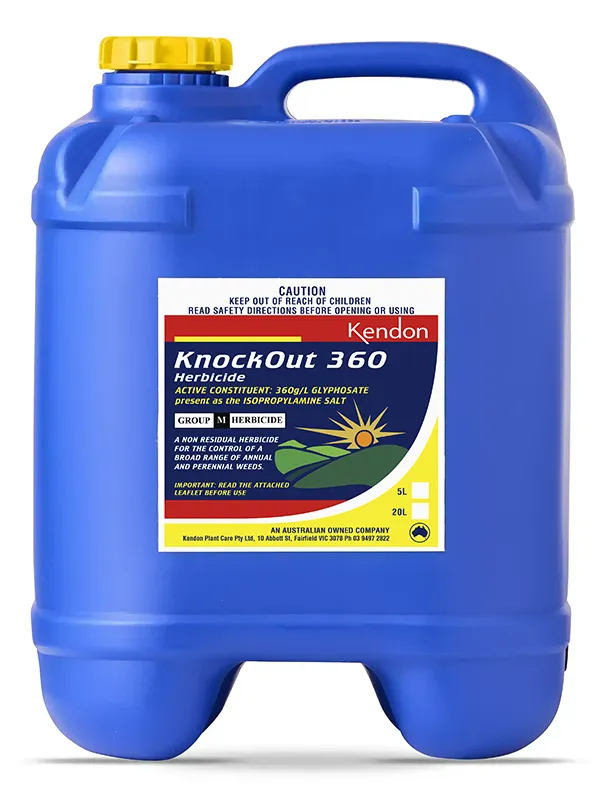
Knockout 360
Broad-spectrum, non-selective, systemic herbicide used to control annual and perennial grasses, broadleaf weeds, and woody plants. Ideal for use in agricultural, industrial, non-crop areas and aquatic weeds. Provides effective knockdown with flexible application timing.
| Knockout 360 | |
|---|---|
Target |
Common annual and perennial grasses | broadleaf weeds | aquatic weeds | woody plants. |
Product Type |
Herbicide |
Active Ingredient |
360g/L Glyphosate |
Group |
M |
Pack Size |
1L, 5L, 20L |
APVMA Registration # |
62841
Search APVMA number at APVMA PubCRIS. |
Profile
- First Marketed in 1974
- Glyphosate is absorbed by foliage, translocated both acropetally and basipetally via phloem and xylem throughout the plant
- Inactivated on contact with soil
- Classified as an aromatic amino acid synthesis inhibitor
- Glyphosate works by inhibiting the enzyme EPSPS, blocking the shikimic acid pathway and preventing the production of essential aromatic amino acids, leading to plant death
Key Features & Benefits
- Provides broad-spectrum weed control, effectively managing a wide range of weed species across both land and aquatic environments
- It is registered for use in aquatic settings, making it suitable for treating weeds in waterways, drains, and wetlands
- With its non-selective formula, it targets and eliminates all treated plants, making it ideal for clearing heavy or mixed infestations
- Safety: Non-residual and non-volatile.
Toxicity
- Acute oral Mammalian Toxicity (LD50, mg/kg) - rats > 5000
APPLICATION GUIDE
Kendon KnockOut 360 Herbicide is a non-selective, non-residual herbicide that is translocated throughout the plant, killing both foliage and roots. It is effective against a wide range of annual and perennial broadleaf weeds and grasses. Symptoms of chemical activity typically appear 2–7 days after spraying annual species and 2–3 weeks after spraying perennial species, progressing from yellowing and wilting through to complete brownout. The tables below provide registered weed species, application rates by equipment type, and critical comments drawn directly from the APVMA-registered product label.
General instructions — apply to all situations:
- Always spray actively growing plants. DO NOT treat weeds under poor growing conditions or when plants are dormant — this includes drought, waterlogging, disease, insect damage, or following frost.
- Reduced control may occur when treating weeds heavily covered with dust or silt.
- Rainfall occurring up to 6 hours after application may reduce effectiveness. Heavy rainfall within 2 hours of application may wash the chemical off the foliage; a repeat treatment may be required.
- DO NOT apply under weather conditions or from equipment that may cause spray to drift onto nearby susceptible plants, crops, cropping lands, or pastures.
- DO NOT contaminate streams, rivers, or waterways with the product or used containers.
- Grazing withholding: to allow efficient absorption by sprayed vegetation, keep livestock clear of treated annual weeds for 1 day after spraying, and for perennial weeds 7 days. For plants known to be toxic to stock, keep stock away until complete brownout occurs.
- Surfactant: the addition of surfactant may improve weed control where water rates are high or product rates are low. Suggested rates: Kenwet 1000LF at 200mL/100L, or Kendral 600 at 250–500mL/100L.
- Soil persistence: this product is not persistent in soils and is rapidly broken down by soil microbes and hydrolysis.
- Resistance warning — Group M herbicide: some naturally occurring weed biotypes resistant to Kendon KnockOut 360 Herbicide and other Group M herbicides may exist through normal genetic variability. Resistant individuals can eventually dominate the weed population if Group M herbicides are used repeatedly and will not be controlled by this product.
- Select the accordion section below that matches your weed type or situation and refer to the rate column for your application equipment.
Annual Weed Control — All States
The table below lists all annual weed species registered for control with Kendon KnockOut 360 Herbicide across all states. A single rate range applies to all listed species. Use the lower rate on weeds up to 15cm tall; increase to the higher rate when weeds are over 15cm tall. For wiper equipment and controlled droplet applicators, refer to the Application Section of the current product label.
| Weeds Controlled | Rate — Boom | Rate — Handgun | Rate — Knapsack | Critical Comments |
|---|---|---|---|---|
| Amaranth (Amaranthus spp.) Barley Grass (Hordeum leporinum) Barnyard Grass (Echinochloa spp.) Brome Grass (Bromus spp.) Caltrop (Tribulus terrestris) Canary Grass (Phalaris spp.) Capeweed (Arctotheca calendula) Cereals (Volunteer) Chickweed (Stellaria media) Cobbler's Peg (Bidens pilosa) Deadnettle (Lamium amplexicaule) Double Gee (Emex australis) Fumitory (Fumaria officinalis) Ground Cherry (Physalis angulata) Lesser Swinecress (Coronopus didymus) Liverseed Grass (Urochloa panicodes) Mintweed (Salvia reflexa) Paradoxa Grass (Phalaris paradoxa) Paterson's Curse (Echium plantaginium) Pigweed (Portulaca oleracea) Potato Weed (Galinsoga parviflora) Ryegrass (Lolium rigidum) Saffron Thistle (Carthamus lanatus) Silver Grass (Vulpia spp.) Sow Thistle (Sonchus oleraceus) Spear Thistle (Cirsium vulgare) Spiny Burrgrass (Cenchrus spp.) Spurge (Euphorbia spp.) Sub Clover (Trifolium subterraneum) Thornapple (Datura spp.) Variegated Thistle (Silybum marianum) Wild Mustard (Sisymbrium officinale) Wild Oats (Avena spp.) Wild Turnip (Brassica toumefortii) Winter Grass (Poa annua) |
2–3L/ha | 500–700mL/100L water | 75–100mL/15L water | All Weeds Spray actively growing plants. Use the lower rate on weeds up to 15cm tall. Increase to the higher rate when weeds are over 15cm tall. If residual activity is required, this product may be mixed with certain residual herbicides; see the Compatibility section of the current product label. For wiper equipment and controlled droplet applicators, see the Application Section of the current product label. |
Apply Kendon KnockOut 360 Herbicide following the Application Guide above.
Always download and read the current product label before use and follow all regulatory and safety instructions.
Perennial Weed Control
Kendon KnockOut 360 Herbicide controls over 35 perennial weed species. Rates vary by species and application method — refer to the table below for the full species list, boom, knapsack, and handgun rates, and critical comments for each species. Always apply to actively growing plants; growth stage at spraying is critical for most perennial species and is specified in the Critical Comments column for each entry.
| Weeds Controlled | Rate — Boom (L/ha) | Rate — Knapsack (mL/15L) | Rate — Handgun (vol/100L) | Critical Comments |
|---|---|---|---|---|
| Bamboo (Bambusa spp.) | — | 150mL | 1L | Apply to actively growing foliage and/or regrowth which is between 1m and 2m tall. Cut stump: Dilute 1:6 (1 part product with 6 parts water). Cut stems back to 20cm high; pour mixture down hollow stem or wet the cut. |
| Bent Grass (Agrostis tenuis) | 2.5L | 75mL | 500mL | Apply to actively growing plants in late spring when they have some seed head development but before summer drought stress. Bent grass should NOT be grazed heavily at spraying. Follow-up management is required to limit seedling re-establishment. Full disturbance with tyned implement should follow 10–21 days after spraying. Application should be followed by a summer crop and/or by reseeding pasture or crop the following autumn. |
| Blady Grass (Imperata cylindrica) | 9L | 200mL | 1.3L | Spray at head stage while plants are in active growth stage. |
| Bracken (Pteridium esculentum) | 9L | 225mL | 1.5L | For boom application, always add an organosilicone penetrant (e.g. Breach, 200mL/100L spray); otherwise reduced results will occur. Addition of an organosilicone penetrant may also improve control with handgun application. Wiper equipment is recommended; see the Wiper Equipment section of the current product label. Double pass applications required for ropewick equipment. Bracken should be slashed in winter/spring prior to treatment. Apply to fully unfurled actively growing fronds but prior to frosts. Visible symptoms may not be fully apparent until the next season. Complete control will not be achieved from one application. Repeat treatment is recommended, preferably associated with pasture improvement. |
| Carpet Grass (Axonopus spp.) | 3L | 75mL | 500mL | Spray at early head stage while in active growth stage. |
| Cocksfoot (Dactylis glomerata) | 3L | 100mL | 700mL | Spray at early head stage while in active growth stage. |
| Couch (Cynodon dactylon) | 9L | 200mL | 1.3L | Spray at early head stage (late spring). |
| Flatweed (Cat's Ear) (Hypochoeris radicata) | 3L | 100mL | 700mL | Spray at early flowering stage to fully developed rosettes. |
| Glyceria (Glyceria maxima) | 6L | 150mL | 1L | Apply to actively growing plants at mature head stage in late summer/autumn. Add a non-ionic surfactant (Kendral 600) at 200mL/100L. NOTE: Control of Glyceria is only allowable in dry drains and channels and margins of dams, lakes and streams. DO NOT apply to weeds growing in or over water. DO NOT spray across open bodies of water, and DO NOT allow spray to enter water. DO NOT allow water to return to dry channels within 4 days of application. |
| Guinea Grass (Panicum maximum) | 9L | 200mL | 1.3L | Spray at early head stage. Wiper equipment can also be used — refer to the Wiper Equipment section of the current product label. |
| Hoary Cress (Cardaria draba) | 1.5L | 75mL | 500mL | Spray at late rosette to flowering stage, late July to September. At this time of year ensure frosts, waterlogging or drought stress are not a restraint as plants need to be in active growth stage. Wiper equipment can also be used — refer to the Wiper Equipment section of the current product label. |
| Johnson Grass (Sorghum halepense) | 6L | 150mL | 1L | Spray at early head stage when plants are actively growing. Wiper equipment can also be used — refer to the Wiper Equipment section of the current product label. |
| Kangaroo Grass (Themeda australis) | 6L | 150mL | 1L | Spray at early head stage when plants are actively growing. |
| Kikuyu Grass (Pennisetum clandestinum) | 6L | 150mL | 1L | Spray at early head stage when plants are actively growing. |
| Lovegrass, African | 6L | 150mL | 1L | Apply to actively growing plants. Re-treatment and/or pasture improvement is recommended to restrict seedling re-establishment. |
| Ludwigia (Ludwigia peruviana) | — | 150mL | 1L | Apply when actively growing and at or beyond the early bloom stage of growth but before autumn colour changes occur. Thorough coverage is essential for best control. |
| Nutgrass (Cyperus rotundus) | 6L | 150mL | 1L | Non-cultivated situations: Apply to actively growing plants in late summer/autumn (Feb–April) when at least 20% have reached the head stage. |
| 3L + 3L | 100mL + 100mL | 700mL + 700mL | Cultivated situations (two-spray programme): Apply first spray in February when approximately 20–25% of plants have reached heading stage. Apply second spray approximately 2 months later. On grazing or urban land, spray in the February–April period when 20–25% of plants have reached the head stage. Underground runners broken up by cultivation may produce further seedlings; repeat treatments may be needed to obtain total control. | |
| Pampas Grass | — | 150–195mL | 1–1.3L | Apply to actively growing plants during spring, summer, or autumn. Ensure complete coverage of the foliage. For best results apply after flowering. Large plants may be cut or burnt prior to spraying — allow regrowth to reach 1m first. Use the higher rate on plants over 1m high. Low volume applications: Use a 1:9 (10%) mixture of product and water. Apply 2 × 2mL per 0.5m height. Ensure spray contacts all foliage. |
| Paragrass | 9L | 195mL | 1.3L | Apply to actively growing plants at the early head stage. |
| Paspalum (Paspalum dilatatum) | 6L | 150mL | 1L | Spray at early head stage when plants are in active growth. |
| Pellitory | — | 150mL | 1L | Apply to actively growing plants prior to seeding. Repeat applications may be necessary to control seedlings and/or regrowth. |
| Phalaris (Phalaris aquatica) | 3–6L | 75–150mL | 500mL–1L | For medium to longer term control, use the high rates while plants are in active growth phase during winter/spring. The lower rates may be used in conjunction with burning (firebreaks) — this will give a brownout and better burning conditions. Leave for 2–3 weeks after spraying before burning. |
| Plantains (Plantago spp.) | 3L | 100mL | 1L | Spray when plants have reached the early head stage. Note that plantains are slow to develop toxicity symptoms. |
| Prairie Grass (Bromus uniloides) | 6L | 150mL | 1L | Spray at early head stage of heading while plants are in active growth phase. |
| Queensland Blue Grass (Dichanthium sericeum) | 6L | 150mL | 1L | Spray at early head stage of heading while plants are in active growth phase. |
| Red-Leg Grass (Bothriochloa ambigua) | 6L | 150mL | 1L | Spray at early head stage of heading while plants are in active growth phase. |
| Rhodes Grass (Chloris gayana) | 6L | 150mL | 1L | Spray at early head stage of heading while plants are in active growth phase. |
| Rope Twitch (Agropyron repens) | 6L | 150mL | 1L | Leave ground in a dormant state for 8 months prior to spraying in late summer/autumn, so that foliage is fully available for uptake (at least 20cm in height). Ensure drought stress conditions do not exist at time of spraying. |
| Silverleaf Nightshade (Solanum elaeagnifolium) | — | 300mL | 2L | Spray actively growing plants when good soil moisture is present. Spray when plants are in the late flowering to berry stage. Follow-up sprays will be required to maximise control. |
| Sorrel (Rumex acetosella) | 6L | 150mL | 1L | Spray at bud stage so long as plants are in an active growth phase. |
| Soursob (Oxalis pes-caprae) | 1.5L | 75mL | 500mL | Best results are obtained by late winter/early spring sprays. Ensure that foliage is in a healthy, actively growing state at time of spraying. |
| St John's Wort (Hypericum perforatum) | 3L | 75mL | 500mL | Spray at the flowering to post-flowering stage in the summer/autumn period. Follow-up sprays may be needed as spraying is only part of the total management concept of pasture improvement. |
| Thistle, Artichoke (Cynara cardunculus) | 3L | 75mL | 500mL | Spray when plants have reached rosette/early heading stage. Plants should be free of soil deposits, particularly when spraying along roadsides. |
| Thistle, Californian (Cirsium arvense) | 6L | 150mL | 1L | Spray at the flowering stage. Follow-up sprays may be needed as spraying is only part of the total management concept of pasture improvement. |
| Yorkshire Fog (Holcus lanatus) | 3L | 100mL | 700mL | Spray when plants have reached the early heading stage and are in an active growth phase. |
- DO NOT disturb treated weeds by cultivation, sowing or grazing for 7 days after treatment for perennial weeds.
- Glyceria — control is only allowable in dry drains and channels and margins of dams, lakes, and streams. DO NOT apply to weeds growing in or over water, and DO NOT allow water to return to dry channels within 4 days of application.
- Nutgrass — a two-spray programme is required for cultivated situations; refer to the Critical Comments in the table for timing guidance.
- Bracken — for boom application, an organosilicone penetrant (e.g. Breach, 200mL/100L spray) must be added; otherwise reduced results will occur.
- Several species require repeat treatment — refer to the Critical Comments column for each species.
Apply Kendon KnockOut 360 Herbicide following the Application Guide above.
Always download and read the current product label before use and follow all regulatory and safety instructions.
Woody and Scrub Weeds
Kendon KnockOut 360 Herbicide controls 11 brush and woody weed species. The table uses two rate columns: Handgun / Knapsack (mL of product per 1L of water) and Low Volume (product : water ratio, for gas gun, splatter gun, or sprinkler sprayer). Where no Low Volume rate is shown (—), only high-volume application is registered for that species. Apply to actively growing plants only; specific timing requirements are listed in the Critical Comments column for each species.
| Weeds Controlled | Handgun / Knapsack (mL/1L water) | Low Volume — KnockOut 360 : Water | Critical Comments |
|---|---|---|---|
| Bitou Bush / Boneseed (Chrysanthemoides monilifera) | 5 or 10mL | 1:29 or 1:19 | Apply to actively growing plants. Do not treat plants which are stressed, particularly drought stressed. Spray to wet all foliage. Best results are achieved when treated during the winter at peak flowering time. Use the higher rate on bushes over 1.5m. Follow-up treatment may be required to prevent the establishment of germinating weeds. Low volume application (e.g. gas gun and splatter gun): Ensure spray contacts all foliage. Use the higher rate (1:19) on bushes over 1.5m high. |
| Blackberry (Rubus fruticosus) | 10 or 13mL | — | Apply from January to May (flowering to leaf fall). Spray plants which are not under stress due to high temperatures, drought or frost. Spray to thoroughly wet all foliage. Use the higher rate for dense old stands over 2m high. Further treatment may be needed to control seedlings and regrowth. Symptoms may be slow to appear and may not be apparent until next season. Burning (after complete brownout), pasture improvement and/or further treatment are recommended to control seedlings and/or regrowth. TAS ONLY: Do not spray bushes bearing mature fruit. Use of CDA equipment is not recommended. |
| Box Thorn (Lycium ferocissium) | 7–10mL | — | Spray to wet all foliage. Use the lower rate for young bushes and the higher rate for bigger mature bushes. Do not spray if conditions are hot and dry. Burning (after complete brownout), pasture improvement and/or further treatment are recommended to control seedlings and/or regrowth. Use of CDA equipment is not recommended. |
| Crofton Weed (Eupatorium adenophorum) | 5mL | — | Apply to plants with full foliage which are actively growing. Spray to wet all foliage. Further treatment and/or pasture improvement are recommended to restrict seedling re-establishment. |
| Gorse (Furze) | 10mL plus organosilicone penetrant e.g. Breach, 2mL | — | May be applied at any time of the year but plants must be actively growing. Always add an organosilicone penetrant (e.g. Breach) to ensure good results. Spray to wet all foliage. Burning (after complete brownout), pasture improvement, and/or further treatment are recommended to control seedlings and/or regrowth. |
| Groundsel Bush (Baccharis halimifolia) | 7–10mL | 1:9 | Apply to actively growing plants using the higher rate for plants over 2m tall. Do not spray during summer drought stress conditions or in winter. Spray to wet all foliage. Further treatment and/or pasture improvement are recommended to control seedlings and/or regrowth. Low volume application (e.g. gas gun and splatter gun): Use the 1:9 (10%) mixture. Apply 2 × 2mL dose per 0.5m bush height. Ensure spray contacts all foliage. Use of CDA equipment is not recommended. |
| Hawthorn (Crataegus spp.) | 10–13mL | 1:9 | Spray from flowering to leaf fall when plants are actively growing. Use the higher rate for plants over 2m tall. Spray to thoroughly wet all foliage. Burning (after complete brownout), pasture improvement and/or further treatment are recommended to control seedlings and/or regrowth. Low volume application (e.g. gas gun and splatter gun): Use the 1:9 (10%) mixture. Apply 2 × 5mL dose per 0.5m bush height. Ensure spray contacts all foliage. |
| Lantana (Lantana camara) | 10mL | 1:9 | Apply to plants with full foliage which are actively growing. Spray to thoroughly wet all foliage and individual plants. Do not spray during periods of summer drought stress. Burning (after complete brownout), pasture improvement and/or further treatment are recommended to control seedlings and/or regrowth. The addition of an organosilicone penetrant (e.g. Breach, 200mL/100L) may improve control. Low volume application (e.g. gas gun and splatter gun): Apply 2 × 2mL dose per 0.5m bush height. Ensure spray contacts all foliage. Sprinkler sprayer: Apply 6mL of a 1:9 (10%) solution to every square metre of treated area. Use of CDA equipment is not recommended. |
| Mistflower (Eupatorium riparium) | 5mL | 1:9 | Apply to plants with full foliage which are actively growing. Spray to thoroughly wet all foliage. Further treatment and/or pasture improvement are recommended to restrict seedling re-establishment. Sprinkler sprayer: Apply 3mL of a 1:9 (10%) solution to every square metre of treated area. |
| Sifton Bush / Chinese Scrub (Cassinia arcutata) | 10 or 13mL | 1:9 | Apply to actively growing plants ensuring complete coverage. Further treatment and/or pasture improvement recommended to restrict seedling re-establishment and/or regrowth. For high volume application use the higher rate when bushes are over 1m. For wiper application a double pass is required. Best results are achieved if bushes are less than 1m tall and are green at time of application. Low volume application: Apply 40mL per 0.5m height. |
| Sweet Briar (Rosa rubiginosa) | 15–20mL | 1:9 | Apply from late flowering to leaf fall to actively growing plants. Spray to thoroughly wet all foliage. Use the higher rate for bushes over 1.5m tall. Burning (after complete brownout), pasture improvement and/or further treatment are recommended to control seedlings and/or regrowth. Low volume application (e.g. gas gun and splatter gun): Apply 2 × 5mL dose per 0.5m bush height. Ensure spray contacts all foliage. |
- Apply to actively growing plants only. DO NOT treat stressed, dormant, or drought-affected plants.
- Gorse — always add an organosilicone penetrant (e.g. Breach) to ensure good results.
- Blackberry (TAS only) — do not spray bushes bearing mature fruit; CDA equipment is not recommended.
- Burning after complete brownout, pasture improvement, and/or further treatment are recommended for most species to control seedlings and/or regrowth.
- Where a Low Volume rate is shown, specific application equipment (gas gun, splatter gun, sprinkler sprayer) and dose rates per 0.5m bush height are specified in the Critical Comments column.
Apply Kendon KnockOut 360 Herbicide following the Application Guide above.
Always download and read the current product label before use and follow all regulatory and safety instructions.
Unwanted Trees
Kendon KnockOut 360 Herbicide controls a range of unwanted tree species using four registered application methods: Stem Injection, Foliar Application — Low Volume (gas gun or splatter gun), Foliar Application — High Volume (knapsack or handgun), and Cut Stump. Two separate tables are provided below — one for Stem Injection and Low Volume Foliar, and one for High Volume Foliar and Cut Stump. Select the method appropriate to your situation and equipment.
- Restraint: DO NOT apply to trees under stress or to trees that are not actively growing.
- Stem Injection — use a specially calibrated applicator delivering 1 or 2mL. Make cuts at an oblique angle about 5cm deep; ensure the cut penetrates the bark to the sap stream and inject as soon as possible after cutting. Cuts should be 13cm apart, around the tree below any branching. Remove or treat branches below the cut. For multi-stemmed trees treat each stem as an individual tree.
- Low Volume Foliar — calibrate the splatter gun to apply 5mL of solution per dose as a fine spray. Apply 5mL per 0.5m tree height. Ensure spray contacts all foliage.
- Cut Stump — dilute product with water at the recommended ratio. Cut tree close to the ground and wet the stump surface using splatter gun, spray, swab, or brush. Remove any branches on the stump and treat the surface.
Stem Injection and Low Volume Foliar Application (Gas Gun / Splatter Gun)
| Method | Tree Species Controlled | Tree Size | Rate | Critical Comments |
|---|---|---|---|---|
| Stem Injection | Flooded Gum (Eucalyptus grandis), Ghost Gum (E. papuana), Gum Topped Bloodwood (E. dichromophloia), Messmate Stringybark (E. obliqua), Narrowleaf Ironbark (E. crebra), Poplar Box (E. populnea), Privet (Ligustrum spp.), Rhus (Toxicodendron succedaneum), Silverleaf Ironbark (E. melanophloia), Swamp Mahogany (Tristania suaveolens), White Mahogany (E. acmenoides), Willows (Salix babylonica) | Basal diameter to 25cm | Undiluted — 1mL / cut | Use a specially calibrated applicator which can deliver 1 or 2mL. Make a cut at an oblique angle about 5cm deep. Ensure cut penetrates the bark to the sap stream and that product is injected as soon as possible after the cut has been made. Cuts should be 13cm apart and around the tree below any branching. Remove or treat branches below the cut. For multi-stemmed trees treat each stem as an individual tree. |
| Basal diameter over 25cm to 60cm | Undiluted — 2mL / cut | |||
| Camphor Laurel (Cinnamomum camphora) | Basal diameter to 25cm | Mixture 1:1 — 2mL / cut | ||
| Basal diameter over 25cm to 60cm | Undiluted — 2mL / cut | |||
| Foliar Application: Low Volume (Gas gun or Splatter gun) |
Bullich, Marri (E. calophyalla), Jarrah (E. marginata) | 0–1.5m height | 1:15 Add an organosilicone penetrant (e.g. Breach) at 20mL / 10L spray mixture |
Dilute the product in the recommended ratio. Calibrate the splatter gun to apply 5mL of solution per dose as a fine spray. Apply 5mL per 0.5m tree height. Ensure spray contacts all foliage. |
| Eucalyptus spp. | 1:5 Add an organosilicone penetrant (e.g. Breach) at 20mL / 10L spray mixture |
High Volume Foliar Application (Knapsack or Handgun) and Cut Stump
| Method | Tree Species Controlled | Tree Size | Rate | Critical Comments |
|---|---|---|---|---|
| Foliar Application: High Volume (Knapsack or Handgun) |
Eucalyptus spp., Willows | 0–2m height | 1–1.3L / 100L For Eucalyptus spp. add an organosilicone penetrant (e.g. Breach) at 200mL / 100L spray mixture |
Spray to wet foliage. Use the higher rate for trees 1 to 2m high. |
| Cut Stump | Jarrah (E. marginata), Longleaf Box (E. goniocalyx), Marri (E. calophyalla), Messmate Stringybark (E. obliqua), Narrowleaf Peppermint (E. radiata) | 1–10cm basal diameter | 1:15 | Dilute product with water at the recommended ratio. Cut tree close to the ground and wet the stump surface using splatter gun, spray, swab, or brush. Remove any branches on the stump and treat the surface. |
| Privet (Ligustrum spp.), Rhus (Toxicodendron succedaneum) | 0–30cm basal diameter | 1:1 |
Apply Kendon KnockOut 360 Herbicide following the Application Guide above.
Always download and read the current product label before use and follow all regulatory and safety instructions.
Aquatic Weeds
Kendon KnockOut 360 Herbicide controls 11 aquatic weed species including floating, emergent, and riparian weeds. Rates are expressed as boom (L/ha), knapsack (mL/15L), and handgun (Vol/100L). A number of critical general restrictions apply to all aquatic situations and are listed in the bullet points and the first table row below — read these carefully before use.
- DO NOT add extra surfactant or wetter unless it is approved in aquatic situations.
- DO NOT apply this product within 0.5km of a potable water intake in flowing water (e.g. river or stream) or within 0.5km of a potable water intake in a standing body of water such as a lake, pond, or reservoir.
- When making bank-side applications, do not over-spray more than 0.5m into open water. Avoid spraying across moving bodies of water where weeds do not exist.
- Applications to moving bodies of water should be made while travelling upstream wherever possible to prevent concentration of this herbicide in water.
- Reduction in effectiveness may result if more than 1/4 of the above-ground portion of the weed is submerged at treatment. DO NOT submerge weeds when spraying as this may wash herbicide off the leaves.
- When spraying floating weeds, use a low volume, low pressure boom sprayer, CDA, or sprinkler sprayer.
- When emerged infestations require treatment of the total surface area of impounded water, treating the area in strips may avoid sudden impact on habitat.
| Weeds Controlled | Boom (L/ha) | Knapsack (mL/15L) | Handgun (Vol/100L) | Critical Comments |
|---|---|---|---|---|
| Alligator Weed | — | 150mL | 1L | Apply when actively growing, from Summer through Winter. Floating form only. |
| Brown Beetle Grass | 3L | 75mL | 500mL | Apply to actively growing plants. Do not apply to partially submerged plants. |
| Cumbungi (Typha spp.) | 9L | 200mL | 1.3L | Spray during Summer or Autumn period, during the heading stage. Except for Tasmania, wiper equipment can be used. Refer to the Application Equipment section of the current product label. |
| Paragrass (Brachiaria mutica) | 9L | 200mL | 1.3L | Spray at early head stage when plants are in active growth. |
| Phragmites / Common Reed (Phragmites australis) | 9L | 200mL | 1.3L | If the wiper technique is to be used, refer to the Wiper Equipment section of the current product label. Spray when plants are getting close to early head stage and actively growing. Spray symptoms may not be observed for a season or more. |
| Rushes (Juncus spp.) Sedge — Tall (Cyperus gracilis) |
See Critical Comments | Use wiper technique ensuring a high percentage of green matter is present. Refer to the Wiper Equipment section of the current product label for directions for use. | ||
| Water Couch (Paspalum distichum) | 9L | 200mL | 1.3L | Spray actively growing plants in February/March period. 75% of plants should be visible above the water line at time of spraying. |
| Water Hyacinth | 6–9L | 150–195mL | 1–1.3L | Apply to actively growing plants at or beyond the early bloom stage of growth. Use the higher rate on dense infestations. |
| Water Lettuce | — | 150–195mL | 1–1.3L | Best results are obtained from mid-Summer through to Winter. Use the higher rate on dense infestations. |
| Waterlily, Yellow | 6L | 150mL | 1L | Apply when there is a maximum emergence of floating leaves. Allow 2–3 weeks for symptoms to develop, then re-treat if any unaffected plants. Use low volume sprayer. |
Apply Kendon KnockOut 360 Herbicide following the Application Guide above.
Always download and read the current product label before use and follow all regulatory and safety instructions.
Other Situations
Kendon KnockOut 360 Herbicide is registered for use across a range of other situations including dry waterway margins, forestry, non-agricultural areas, onions, pastures, vines and tree crops, row crops, and sugar cane ratooning. Weed species and rates for most situations refer back to the Annual Weed Control and Perennial Weed Control tables above — specific rates or critical comments unique to each situation are provided in the table below.
| Situation | Weeds Controlled | Application Rates | Critical Comments |
|---|---|---|---|
| Dry drains and channels, dry margins of dams, lakes and streams | Refer to Annual Weed Control and Perennial Weed Control tables above for species list. | Refer to rates shown in Annual Weed Control and Perennial Weed Control tables above. | See Critical Comments shown for section and individual weeds under Annual Weed Control and Perennial Weed Control tables above. |
| Forestry | Refer to Annual Weed Control and Perennial Weed Control tables above for species list. | Refer to rates shown in Annual Weed Control and Perennial Weed Control tables above. | Use situations include: prior to nursery establishment; site preparation prior to planting; in established tree areas using shielded or directed sprays or selective wiper equipment. DO NOT allow spray or spray drift to come into contact with foliage or green bark of desirable trees or severe damage may occur. DO NOT allow wiper surface to come into contact with ANY PART of the tree. |
| Non-agricultural areas, rights of way, domestic and public service areas, commercial and industrial areas and around buildings | — | — | This product does not provide residual control. |
| Onions — post-planting or pre-emergent application | Refer to Annual Weed Control and Perennial Weed Control tables above for species list. | 1–3L/ha | Apply post-sowing and at least 7 days before emergence of onion shoots. DO NOT apply to emerging onion plants as severe injury will occur. For small annual weeds use the lower rate. For large annual weeds (greater than 15cm in height) and where perennial weeds are present, use the higher rates. |
| Pastures | Refer to Annual Weed Control and Perennial Weed Control tables above for species list. | Refer to rates shown in Annual Weed Control and Perennial Weed Control tables above. | Application methods include: 1. Directed (spot) application 2. Selective application (see Wiper Equipment section of current product label) 3. Boom applications are used in pasture to control weeds prior to re-seeding of improved pasture crop — see Protection of Livestock and Wiper Equipment sections of the current product label. |
| Vines and Tree Crops Nuts (incl. Almond, Pistachio, Macadamia, Pecan and Walnut), Pome Fruit, Litchi, Stone Fruit, Vineyards, Citrus Fruit, Avocado, Guava, Kiwifruit, Mango, Paw Paw, Bananas |
Refer to Annual Weed Control and Perennial Weed Control tables above for species list. | Refer to rates shown in Annual Weed Control and Perennial Weed Control tables above. | All trees and vines: DO NOT spray near trees and vines less than 3 years old. DO NOT allow Wiper contact. Avocado, Banana, Guava, Kiwifruit, Litchi, Mango, Paw Paw, and Stone Fruit: Spray drift can cause damage if allowed to contact any part of vine, palm, trunk or tree. Be careful to avoid contact with split bark on Kiwifruit and green stems on Paw Paw. Citrus, Litchi, Olives, Pome Fruit, Nuts and Vineyards: DO NOT allow spray to contact any part of the plant. |
| Row Crops (Cotton, Navy Beans, Peanuts, Soybeans, Sugar Cane) Where Wiper Equipment or Shielded Sprayer (cotton only) is used to control weeds in row crops |
Refer to Annual Weed Control and Perennial Weed Control tables above for species list. | Refer to Wiper Equipment section of the current product label. For Shielded Sprayer (cotton only) refer to the Weeds Controlled Tables for application rates. |
Refer to the Wiper Equipment section of the current product label. Apply to weeds growing 15cm above the crop canopy or weeds growing between rows. DO NOT allow the product to come into direct contact with crops or solution to drip onto crops. DO NOT apply in crops under 20cm high. Shielded Sprayers (cotton only): apply to weeds growing between crop rows using a shielded sprayer. |
| Sugar Cane (Ratoon sprayout) |
— | 4–9L/ha | Spray only if ratoons are in active growth phase and are 60–100cm in height. DO NOT apply if plants are drought stressed or suffering effects of waterlogging. Ensure boom is at a height above the ratoon canopy that allows the correct overlap of the spray pattern. Use higher rates to control. Use lower rates for suppression if it is planned to follow up with cultivation. |
Apply Kendon KnockOut 360 Herbicide following the Application Guide above.
Always download and read the current product label before use and follow all regulatory and safety instructions.
What is Kendon KnockOut 360 Herbicide and what is it used for?
What is the active constituent in Kendon KnockOut 360 Herbicide?
What weed types does Kendon KnockOut 360 Herbicide control?
How does Kendon KnockOut 360 Herbicide work?
How do I apply Kendon KnockOut 360 Herbicide?
Application rates and methods vary by weed type and situation. Refer to the Application Guide above for full rates by boom, handgun, knapsack, and other equipment. Always spray actively growing plants. DO NOT treat weeds under poor growing conditions or dormant conditions such as drought, waterlogging, disease, insect damage, or following frost. Reduced control may occur when treating weeds heavily covered with dust or silt. Rainfall occurring up to 6 hours after application may reduce effectiveness; heavy rainfall within 2 hours may require a repeat treatment.
For Controlled Droplet Application (CDA) equipment rates and nozzle guidance, refer to the current product label.
Always download and read the current product label before use. This product is not to be used for any purpose or in any manner contrary to the label unless authorised under appropriate legislation.
When should I NOT use Kendon KnockOut 360 Herbicide?
Does Kendon KnockOut 360 Herbicide have a withholding period?
Can Kendon KnockOut 360 Herbicide be mixed with other herbicides?
What are the key restraints and DO NOT statements for Kendon KnockOut 360 Herbicide?
- DO NOT apply under weather conditions that may cause spray drift onto nearby susceptible plants, crops, or pastures;
- DO NOT contaminate streams, rivers, or waterways with the product or used containers;
- DO NOT apply aquatic weed treatments directly to open water;
- DO NOT treat weeds under poor growing conditions or when dormant;
- DO NOT disturb treated weeds by cultivation, sowing, or grazing within the recommended periods. In orchards and vineyards,
- DO NOT allow spray to contact foliage, green bark, or exposed roots of desirable trees or vines.
- DO NOT use for turf renovation unless the turf area is being completely renovated.
- DO NOT store in galvanised steel or unlined containers.
What personal protective equipment (PPE) do I need when using Kendon KnockOut 360 Herbicide?
What should I do in case of poisoning or health concerns with Kendon KnockOut 360 Herbicide?
Where can I buy Kendon KnockOut 360 Herbicide?
POPULAR PRODUCTS
BROWSE OUR RANGE
BUY FROM
Our Distributors