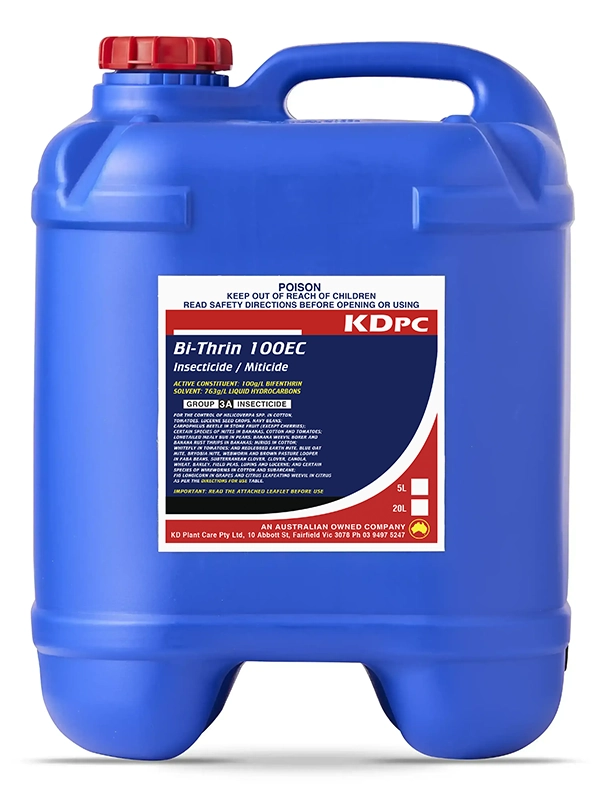
Bi-thrin Insecticide / Miticide
A non-systemic insecticide active by contact and ingestion. Effectively controls certain mites, Weevil, Budworms, Bugs, whiteflies in a wide range of crops.
| Bi-Thrin Insecticide / Miticide | |
|---|---|
Target Pests |
Mites | Weevil | Beetles | Budworm Thrips | Whiteflies | Bugs |
Product Type |
Insecticide |
Active Ingredient |
100g/L Bifenthrin |
Group |
3A |
Pack Size |
1L, 2.5L, 5L, 20L |
APVMA Registration # |
67458
Search APVMA number at APVMA PubCRIS. |
Profile
First marketed in 1984. Modulation of voltage-gated sodium channels, preventing the channels from closing and resulting in hyperexcitation.
Key Features & Benefits
- Solvent based & Fast Acting
- Extensive range of targeted pests
- Excellent residual action
- Residual surface treatment
- Mixes with water as the carrier solution
Toxicity
Acute oral (LD50, mg/kg) rats 53.4
What is Bi-Thrin 100EC Insecticide Miticide?
100 g/L bifenthrin | Group 3A Insecticide | Emulsifiable Concentrate
Bi-Thrin 100EC is a broad-spectrum bifenthrin insecticide and miticide that delivers reliable contact and residual control across a wide range of crops — from bananas, cotton and tomatoes through to stone fruit, grapes, citrus, broadacre cereals and pastures, sugarcane and pears. Whether you are protecting soft fruit from pre-harvest beetle attack, managing wireworm pressure at planting, or controlling earth mites in newly sown pastures, Bi-Thrin 100EC provides a versatile, proven tool for growers and agronomists across Australia.
- Broad-spectrum control — effective against insects and mites across more than a dozen registered crop groups.
- Contact and residual activity — acts as both a knockdown treatment and a protective barrier when applied at regular intervals.
- Flexible application — registered for foliar, soil-directed, stool, band, in-furrow and aerial use depending on the crop situation.
- Multiple crop segments — registered in horticulture, broadacre, sugarcane and tropical cropping systems.
- Complements the Kendon range — fits naturally alongside other Kendon Plant Care insecticides and miticides as part of a resistance management programme.
- Australian-owned product — registered and supported by KD Plant Care Pty Ltd, Fairfield VIC.
What are the withholding periods (WHPs) I need to know for the main crop groups?
Can I use Bi-Thrin 100EC in an IPM programme where predatory mites are present?
What is the difference between the seasonal programme and the monitoring programme in bananas?
What herbicides and fungicides is Bi-Thrin 100EC compatible with?
What is the difference between stool treatment and band treatment in bananas?
What is the larval size restriction for Helicoverpa armigera and why does it matter?
What does dilute versus concentrate spraying mean for stone fruit and what limits apply?
Dilute spraying applies product at the label rate per 100L of water to near the point of run-off (50ml / 100L for stone fruit). Concentrate spraying uses reduced water volume with a proportionally higher product concentration — however the total product applied per hectare must remain equivalent regardless of method, and the concentrate rate must not exceed 100ml / 100L. No more than 2 applications per season are permitted, with a minimum of 10 days between treatments. See the Application Guide for Stone Fruit.
How should I manage resistance when using Bi-Thrin 100EC?
Can Bi-Thrin 100EC be applied by aircraft?
I am exporting stone fruit — can I still use Bi-Thrin 100EC?
How do I mix Bi-Thrin 100EC correctly and what spray volumes should I use?
What are the key safety precautions when handling and applying Bi-Thrin 100EC?
How should I store and dispose of Bi-Thrin 100EC containers?
Is Bi-Thrin 100EC dangerous to bees, fish or aquatic life?
Where can I buy Bi-Thrin 100EC?
APPLICATION GUIDE
Global Restraints
Before applying Bi-Thrin 100EC, note these label-wide restraints that apply across all crop situations:
- DO NOT use a foliar spray in banana plantations or in any orchard / situation where mite predators are established and providing effective mite control.
- DO NOT apply as a foliar treatment if rainfall is expected before spray deposits have dried on leaf surfaces.
- DO NOT apply to bananas by aircraft.
Bananas
Bi-Thrin 100EC is registered in QLD, NSW, WA and NT for the control of Banana Weevil Borer (Cosmopolites sordidus) and Banana Rust Thrips (Chaetanaphothrips signipennis), as well as Strawberry Spider Mite (Tetranychus lambi) in QLD and WA. Applications are soil-directed (stool or band treatment) for weevil borer and thrips — foliar sprays for mite are only appropriate where predatory mites are not already providing control. Choose between a fixed seasonal programme (one or two treatments per year on a calendar schedule) or a monitoring programme (treatments triggered by trap counts and corm damage assessments from September through April).
| Crop / Situation | Pest | State | Rate | WHP | Critical Comments |
|---|---|---|---|---|---|
| Bananas | Banana Weevil Borer (Cosmopolites sordidus) Banana Rust Thrips (Chaetanaphothrips signipennis) |
QLD, NSW, WA, NT only | Seasonal Program Stool Treatment Method 250ml - 330ml / 100L Twice Per Year OR 660ml / 100L Once Per Year Band Treatment Method 250ml / 100L Twice Per Year Monitoring Program Stool Treatment Method 330ml / 100L v Band Treatment Method 250ml / 100L | 1 Day | Seasonl Program Twice per year timing: Apply in October / November (Spring /early Summer) and March /April (late Summer / Autumn). Use the higher rate (concentration) when borer pressure or damage is high. Once per year timing: Apply in October / November OR March / April. Monitoring program: Monitor weevil borer populations carefully by trap counts and / or corm damage ratings, beginning in September when pest activity is on the increase and continue until April. Apply treatment when Banana Weevil Borers reach or exceed acceptable levels. Monitor borer control after application and re treat as required. Banana Weevil Borer: Application should be made after rain or irrigation during periods of high adult borer activity. Banana Rust Thrips: Application against Banana Weevil Borer will give coincident rust thrip control, particularly when application is made when thrips activity is on the increase, usually beginning September and into Summer months. Application Methods Stool Treatment Application: Remove trash from the base of stools and apply 500ml - 750ml of spray solution to each stool, depending on stool size. Treat the bottom 30cm of each stool as well as the soil in a 30cm band around each stool, ensuring thorough treatment of both butt(s) and follower(s). Use the lower spray volume 500ml on small stools less than 50cm across the entire base. Band Treatment Application: Apply as a band application with a side delivery boom and offset nozzles on both sides of the row with the spray pattern positioned to spray 30cm of soil on either side of the row and 30cm in height. Aim to apply a total spray volume of 1L / Stool area. For single sucker row configurations, apply 28L of solution per 100 metres of row in a band 0.5m wide on each side of the row, overlapping in the centre. For double sucker row configurations, apply 56L of solution per 100 metres of row in a band 1m wide on each side of the double row with the spray pattern overlapping between the rows. |
| Strawberry Spider Mite (Tetranychus lambi) | QLD & WA only | 40ml / 100L | 8 Days |
Monitor mite population on old leaves, particularly during hot dry conditions. Apply KDPC Bi-Thrin 100EC Insecticide / Miticide as a preventative rather than a curative treatment before damage occurs, and before mite numbers build up to damaging levels. Follow up applications may be required 10-14 day intervals. Thorough coverage of the lower leaf surface is essential to ensure good control. Use a total spray volume of 300L - 500L / ha. |
Notes:
- Choose the seasonal programme for calendar-based management; choose the monitoring programme if you have robust trap-count data and prefer threshold-driven applications.
- Always apply stool treatments after rain or irrigation during periods of high adult borer activity for best uptake and efficacy.
- DO NOT apply foliar sprays in banana plantations where mite predators are already providing effective control.
- DO NOT apply to bananas by aircraft.
- WHP for ground applications is 1 day; for foliar applications it is 8 days.
Always download and read the current product label before use and follow all regulatory and safety instructions.
Cotton
Bi-Thrin 100EC is registered in QLD, NSW and WA for a broad range of cotton pests including Helicoverpa spp. (native budworm and bollworm), Two Spotted Mite, Green Mirid and Apple Dimpling Bug. Applications must be timed to egg hatch when H. armigera larvae are no longer than 5 mm — applying to larger larvae is neither effective nor permitted. Critical livestock restrictions apply: treated cotton must not be grazed, cut for stockfeed, or have its trash fed to livestock. In-furrow wireworm treatments at planting are covered in the second table below.
| Crop / Situation | Pest | State | Rate | WHP | Critical Comments |
|---|---|---|---|---|---|
| Cotton | Native Budworm (Helicoverpa punctigera) Cotton Bollworm (Helicoverpa armigera) Two Spotted Mite (Tetranychus urticae) Green Mirid (Creontiades dilutus) Apple Dimpling Bug (Campylomma liebknechti) |
QLD, NSW & WA only | 600ml – 800ml / ha | 14 Days DO NOT GRAZE OR CUT FOR STOCK FEED DO NOT FEED COTTON TRASH TO LIVESTOCK |
Apply as indicated by field checks. Use the higher rate when pest pressure is high, conditions favour pest development or when increased residual protection is required. Budworm & Bollworm: Time applications to coincide with egg hatch when small larvae up to 5mm are present. DO NOT apply to Helicoverpa armigera larvae longer than 5mm. Two Spotted Mite: Applications against Helicoverpa spp. will give good control of coincident Two Spotted Mite, particularly at low mite populations (around 10% leaf infestation). A second application 14–20 days later may be required if conditions continue to favour mite development. Green Mirid & Apple Dimpling Bug: Apply at recommended threshold levels as indicated by field checks. Use the higher rate for increased pest pressure and longer residual protection. |
| False Wireworm (Pterohelaeus alternatus) Sugarcane Wireworm (Agrypnus variabilis) |
375ml / ha¹ OR 3.8ml / 100m of row |
Wireworms: Apply as a spray into the furrow at planting. Use a nozzle delivering a coarse spray in a total volume of 60L – 100L / ha in a 10cm band over the seed before soil is brought in behind covering tyres in front of the press wheel. ¹ Rate based on 1m row spacing. If row spacing varies from 1m, apply at the ml / 100m of row rate. |
Notes:
- Time all Helicoverpa applications to egg hatch — only target larvae ≤ 5mm in length.
- DO NOT apply to H. armigera larvae larger than 5mm; efficacy is greatly reduced and resistance pressure increases.
- Adhere to the Summer Crop Insecticide Strategy developed by QLD DPI and NSW Agriculture to help manage pyrethroid resistance in northern NSW and QLD.
- DO NOT graze or cut treated cotton for stockfeed; DO NOT feed cotton trash to livestock.
- Wireworm in-furrow rate is based on 1 m row spacing — convert to ml / 100m of row if spacing differs.
Always download and read the current product label before use and follow all regulatory and safety instructions.
Tomatoes
Bi-Thrin 100EC is registered nationally for Helicoverpa spp., Two Spotted Mite, Tomato Russet Mite and Whitefly in tomatoes. High-volume (dilute) or low-volume applications are both registered, however low-volume ground or aerial application must not be used on trellis tomatoes. Apply either on a crop monitoring programme triggered by field checks, or on a 7–10 day scheduled programme alternating with a non-pyrethroid insecticide. The WHP is 1 day before harvest.
| Crop / Situation | Pest | State | Rate | WHP | Critical Comments |
|---|---|---|---|---|---|
| Tomatoes | Native Budworm (Helicoverpa punctigera) Corn Earworm (Helicoverpa armigera) Two Spotted Mite (Tetranychus urticae) Tomato Russet Mite (Aculops lycopersici) |
All States | High Volume 40ml – 60ml / 100L OR Low Volume 40ml – 60ml / 100L | 1 Day | DO NOT use low volume ground or air application on trellis tomatoes. Crop Monitoring Programme: Helicoverpa spp: Apply as indicated by field checks. Time applications to coincide with egg hatch when small larvae up to 5 mm are present. DO NOT apply this product to Helicoverpa (= heliothis) armigera larvae larger than 5mm. Schedule Spray Programme: If fields are not regularly monitored during pest infestation periods, apply on a 7–10 day alternating programme with a non-pyrethroid insecticide. Use the higher rate and shorter application interval when pest infestation is more severe or increased residual protection is required. DO NOT apply this product to Helicoverpa armigera larvae larger than 5mm. Mites: Applications against Helicoverpa spp. will give good control of coincident mites when applied at low mite populations. A second application 14–20 days later may be required if conditions continue to favour mite development. |
| Whitefly (Trialeurodes vaporariorum) | 30ml / 100L Water | Apply as indicated by pest incidence and repeat as necessary. Use a total spray volume of 2500L / ha. |
Notes:
- Choose the monitoring programme over the schedule programme wherever possible to reduce resistance pressure on Group 3A chemistry.
- DO NOT use low-volume applications on trellis tomatoes — high-volume dilute spraying is required for adequate canopy penetration.
- Target Helicoverpa larvae at ≤ 5mm only; always time sprays to egg hatch.
- Monitor mite populations closely after Helicoverpa timings and apply a second treatment if populations rebound within 14–20 days.
Always download and read the current product label before use and follow all regulatory and safety instructions.
Stone Fruit (Peaches, Nectarines, Plums, Apricots)
Bi-Thrin 100EC is registered nationally for Carpophilus Beetle (Carpophilus spp.) in peaches, nectarines, plums and apricots — not cherries. Monitor orchards closely as fruit approaches maturity and applies once beetles reach damaging levels. A maximum of two applications per season is permitted, with a minimum of 10 days between treatments. Both dilute and concentrate spraying methods are registered; the total amount of product applied per crop must be equivalent regardless of method. Note: Growers exporting treated stone fruit should contact KD Plant Care Pty Ltd or the Australian Fresh Stone Fruit Growers Association regarding maximum residue limits (MRLs) in target markets before applying.
| Crop / Situation | Pest | State | Rate | WHP | Critical Comments |
|---|---|---|---|---|---|
| Peaches, Nectarines, Plums, Apricots (not cherries) |
Carpophilus Beetles (Carpophilus spp.) | All States | Dilute Spraying 50ml / 100L Concentrate Spraying Refer to Mixing / Application section. Maximum 100 ml / 100 L concentrate spray. |
1 Day | Monitor stone fruit orchards for Carpophilus Beetle as fruit approach maturity and become susceptible to attack. Apply KDPC Bi-Thrin 100EC Insecticide / Miticide as a dilute spray before beetles reach damaging levels. Apply to the foliage and fruit of trees. Continue to monitor beetle numbers and if necessary re-apply KDPC Bi-Thrin 100EC Insecticide / Miticide up to 1 day before harvest or use another insecticide registered for this purpose. Apply no more than 2 applications per season. There must be a minimum of 10 days between the re-treatment and the initial application. Apply the same total amount of product to the target crop whether applying this product by dilute or concentrate spraying methods. DO NOT use at rates greater than 100ml / 100L water when using the concentrate spraying. Cultural control methods (eg. Destruction of fallen fruit by mulching) should be used to prevent excessive build up of Corpophilus Beetle. |
Notes:
- Begin monitoring as fruit approaches maturity; apply promptly once beetles are detected at damaging levels.
- Maximum 2 applications per season, with a minimum of 10 days between treatments.
- Maintain equivalent total product per hectare whether using dilute or concentrate method — do not exceed 100 ml / 100 L in concentrate spraying.
- Integrate cultural controls such as fallen-fruit removal and mulching to reduce beetle pressure between sprays.
- Check export MRL status before applying to stone fruit destined for overseas markets — not all markets have tolerances in place.
Always download and read the current product label before use and follow all regulatory and safety instructions.
Grapes
Bi-Thrin 100EC is registered in NSW, ACT and WA for Fig Longicorn (Acalolepta vastator) in grapes. The application is a single, once-per-season high-volume trunk and cordon spray applied at late dormancy after pruning and before bud burst — timing is critical. Apply by hand using a high-volume coarse spray directed at the bark of the trunk and cordons (arms) of each vine, targeting approximately 500 ml of spray solution per vine.
| Crop / Situation | Pest | State | Rate | WHP | Critical Comments |
|---|---|---|---|---|---|
| Grapes | Fig Longicorn (Acalolepta vastator) | NSW, ACT & WA only | 1L / 100L ~500ml spray solution / vine (approx. 1,250L / ha at 2,500 vines / ha) |
Not required when used as directed | Application must be made at late dormancy, after pruning and before bud burst. Apply a single high volume spray, with nozzles directing the spray solution to the trunk and cordons (arms) of grapevines to achieve thorough wetting of bark. Total spray volume should be about 500ml / vine achieved by hand application. |
Notes:
- Timing is non-negotiable — this is a late dormancy treatment; do not apply once bud burst has commenced.
- Single application per season; direct the spray at the trunk and cordons to ensure thorough bark wetting.
- Registered in NSW, ACT and WA only.
Always download and read the current product label before use and follow all regulatory and safety instructions.
Citrus
Bi-Thrin 100EC is registered nationally for Citrus Leafeating Weevil (Eutinophaea bicristata) in citrus. Applications are high-volume, soil-directed band sprays applied under the tree canopy — not foliar treatments. Choose between a pre-emergence programme (fixed timing at mid-October before major beetle emergence) or a post-emergence monitoring programme (applied at peak emergence in October / November as indicated by polystyrene-trap monitoring counts). WHP is not required when used as directed.
| Crop / Situation | Pest | State | Rate | WHP | Critical Comments |
|---|---|---|---|---|---|
| Citrus | Citrus Leafeating Weevil (Eutinophaea bicristata) | All States | Pre-Emergence Programme 12.5ml OR 25ml / Tree Post-Emergence Monitoring Programme 6ml / Tree |
Not required when used as directed | Apply as a high volume band application in a 1.5 to 2 metres wide swath, to the ground, both sides of the row, under each tree. Aim to apply a total spray volume of 5L to 10L / tree (eg. At 250 trees / ha = 1250L to 2500L / ha. Pre-emergence Program: Apply just prior to, or at the first sign of major beetle emergence mid-October. Use the higher rate in blocks with a history of high beetle numbers or when longer residual control is required. Post-emergence Monitoring Program: Apply at peak beetle emergence in October / November as indicated by field monitoring. (Refer to monitoring statment on label). Follow up treatment may be necessary based on threshold of 25 beetles per 10 sites per orchard in consecutive counts 1 - 2 weeks apart. |
Notes:
- This is a soil-directed application — spray to the ground under the tree canopy, not to the foliage.
- Start monitoring from mid-October at 1–2 week intervals; apply the post-emergence treatment once the threshold of 25 beetles per 10 sites is reached in consecutive counts.
- Use the higher pre-emergence rate (25 ml / tree) in blocks with a history of heavy beetle pressure or to extend residual protection.
- Ensure adequate spray volume (5–10 L / tree) to achieve sufficient soil coverage in the treated band.
Always download and read the current product label before use and follow all regulatory and safety instructions.
Broadacre & Pasture
Bi-Thrin 100EC is registered nationally for a range of mite and caterpillar pests across canola, faba beans, subterranean clover, clover, barley, field peas, lupins, lucerne and wheat. Applications may be made by broadcast ground rig (50–200L / ha) or by aircraft (minimum 20L / ha). A 4-week grazing and cutting withholding period applies after application. Navy beans and lucerne seed crops are covered in the second table below as they carry specific Helicoverpa directions.
| Crop / Situation | Pest | State | Rate | WHP | Critical Comments |
|---|---|---|---|---|---|
| Canola, Faba Beans, Subterranean Clover, Clover, Barley, Field Peas, Lupins, Lucerne & Wheat | Red Legged Earth Mite (Halotydeus destructor) Brown Pasture Looper (Ciampa arietaria) Webworm |
All States | 50ml – 100ml / ha | 4 Weeks (Grazing) | Apply as broadcast ground rig in 50L – 200L / ha total water volume, or by air in a minimum of 20L / ha. Apply to bare soil after conventional cultivation and sowing, or onto well-grazed pasture after direct drilling. Treat infested paddocks after sowing. Use the higher rate on heavier infestations and for longer residual protection. |
| Blue Oat Mite (Penthaleus major) Pasture Webworm (Hednota spp.) |
100ml / ha | ||||
| Bryobia Mites (Bryobia spp.) | 200ml / ha | ||||
| Canola | Vegetable Weevil (Listroderes difficilis) (Canola only) |
100ml – 200ml / ha | Use 100ml rate when pest pressure is low. Monitor adjacent habitat and edges of the field for presence of Vegetable Weevil prior to making a decision to spray. |
| Crop / Situation | Pest | State | Rate | WHP | Critical Comments |
|---|---|---|---|---|---|
| Lucerne Seed Crops | Native Budworm (Helicoverpa punctigera) | All States | 400ml – 600ml / ha | Not required when used as directed | DO NOT treat lucerne seed crops intended for alfalfa sprout production. Apply as indicated by field checks after commencement of flowering. Use the higher rate when pest pressure is high, conditions favour pest development and when increased residual protection is required. Native Budworm: Applications should be timed to coincide with egg hatch and when small larvae up to 5mm are present. |
| Navy Beans | Native Budworm (Helicoverpa punctigera) Corn Earworm (Helicoverpa armigera) |
All States | 600ml – 800ml / ha | 14 Days (Harvest & Grazing) | Apply as indicated by field checks from flowering onwards. Use the higher rate when pest pressure is high, conditions favour pest development and when increased residual protection is required. Budworm & Earworm: Application should be timed to coincide with egg hatch and when small larvae up to 5mm are present. DO NOT apply this product to Helicoverpa (=Heliothis) armigera larvae longer than 5mm in length. |
Notes:
- A 4-week grazing / cutting WHP applies to all pasture and broadacre crops — plan stock management accordingly.
- Bryobia mites require the highest broadacre rate (200ml / ha) — do not under-dose for this pest.
- Ground rig applications should use hollow cone nozzles delivering a droplet size of 150–200 microns.
- Aerial application: use at least 20 L / ha total spray volume. Spray during the cooler parts of the day or night. Avoid calm conditions or light and variable winds to minimise drift; preferably spray in a crosswind. A spray-drift minimisation strategy must be employed at all times when making aerial applications near sensitive areas.
- DO NOT treat lucerne seed crops intended for alfalfa sprout production.
- Helicoverpa applications in navy beans: target larvae ≤ 5mm at egg hatch only.
Always download and read the current product label before use and follow all regulatory and safety instructions.
Sugarcane
Bi-Thrin 100EC is registered in QLD, NSW and WA for Sugarcane Wireworm (Agrypnus spp.) as an in-furrow spray at planting. The treatment is applied as a coarse spray into the furrow over the setts before covering soil is brought in. The rate is based on 1.5 m row spacing — convert to ml / 100 m of row if spacing differs.
| Crop / Situation | Pest | State | Rate | WHP | Critical Comments |
|---|---|---|---|---|---|
| Sugarcane | Sugarcane Wireworm (Agrypnus spp.) | QLD, NSW & WA only | 375ml / ha² OR 5.6ml / 100m of Row |
Not required when used as directed | Apply as a spray into the furrow at planting. Use a spray nozzle delivering a coarse spray in a total volume of 60L – 100L / ha in a band 20–30cm wide over the base of the furrow, on top of the setts and before covering soil is brought in by tynes. ² Rate based on 1.5m row spacing. If row spacing varies from 1.5m, apply at the ml / 100m of row rate. |
Notes:
- In-furrow application only — this is not a foliar treatment.
- Rate is based on 1.5 m row spacing; convert to ml / 100 m of row if row spacing differs.
- Apply before covering soil is placed over the setts; soil coverage after application is essential for efficacy.
Always download and read the current product label before use and follow all regulatory and safety instructions.
Pears
Bi-Thrin 100EC is registered in VIC and WA for Long-tailed Mealy Bug (Pseudococcus longispinus) in pears. The application is a foliar spray applied as a tank mixture with horticultural spray oil, timed between green tip and the commencement of flowering. Do not spray once flowering has commenced, and do not spray until large numbers of young nymphs have emerged in spring. WHP is 14 days before harvest.
| Crop / Situation | Pest | State | Rate | WHP | Critical Comments |
|---|---|---|---|---|---|
| Pears | Long-tailed Mealy Bug (Pseudococcus longispinus) | VIC & WA only | 25ml / 100L PLUS Spray oil at 1L / 100L (apply to near point of run-off) |
14 Days | Examine wood for the presence of overwintering Long-tailed Mealy Bugs; do not spray until large numbers of young nymphs emerge in spring. Apply the mixture to near the point of run-off to all above-ground parts of the tree, between green tip and the commencement of flowering. DO NOT spray after flowering has commenced. |
Notes:
- Registered in VIC and WA only.
- Spray oil must be included in the tank mix at 1L / 100L — do not apply Bi-Thrin alone for this use.
- Timing window is narrow: green tip to pre-flowering; do not apply once flowering commences.
- Inspect wood for overwintering populations in early spring before making a spray decision.
- WHP is 14 days before harvest.
Always download and read the current product label before use and follow all regulatory and safety instructions.
BUY FROM
Our Distributors