
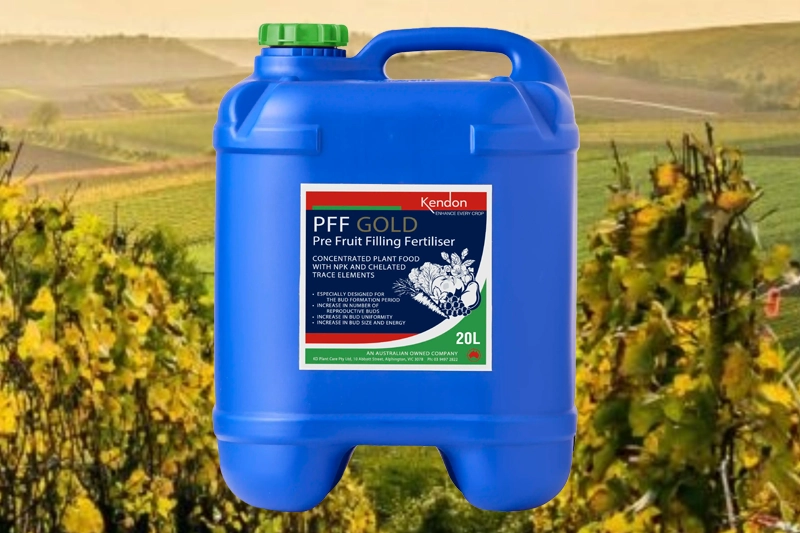
The post-harvest pre-senescence window is the most critical phase for building grapevine nutrient reserves. Research indicates that up to 50% of next season’s nitrogen and phosphorus comes from reserves stored during this period. Using a balanced foliar nutrient like Kendon PFF Gold (5:3:5 NPK) ensures the canopy remains active, allowing for maximum carbohydrate translocation and uniform budburst in the spring.
Why the Post-Harvest Pre-Senescence Window is Critical for Grapes
This period immediately after harvest—known as the post-harvest pre-senescence stage—is one of the most important physiological phases in vineyard management. Although fruit has been removed, vines remain metabolically active and continue photosynthesising while leaves are still functional.
During this stage, carbohydrates and nutrients produced in the canopy are transported to the roots, trunk, and canes, where they are stored as reserves for the following growing season.
Research shows that nutrient reserves accumulated during this stage strongly influence early spring growth, budburst, and shoot development. A large proportion of the nutrients used in the following season originate from reserves stored during the previous post-harvest period. Studies with mature grapevines indicate that approximately 50% of the nitrogen and phosphorus used in the new season’s canopy comes from stored reserves, while smaller portions of potassium, calcium, magnesium, and other micronutrients are also mobilised from storage tissues.
Furthermore, research suggests that around one-third of the annual nitrogen and phosphorus requirements of grapevines can be absorbed and stored during the post-harvest period, together with approximately 20% of calcium and magnesium and about 15% of potassium. These findings highlight the importance of maintaining an active canopy and supplying balanced nutrition before natural leaf senescence occurs.
The Science of Nutrient Translocation: How Grapes Store Nitrogen and Phosphorus
During this stage, the vine transitions from fruit production to reserve accumulation. Nutrient uptake and re-translocation occur simultaneously as leaves move nutrients to perennial structures such as roots and woody tissues. This process supports early growth the following season, when developing shoots rely heavily on stored reserves before new leaves become fully photosynthetically active.
- Nitrogen (N): The most important nutrient stored during this stage. Post-harvest nitrogen uptake replenishes vine reserves and supports strong early shoot growth and budburst in spring.
- Phosphorus (P): Plays a key role in energy transfer and root metabolism, supporting the storage and mobilisation of nutrients within the plant.
- Potassium (K): Contributes to carbohydrate transport, osmotic regulation, and enzyme activation.
- Calcium (Ca) and Magnesium (Mg): Accumulate in roots and woody tissues after harvest, supporting cell structure, metabolic stability, and overall vine resilience.
- Micro Nutrients: Including Molybdenum (Mo), Boron (B), and Zinc (Zn), which support good quality fruit set during the following season.
Maximising Photosynthesis: Why a Healthy Canopy Drives Nutrient Storage
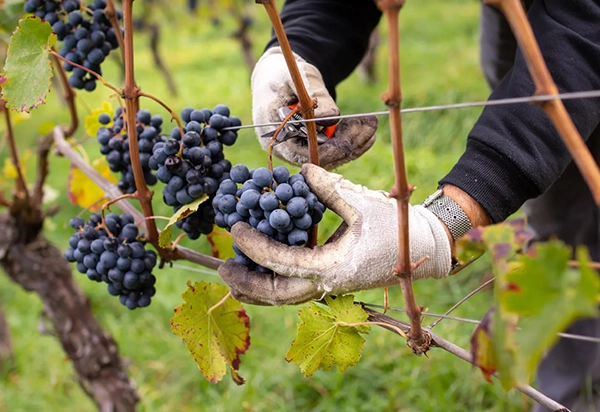
For nutrient uptake and reserve accumulation to occur effectively, vines must maintain a healthy and functional leaf canopy during the post-harvest pre-senescence stage.
Continued photosynthesis during this period drives carbohydrate production and supports the translocation of nutrients into storage tissues. Irrigation, canopy health, and nutrient availability work together to determine the success of reserve accumulation before the onset of natural senescence.
Kendon PFF Gold: A Balanced Foliar Solution for Post-Harvest Vines
Balanced foliar nutrition is an effective strategy for supporting vines during this physiological window.
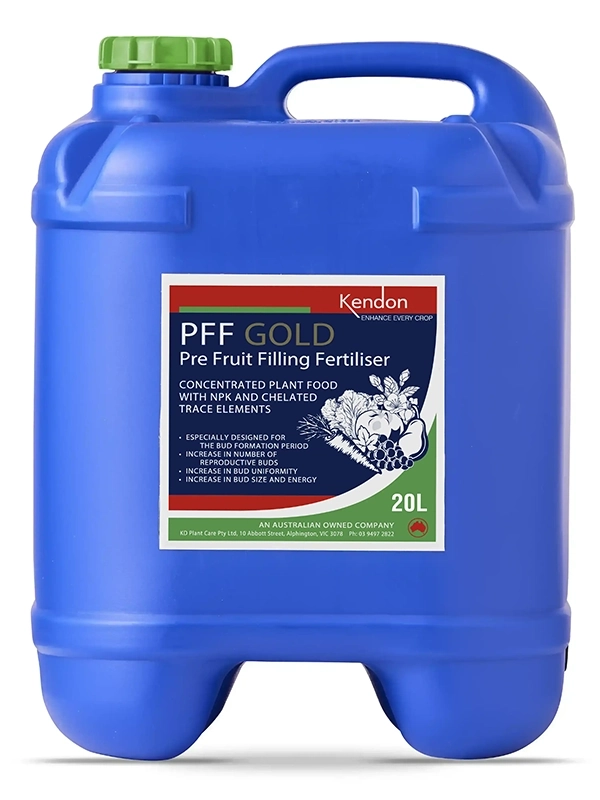
Kendon PFF Gold, with a balanced NPK ratio (5:3:5 %w/w), aligns with the nutritional requirements of grapevines during the post-harvest pre-senescence stage.
This balanced ratio provides:
- Nitrogen (5%) to maintain chlorophyll activity and sustain photosynthesis.
- Phosphorus (3%) to support energy transfer and nutrient storage processes.
- Potassium (5%) to assist carbohydrate transport and facilitate calcium uptake from the roots.
- EDTA‑chelated Magnesium (Mg), Zinc (Zn), Boron (B), and Molybdenum (Mo) to support efficient foliar absorption.
By supplying nutrients in balanced proportions, this formulation supports the vine’s natural physiological processes during reserve accumulation.
Key Agronomic Benefits of Applying Kendon PFF Gold Post-Harvest
Applying a balanced foliar nutrient during this stage helps:
- Maintain green leaf area and photosynthetic activity.
- Improve carbohydrate production and storage.
- Support nutrient reserve accumulation in roots and woody tissues.
- Strengthen vine recovery following harvest.Promote uniform budburst and early canopy development.
Conclusion
The post-harvest pre-senescence stage represents a critical opportunity to build the nutrient and carbohydrate reserves that drive the following season’s growth. Maintaining canopy activity and providing balanced nutrition during this window is key to vineyard productivity. Nutrient programs incorporating formulations such as Kendon PFF Gold offer a practical approach to supporting vine physiology and preparing for a strong start to the next growing season.
Maintaining canopy activity and providing balanced nutrition during the Post-Harvest Pre-Senescence window can therefore play a key role in vineyard productivity for the following year. Nutrient programs incorporating balanced formulations such as Kendon PFF Gold offer a practical approach to supporting vine physiology, improving reserve accumulation, and preparing vines for a strong start to the next growing season.
Expert Support and Safety Data Sheets for Kendon PFF Gold
Have questions or need more details? Reach out to us on our contact form or (03) 9497 2822 — we’re always happy to help.
Or simply click on the REQUEST SDS button for a Safety Data Sheet (SDS) on the pages below: