Material Safety Data Sheet
Issue date: July 2004
Hazardous
according to criteria of Worksafe Australia
Formaldehyde
|
1. CHEMICAL
PRODUCT AND COMPANY IDENTIFICATION |
COMPANY DETAILS:
Kendon Chemical & MNFG. Co. Pty
Ltd
71 McClure Street
Thornbury, Vic, 3071
Phone: 03 9497 2822
Fax: 03 9499 7225
PRODUCT DETAILS:
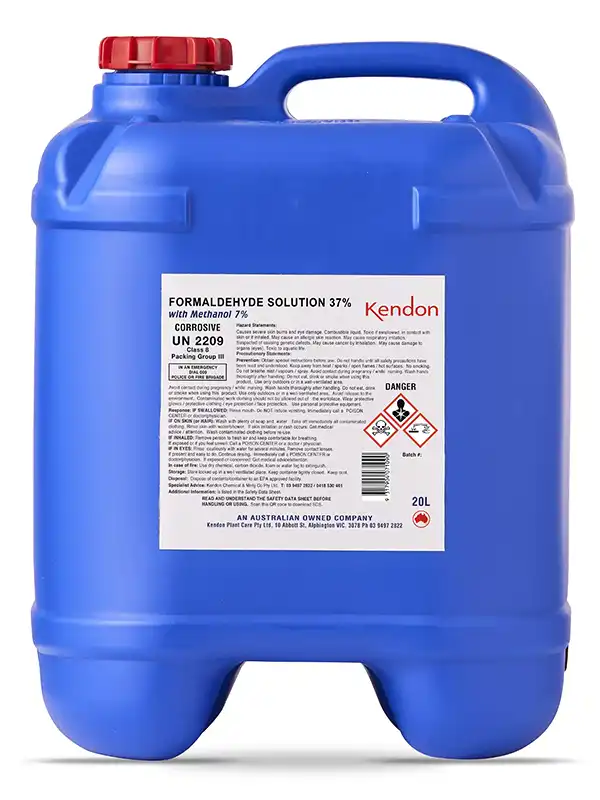
Product Name: Formaldehyde
Synonyms: Formalin, Formol,
Morbicid
Manufacturer's Product Code(s): A710
Use:Used as disinfectant, biocide and in
manufacture of phenolic resins and adhesives. Renders casein, albumin and
gelatin insoluble.
UN Number: 2209
Proper Shipping Name: FORMALDEHYDE SOLUTION
Dangerous Goods Class: 8
Subsidiary risk: None allocated
Packing Group: III
Hazchem Code: 2Z
|
2. COMPOSITION /
INFORMATION ON INGREDIENTS |
SUBSTANCE NAME Proportion CAS Number
FORMALDEHYDE 37% 50-00-0
METHANOL [METHYL ALCOHOL] 7% 67-56-1
FORMIC ACID (Below
Cutoff) 0.03% 64-18-6
WATER Balance 7732-18-5
|
3. HAZARD IDENTIFICATION |
Hazardous according to the criteria of
Worksafe Australia
Hazard Category: Harmful, Corrosive
ACUTE HEALTH EFFECTS
Swallowed:
Toxic if swallowed.
Will cause burns to the mouth, mucous membranes,
throat, oesophagus and stomach. If sufficient quantities are ingested
(swallowed) death may occur.
The methanol stabilizer in solutions is a cause of
visual impairment and possible permanent blindness.
Eye:
Will cause burns to the eyes with effects including:
Pain, tearing, conjunctivitis and if duration of exposure is long enough,
blindness will occur.
Skin:
Toxic by skin contact.
Will cause burns to the skin, with effects including;
Redness, blistering, localised pain and dermatitis.
The material is capable of causing allergic skin
reactions and may cause skin sensitisation. Toxic effects may result from skin
absorption..
Inhaled:
Toxic if inhaled.
Will cause severe irritation to the nose, throat and
respiratory system with effects including: Dizziness, headache, incoordination,
chest pains, coughing, respiratory paralysis and or failure.
Chronic:
Some long trerm animal test data suggests a
carcinogenic potential for the formaldehyde contained in these solutions. This
was found to occur at levels which caused chronic tissue irritation, and was
well above the exposure standard. These particular data are not considered
relevant to normal use because these high concentrations would not be
voluntarily tolerated by humans, but do emphasise the need for care in
handling. Chronic exposure to methanolfrom skin contact, inhalation and/or
swallowing, at concentrations greater than 1000ppm can result in permanent
blindness and central nervous system effects.
Formaldehyde:
Reported fatal dose for hgumans: 60-90 mL
Oral LD50 (rat): 800 mg/kg
Inhalation LC50 (rat): 590 mg/m3
Low concentrations of formaldehyde may cause
sensitisation by skin contact. Formaldehyde vapour is irritant to mucous
membranes and respiratory tract. Asthma like symptoms have occasionally been
reported following inhalation.
Animal studies have shown formaldehyde to cause
carcinogenic effects. In particular, chronic inhalation studies in rats have
shown thec development of nasal cavity carcinomas at 6 and 15 ppm. These
cancers developed at concentrations which produced chronic tissues irritation
and would not be voluntarily tolerated by humans. [IPCS Environmental Health Criteria 89, Formaldehyde, World
Health Organisation, Geneva, 1989.]
Some positive mutagenic effects have been reported for
formaldehyde. Available animal data do not show embryotoxic or teratogenic
effects following exposure to formaldehyde.
This material has been classified by the International
Agency for Research on Cancer (IARC) as a Group 2A agent. Group 2A - The
agent is probably carcinogenic to humans. [IARC Monographs on the
Evaluation of the Carcinogenic Risk of Chemicals to Humans. - Supplement 7,
World Health Organisation, 1987].
Methanol
Oral LD50 (rat): 5628 mg/kg
Inhalation LC50 (rat): 64000 mg/kg / 4 hrs
Repeated or prolonged exposure to methanol could
result in visual impairment and central nervous system effects.
|
4. FIRST AID MEASURES |
Swallowed:
If swallowed, DO NOT induce
vomiting. Seek urgent medical assistance.
Eye:
If material is splashed into eyes,
flush with plenty of water for at least 15 minutes, ensuring eye lids are held
open. Immediately transport to hospital or doctor.
Skin:
If material is splashed onto the
skin, remove any contaminated clothing and wash skin thoroughly with water and
soap if available.
Inhaled:
Remove victim to fresh air. Apply
resuscitation if victim is not breathing - DO NOT USE DIRECT MOUTH - TO - MOUTH
METHOD if victim ingested or inhaled substance; use alternative respiratory
method or proper respiratory device -
First Aid Facilities:
Eye wash fountain, safety shower and
normal wash room facilities.
Advice to Doctor:
For acute or short term repeated
exposures to formaldehyde
INGESTION:
Patients present early with severe
corrosion of the gastro-intestinal tract and systemic effects. Inflamation and
ulceration may progress to strictures. Severe acidosis results from rapid
conversion of formaldehyde to formic acid. Coma, hypotension, renal failure and
apnoea complicate ingestion. Decontaminate by dilution with milk or water
containing ammonium caetate; vomiting should be induced. Follow with
gastric lavage using a weak ammonia solution (converts formaldehyde to
relatively inert pentamethylenetetramine). Gastric lavage is warranted only in
first 15
minutes following ingestion.
SKIN:
Formaldehyde can combine with with
epidermal protein to produce a hapten-protein couples capable of sensitising
T-lymphocytes. Subsequent exposures cause a type IV hypersensitivity reaction
(ie allergic contact dermatitis).
|
5. FIRE-FIGHTING MEASURES |
Fire/Explosion Hazard
CAUTION: Use of water spray when fighting
fire may be ineffecient.
EXTINGUISHING MEDIA: Use dry chemical, carbon dioxide, foam or
water fog.
SPECIAL FIRE FIGHTING PROCEDURES: Self-contained breathing apparatus (SCBA)
required for fire-fighting personnel. If possible to do so safely, shut off
fuel to fire. Use water spray to spray to cool fire-exposed surfaces and to
protect personnel.
UNUSUAL FIRE AND EXPLOSION HAZARDS: If
tanks, drums or containers of this material are heated, they may rupture and
project corrosive liquids over a wide area.
Formaldehyde vapourises readily from
solution and is flammable in air.
Flammability
Combustible liquid and vapour.
If involved in a fire generate
noxious and corrosive fumes.
|
6. ACCIDENTAL RELEASE MEASURES |
EMERGENCY ACTION:
Keep unnecessary people away; Isolate hazard area and
deny entry. Stay upwind; Keep out of low areas. Isolate for 800 m in all
directions if tank, rail car or tanker truck is involved in fire.
SPILL OR LEAK PROCEDURE:
Shut off ignition sources, no flares, smoking or
flames in hazard area. Stop leak if you can do it without risk. Water spray may
reduce vapour; but it may not prevent ignition in closed spaces.
SMALL SPILLS:
Take up with sand, dirt or vermiculite. DO NOT use
sawdust. Use non-sparking tools. Place into labelled drum(s) for later disposal.
LARGE SPILLS:
Notify Emergency Services (Police or Fire Brigade). Tell them location,
nature and any information that would be helpful. Contain spill. Remove all
ignition sources and safely stop flow of spill. Bund area.Trained personnel
should wear Personal Protective equipment as highlighted in this MSDS. Blanket
the spill with foam or use water fog to disperse vapour clouds. Consult an
expert regarding disposal of this product.
|
7. HANDLING AND STORAGE |
Store in a moderately warm place.
Classified as C1 (Combustible Liquid) for the purpose of storaghe
and handling. Store away from sources
of heat or ignition, strong alkalis, acids, combustibles and oxidizing agents.
All equipment must be earthed. Store in original packages as approved by
manufacturer. Check all fittings, valves, reticulation (piping) and any
ancillary equipment for leaks. A supplied air respirator or a Self-Contained
Breathing Apparatus (SCBA) for emergencies should be available and checked
regularly. For further information please refer to the Engineering Controls of
this MSDS.
|
8. EXPOSURE CONTROLS / PERSONAL
PROTECTION |
Exposure Standards
***************************
FORMALDEHYDE ...%
(Worksafe Australia)
[TWA]1 ppm 1.2 mg/m³
[STEL]2 ppm 2.5 mg/m³
Carcinogen Category: 2
Notices: H;R
(ACGIH)
[STEL]0.3 (Ceiling) 0.37 (Ceiling)
Carcinogen Category: A2
***************************
METHANOL [METHYL ALCOHOL]
(Worksafe Australia)
[TWA]200 ppm 262 mg/m³
[STEL]250 ppm 328 mg/m³
Notices: H
(ACGIH)
[TWA]200 ppm 262 mg/m³
[STEL]250 ppm 328 mg/m³
Notices: Sk
***************************
FORMIC ACID ... % (Below Cutoff)
(Worksafe Australia)
[TWA]5 ppm 9.4 mg/m³
[STEL]10 ppm 19 mg/m³
Notices: H
(ACGIH)
[TWA]5 ppm 9.4 mg/m³
[STEL]10 ppm 19 mg/m³
***************************
Engineering Controls
Corrosive liquid. Single significant
exposure may cause severe injury. Maintain adequate ventilation at all times.
Prevent accumulation of gas(es) in hollows or sumps. Eliminate any sources of
ignition.
Exposure to this material may be
controlled in a number of ways.The measures appropriate for a particular
worksite depend on how the material is used and on the potential for
exposure. Engineering methods to
prevent or control exposure are preferred. Methods include process or personnel
enclosure, mechanical ventilation (dilution and local exhaust), and control of
process conditions. If engineering controls and work practices are not
effective in preventing or controlling exposure, then suitable personal
protective equipment, which is known to perform satisfactorily, should be used.
Personal Protection Equipment
CLOTHING: PVC, Nitrile, Neoprene,
Natural rubber or any other type of apron or splash suit.
GLOVES: PVC, Nitrile, Neoprene,
Natural rubber or any other type of glove.
EYES: Chemical goggles or faceshield
to protect eyes.
RESPIRATORY PROTECTION: Avoid
breathing of gases. Select and use respirators in accordance with AS/NZS
1715/1716. When the concentration of airborne contaminants reach the exposure
standards then the use of a half-face respirator with acid vapour cartridge is
recommended. For high concentration use a atmosphere-supplied, positive
pressure demand self-contained or airline breathing apparatus supplied air
respirator complying with the requirements of AS/NZS 1715 is recommended. Filter capacity and respirator type depends
on exposure levels.
If entering spaces where the
airborne concentration of a contaminant is unknown then the use of a
Self-contained breathing apparatus (SCBA) with positive pressure air supply
complying with AS/NZS 1715 / 1716, or any other acceptable International
Standard is recommended. The use of
fully-encapsulating, gas-tight suits is also recommended.
|
9. PHYSICAL AND CHEMICAL PROPERTIES |
Appearance: Clear liquid with pungent odour.
Boiling Point: ~ 96 °C @ 760 mm Hg
Vapour Pressure: None Available.
Specific Gravity: 1.1
Flash Point: 64
- 85 °C
Lower Explosive Limits: 7%
Upper Explosive Limits: 73%
Solubility in Water: Miscible
pH: 2.8-4.0
|
10. STABILITY AND REACTIVITY |
STABILITY:
On standing, especially in cold may become cloudy and
on exposure to very low temperatures a precipitate of trioxymethylene is
formed. In the air it is slowly oxidizes to formic acid.
When evaporated, some formaldehyde escapes, but most
of it is changed to trioxymethylene.
HAZARDOUS DECOMPOSITION PRODUCTS:
Emits choking and corrosive fumes when heated to
decomposition.
HAZARDOUS POLYMERIZATION:
Will not occur.
INCOMPATIBILITIES:
Powerful reducing agent. Reacts with oxidising agents,
acids, alkalis, and metal salts.
CONDITIONS TO AVOID:
Heat, flames, ignition sources and incompatibles.
|
11. TOXICOLOGICAL INFORMATION |
NON-LETHAL IRREVESIBLE EFFECTS AFTER A SINGLE EXPOSURE
This substance is capable of causing serious
irrevesible effects
after a single exposure and is determined to be a
hazardous substance.
Such irreversible effects can include central nervous
system effects, kidney necrosis
liver lesions, anaemia or paralysis.
RISK PHRASES
R23/24/25
Toxic by inhalation, in contact with skin and if swallowed.
R34 Causes
burns.
R40 Possible
risk of irreversible effects
R41 Risk of serious damage to eyes
R43 May cause
sensitisation by skin contact.
R40(3) Possible risks of irreversible effects
SAFETY PHRASES
S1/2 Keep
locked up and out of reach of children.
S7 Keep
container tightly closed.
S16 Keep away
from sources of ignition - No smoking.
S23 Do not
breathe vapour/spray.
S24/S25 Avoid
contact with skin and eyes.
S26 In case of
contact with eyes, rinse immediately with plenty of water and contact a doctor
or Poisons Information Centre.
S36/37/39 Wear
suitable protective clothing, gloves and eye/face shields.
S45 In case of
accident or if you feel unwell, contact a doctor or Poisons Information Centre
immediately and show this container or label.
S51 Use only in
well ventilated areas.
|
12. ECOLOGICAL INFORMATION |
Formaldehyde:
Formaldehyde has a relatively low
toxicity for fish, 96 h LC50 values being higher than 10 mg/L in all
cases, e.g. Rainbow Trout 96 h LC50:
123 mg/L
Algae and some invertebrates seem to
be more susceptible to formaldehyde, however responses differ widely:
Bacteria (E.Coli): 1mg/L
Algae (Scenedesmus): 0.3-0.5 mg/L
Inhibits anaerobic sludhe digestion
at 100 mg/L
aerobic degradation at 135-175 mg/L
[Handbook of Environmental Data on
Organic Chemicals 2nd ed K Veschueren Van NostrandReinhold Co, 1983]
Methanol:
Environmental fate: THOD 1.5 mg/L O2
Aquatic Toxicity:
Trout LC50 (48 hrs): 8000 mg/L
|
13. DISPOSAL CONSIDERATIONS |
Whatever cannot be saved for recovery or recycling
should be handled as hazardous waste and sent to an approved waste facility.
Processing, use or contamination of this product may change the waste
management options. State and local disposal regulations may differ from
federal disposal regulations. Dispose of container and unused contents in
accordance with federal, state and local requirements.
|
14. TRANSPORT INFORMATION |
UN Number: 2209
Proper Shipping Name: FORMALDEHYDE SOLUTION
Dangerous Goods Class: 8
Subsidiary risk: None allocated
Packing Group: III
Hazchem Code: 2Z
Classified as a CLASS 8 (CORROSIVE) Dangerous Good
according to the Australian Code for the Transport of Dangerous Goods by Road
and Rail, 6th Edition.
Dangerous goods of Class 8 (Corrosive) are
incompatible in a placard load with any of the following:
- Class 1
- Class 4.3
- Class 5
- Class 6, if the Class 6 dangerous
goods are cyanides and the Class 8 dangerous goods are acids
- Class 7
and are incompatible with food and food packaging in
any quantity.
Emergency information(Transport):
Dangerous Goods - Initial Emergency Response Guide
(SAA/SNZ HB76:1997)
For TOXIC AND/OR CORROSIVE Guide No: 37
|
15. REGULATORY INFORMATION |
Poison
Schedule: S6
|
16. OTHER INFORMATION |
Contact Point
Technical Department After
Hours
03 9497 2822 mobile:
0418-530-461
Disclaimer
The information herein is to the best of our
knowledge, correct and complete. It descibes the safety requirements for this
product and should not be construed as guaranteeing specific properties. Since
methods and conditions are beyond our control we do not accept liability for
any damages resulting from the use of, or reliance on, this information in
inappropriate contexts.
VL 09/00